
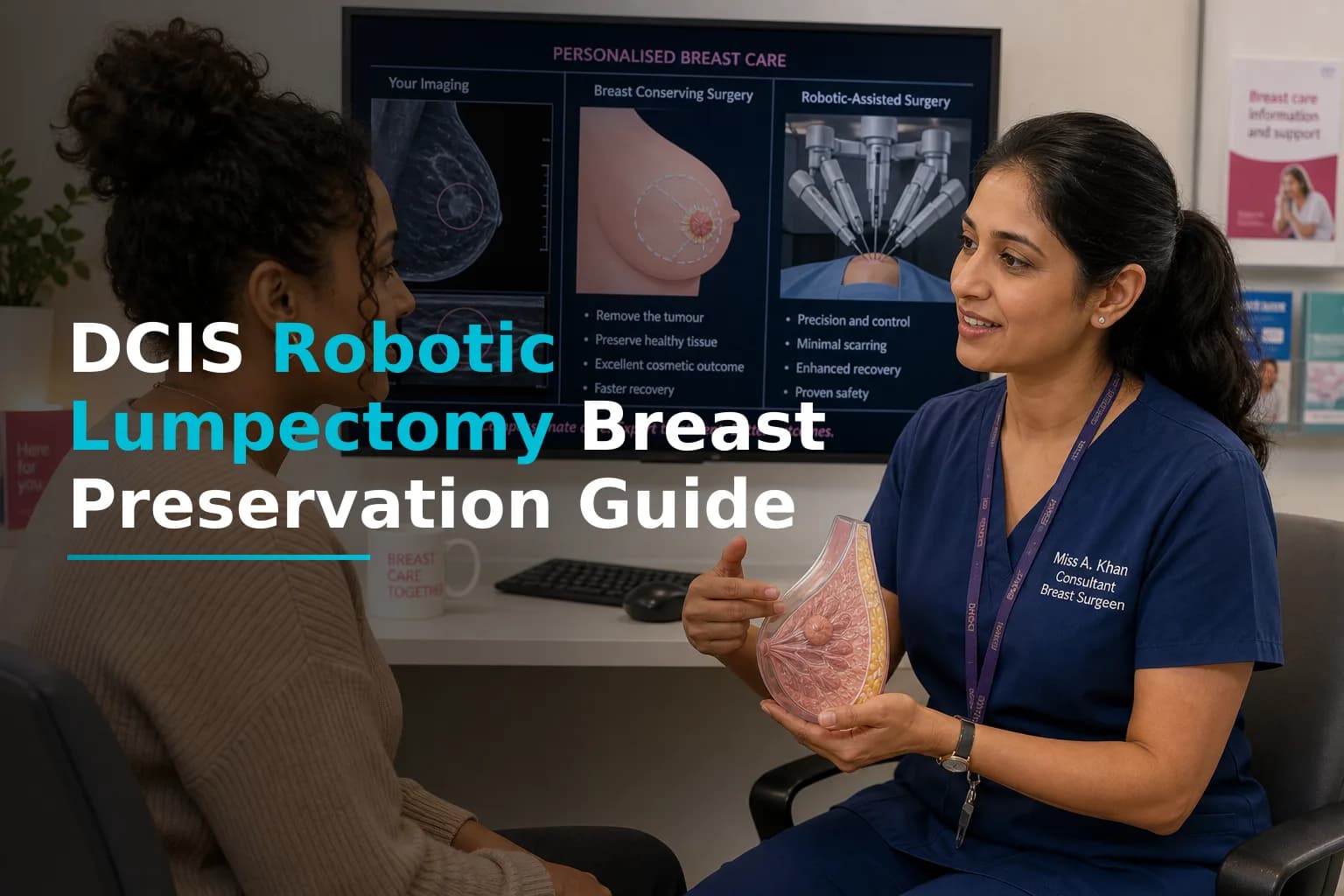
A DCIS Diagnosis Does Not Always Mean Losing Your Breast
Finding out you have ductal carcinoma in situ (DCIS) can feel like the ground has shifted. You may have heard the words "pre-invasive" or "stage zero," and still felt completely overwhelmed. You are already being asked about surgery before you have had time to absorb what the diagnosis means.
For many women, the biggest fear is not the operation itself. It is what comes after. Will the breast be preserved? Will it look and feel the same? Can you get through this with minimal disruption to your body and your life?
These are fair questions. This guide explains your surgical choices if you have DCIS. It covers lumpectomy vs mastectomy, how robotic surgery can help with breast-conserving surgery, and why some UK women seek specialist care elsewhere.
What Is DCIS and Why Does Surgery Matter?
DCIS stands for ductal carcinoma in situ. The words "in situ" mean the abnormal cells are inside the milk ducts of the breast. They have not spread into surrounding tissue or elsewhere in the body. Because of this, experts call DCIS stage 0 breast cancer or a pre-invasive condition.
According to Cancer Research UK, DCIS is one of the most common diagnoses found through the NHS Breast Screening Programme, accounting for about one in five screen-detected breast cancers.
Left untreated, some DCIS cells may become invasive breast cancer over time. Surgery removes the affected cells before that can happen. The key question is: how much surgery is needed, and how much of the breast must be involved?
Lumpectomy vs Mastectomy for DCIS: What You Need to Know
For most women with DCIS, there are two main surgical paths:
- Wide local excision (lumpectomy): The surgeon removes the area of DCIS along with a small border of healthy tissue around it. The rest of the breast remains in place.
- Mastectomy: The whole breast is removed. Reconstruction may be offered at the same time or at a later date.
Breast Cancer Now explains that for many women with DCIS, a wide local excision and a mastectomy work equally well at treating the condition. For many women, the choice is theirs to make—guided by clinical factors and personal priorities.
Doctors recommend a mastectomy when the DCIS affects more than one part of the breast, when the affected area is large relative to breast size, or when a lumpectomy cannot achieve a clear margin of healthy tissue. In these situations, your surgical team will explain the reasoning and discuss reconstruction options.
After a lumpectomy for DCIS, doctors usually offer radiotherapy to the remaining breast tissue. NICE guidance on early and locally advanced breast cancer recommends radiotherapy after breast-conserving surgery to reduce the risk of DCIS returning. If the DCIS is oestrogen receptor positive, doctors may also discuss hormone therapy.
What Is Robotic Lumpectomy?
Robotic lumpectomy uses a surgeon-controlled robotic system to perform breast-conserving surgery more precisely than is possible by hand alone. The most widely used system is the da Vinci Surgical System, though other platforms are now in use at specialist centers.
During the procedure, the surgeon sits at a console and uses hand controls to guide small robotic arms holding the surgical instruments. A high-definition, three-dimensional camera provides a magnified view of the operative area throughout the procedure.
The robotic instruments can move with greater range of motion than the human wrist, making it possible to work accurately in a confined space. For breast-conserving surgery, this matters greatly. The goal is to remove exactly the right amount of tissue—enough to achieve a clear margin around the DCIS, but as little as possible to preserve the breast's appearance and structure.
Research published on the US National Institutes of Health research database found that robotic breast surgery may offer better surgical precision, fewer complications, and higher patient satisfaction compared to conventional approaches. The authors noted that larger long-term studies are still needed to fully understand its role—an important point to discuss with your clinical team.
Why Some Women With DCIS Are Choosing Robotic Lumpectomy
Women diagnosed with DCIS who are eligible for breast-conserving surgery are asking whether a robotic approach is available. Here are the main reasons.
Smaller incisions and less visible scarring
Robotic lumpectomy typically requires small access points instead of a longer incision across the breast. For many women—particularly younger women or those who care about breast appearance after surgery—this matters.
Potentially reduced pain after surgery
Because the procedure causes less disruption to surrounding tissue, many women who had robotic breast surgery report less pain after surgery compared to those who had traditional open surgery. Individual experience varies, and your surgical team will advise you what to expect based on your specific procedure.
Faster return to everyday life
Smaller incisions and less tissue disruption may mean a shorter recovery for some women. Getting back to family life, work, and daily routine matters, especially when you have other treatment coming up.
Precision in achieving clear surgical margins
If margins are not clear the first time, a second operation may be needed. The enhanced control offered by robotic assistance may help surgeons achieve clear margins more consistently—though this depends on your anatomy and the extent of the DCIS.
Preserving body image and psychological well-being
According to Macmillan Cancer Support, body image and psychological well-being are important parts of recovery from breast cancer treatment. Breast-conserving surgery, where medically appropriate, may help women feel more like themselves during and after treatment. This matters as part of your overall recovery.
Robotic vs Traditional Lumpectomy: A Side-by-Side Look
| Factor | Traditional Lumpectomy | Robotic Lumpectomy |
|---|---|---|
| Incision size | Longer, visible scar | Smaller, often less visible incisions |
| Surgical visibility | Standard two-dimensional view | High-definition 3D view |
| Instrument precision | Limited by natural hand movement | Extended range of motion and fine control |
| Postoperative pain | Moderate, varies by patient | Often reduced in the short term |
| Recovery time | Typically several weeks | May be shorter for some women |
| Cosmetic outcome | Variable depending on technique | Often better preserved breast shape |
| NHS availability | Widely available across UK trusts | Limited specialist centers; more accessible privately or abroad |
Individual outcomes vary. The right approach for you depends on your diagnosis and the judgment of your surgical team.
For more details on how robotic breast surgery compares, see our guide on robotic breast surgery options for UK patients at home and abroad.
Why Some UK Women With DCIS Look Beyond Their Local Services
The NHS provides strong breast cancer care, and for many women with DCIS, local treatment is the right choice. However, some women find that access to robotic lumpectomy specifically is limited where they live. Robotic breast surgery is still not widely available across all NHS trusts, and where it is offered, demand can be high.
Some women are advised that a mastectomy is recommended, but want to explore whether breast-conserving surgery is still possible with the right specialist. Others want a second surgical opinion before committing to a procedure that will permanently change their body.
For these women, looking elsewhere—whether at private care in the UK or internationally—becomes a natural choice. Access to certain surgical technologies varies, and some women have priorities their local pathway does not fully meet. The decision matters deeply.
Why India Is Gaining Recognition for Robotic Breast Surgery
India has invested significantly in robotic surgical technology over the past decade. Many major cancer centers now have dedicated robotic breast surgery programs led by experienced surgeons who have trained and practiced internationally.
For UK women considering traveling for specialist care, India offers several practical advantages:
- High-volume surgical teams: Leading Indian cancer hospitals perform many robotic breast procedures each year. Volume matters in surgery—teams that operate frequently develop expertise in their chosen approaches.
- English-speaking care throughout: Most major Indian hospitals serving international patients have English-speaking doctors, nurses, and patient coordinators at every stage of care. Communication barriers are rarely a concern at accredited centers.
- International patient services: Hospitals in cities such as Mumbai, Delhi, Bangalore, and Chennai have dedicated international patient departments. These teams assist with visa documentation, accommodation, travel logistics, and communication with UK-based clinicians before and after your visit.
- Comprehensive multidisciplinary review: Before any treatment recommendation, a full team of specialists—including surgeons, oncologists, and radiologists—reviews your records. This includes mammogram reports, biopsy results, histopathology findings, and any existing treatment plan.
- Significantly lower cost than UK private care: The cost of robotic breast surgery at accredited Indian hospitals is substantially lower than equivalent private surgery in the UK, without compromising the standard of care. For women who cannot access robotic lumpectomy on the NHS and find UK private costs too high, this difference matters.
For more details, see our guide: From Diagnosis to Surgery: A UK Breast Cancer Patient's Real-World Guide to Accessing Robotic Treatment in India.
What the Journey Looks Like for a UK Patient With DCIS
The process of accessing robotic breast surgery abroad is simpler than many expect. Here is what a typical pathway looks like:
- Online consultation: You submit your medical reports and have a video consultation with a specialist surgeon. No travel is required at this stage.
- Medical report review and treatment planning: The surgical team reviews your mammogram, biopsy results, histopathology report, and any MRI or PET-CT scans. They provide a written assessment and a clear treatment recommendation.
- Travel arrangements: The hospital's international patient team helps with visa documentation, timing of flights, and local accommodation for you and any companion.
- Surgery: On arrival, you complete any necessary pre-operative tests before the robotic procedure—typically within a few days of reaching the hospital.
- Recovery: You remain at or near the hospital for a short post-operative period. The team monitors your recovery and manages any early concerns before discharge.
- Follow-up care in the UK: Detailed discharge notes, pathology results, and follow-up instructions are shared with your UK GP or oncologist. Video follow-up appointments with the operating team are usually available after you return home.
For women with DCIS specifically, the surgery is often less extensive than for invasive breast cancer. This can mean a shorter hospital stay and a more straightforward recovery compared to more complex breast procedures.
For similar details on early-stage invasive cancer, see our guide on early-stage breast cancer and robotic lumpectomy for UK patients considering care in India. Many practical considerations will apply to DCIS as well.
A Perspective From a Breast Surgical Oncologist
Women with DCIS are in a fortunate position in one way: in most cases, there is time. Time to gather information, ask questions, and seek a second opinion if the first recommendation does not feel right. Robotic lumpectomy gives surgeons a tool for removing the affected tissue precisely while preserving the breast's appearance and natural structure. The technology continues to develop rapidly. My advice to any woman with DCIS is to ask your surgical team directly whether breast-conserving surgery is possible in your case and whether robotic assistance is available where you are being treated. If the answers are unclear, exploring a specialist second opinion is a reasonable next step.
Is Robotic Lumpectomy the Right Choice for You?
Not every woman with DCIS is a suitable candidate for a lumpectomy, robotic or otherwise. Suitability depends on the size and location of the DCIS, the grade of the cells, the size of the breast relative to the affected area, and other individual factors. Where lumpectomy is already an option, robotic assistance offers a more precise and less disruptive way to perform it.
If you have been told that a lumpectomy is not possible but would like to explore this further, seeking a second surgical opinion is reasonable. If you specifically want to understand whether robotic breast-conserving surgery might apply to your situation, speaking to a center that specializes in this approach—whether in the UK or abroad—is worth considering.
Request a Personalised Robotic Surgery Assessment
If you have been diagnosed with DCIS and want to understand whether robotic breast-conserving surgery may be an option for you, you can request a personalised assessment from a specialist team. To receive a clear, written recommendation, please upload whichever of the following reports you have available:
- Mammogram reports
- Biopsy reports
- Histopathology reports
- MRI scans
- PET-CT scans
- Any existing treatment plan
A specialist will review your records and provide a personalised assessment of whether robotic lumpectomy may be an option for you. The process begins entirely online, with no obligation or commitment to travel.
When to Talk to Your Doctor
If you have recently been diagnosed with DCIS and are unsure which surgical option is right for you, raise your questions with your breast care nurse or oncologist at your next appointment. Ask directly whether breast-conserving surgery is possible in your case and whether robotic lumpectomy is available through your current provider. If you are considering treatment abroad, let your UK team know so that they can support your follow-up care and keep your records continuous.
This article is for general information and is not a substitute for medical advice. Always consult your oncologist or care team about your specific situation.