
When a Diagnosis Turns Your World Upside Down
Around 55,000 women in the UK are diagnosed with breast cancer every year, according to Cancer Research UK. For most, the days that follow are a blur of unfamiliar words, rapid-fire appointments, and decisions that feel impossibly large. You may have been told you need surgery. You may be wondering whether you can keep your breast. You may be asking how long the wait will be.
This guide is for you. It explains what robotic breast cancer surgery is, why some UK women are choosing to have it in India, and what the whole process looks like from start to finish.
Understanding Robotic Breast Cancer Surgery
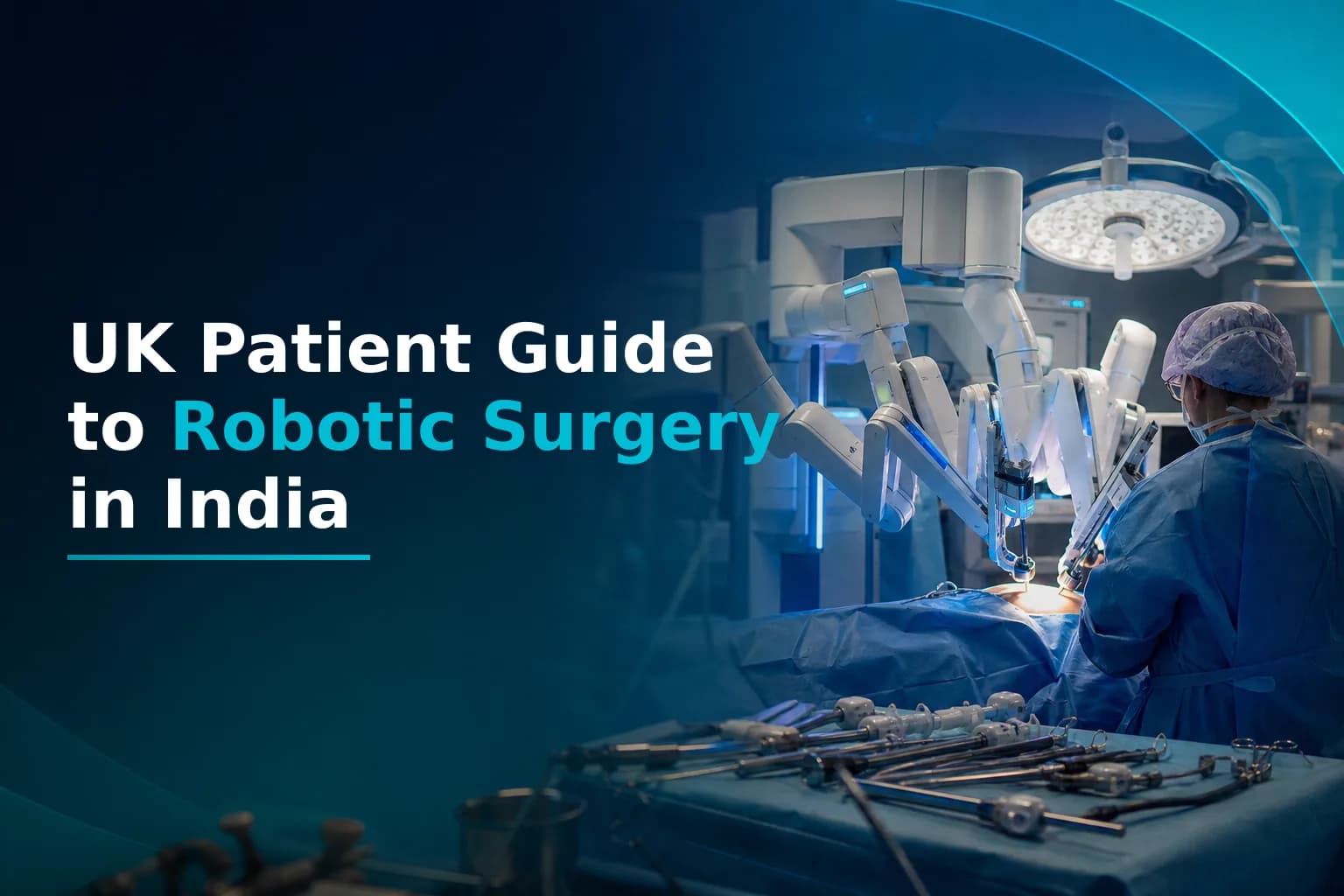
Robotic breast cancer surgery uses a computer-assisted platform. The da Vinci Surgical System is the most common choice. A surgeon sits at a console nearby and controls robotic arms that hold the instruments and a high-definition 3D camera.
The robot does not operate independently. The surgeon directs every movement. The main benefit of the technology is precision. Movements are scaled down. Natural hand tremor is filtered out. The camera gives a magnified view that the naked eye cannot match.
This approach is used for procedures including:
- Nipple-sparing mastectomy — removing breast tissue whilst preserving the nipple and surrounding skin
- Skin-sparing mastectomy
- Robotic-assisted lumpectomy (removal of the tumour and a margin of healthy tissue)
- Immediate breast reconstruction at the time of mastectomy
- Axillary lymph node procedures — sampling or removing lymph nodes under the arm
A 2025 review published in a peer-reviewed oncology journal found that robotic systems offer enhanced precision, three-dimensional visualisation, and improved ergonomics, with the goal of reducing invasiveness and limiting postoperative complications. Longer-term data continue to emerge, and suitability varies by individual diagnosis.
If you are weighing your options across home and international settings, our overview — Robotic Breast Surgery: A Complete Guide for UK Patients Exploring Your Options at Home and Abroad — covers the full landscape.
Why Patients Are Choosing to Explore Robotic Surgery
Breast cancer surgery has changed considerably over the past two decades. Many women can now keep their breast entirely, or, if mastectomy is recommended, have reconstruction at the same time. Robotic techniques are extending these possibilities further.
Key reasons women explore robotic surgery include:
- Cosmetic outcomes. The main incision is placed discreetly, often in the armpit or along the natural breast fold, so there is no large scar across the chest. Nipple-sparing mastectomy may preserve the natural appearance of the breast.
- Reduced blood loss. Robotic-assisted nipple-sparing mastectomy appears to result in less blood loss and fewer major complications compared with open surgery. The surgery may take longer, however.
- Potentially faster recovery. Smaller incisions typically mean less tissue disruption, which may support a shorter recovery period for some patients.
- Breast preservation. For women hoping to avoid mastectomy, robotic lumpectomy may allow complete removal of the tumour with better cosmetic results than conventional open techniques.
- Quality of life. Keeping the breast envelope and nipple-areola area may improve how women feel about their body and their overall satisfaction after surgery.
An early feasibility study published in a peer-reviewed surgical journal found that all patients in the study expressed satisfaction with their postoperative aesthetic outcome. These results will not apply to every woman. Your own suitability depends on tumour size, position, cancer subtype, and overall health.
If you have HER2-positive breast cancer and are exploring whether breast preservation is possible, you may find useful detail in our article: I Have HER2-Positive Breast Cancer and Want Breast Preservation. Is Robotic Lumpectomy a Real Option for Me?
Robotic Surgery vs Traditional Breast Cancer Surgery
The table below offers a comparison. Every diagnosis is unique, and your surgeon is best placed to advise which approach suits your situation.
| Factor | Robotic Surgery | Traditional Open Surgery |
|---|---|---|
| Incision size | Small cuts, often 1–3 cm, placed discreetly | Larger incisions across the breast or chest wall |
| Surgeon view | Magnified 3D camera inside the body | Direct, unaided vision of the surgical field |
| Visible scarring | Minimal; incisions often hidden in natural skin folds | Visible scar on the breast or chest |
| Blood loss | Research suggests lower blood loss in many cases | Variable; depends on extent of surgery |
| Operative time | Often longer due to set-up and robotic docking | Generally shorter operative time |
| Hospital stay | Typically 2–4 days for most robotic procedures | Typically 2–5 days depending on complexity |
| Availability in the UK | Growing but currently limited to specialist centres | Widely available across NHS and private hospitals |
| Surgeon specialisation | Requires dedicated robotic surgery training and volume | Standard breast surgical training |
The NHS has committed to expanding robotic surgery across England. According to NHS England, the goal is for 9 in 10 keyhole surgical procedures, including cancer operations, to be delivered with robotic assistance within ten years. Right now, access to robotic breast surgery within the NHS remains limited to a small number of specialist centres.
Why Some UK Patients Are Exploring Treatment Abroad
The NHS provides high-quality breast cancer care, and many thousands of women are treated successfully within it every year. For some patients, however, specific factors lead them to explore private or international options alongside or in place of their NHS pathway.
Common reasons UK women look beyond their immediate local provision include:
- Wanting a second surgical opinion from a high-volume robotic breast surgery specialist
- Seeking nipple-sparing or skin-sparing mastectomy where local access to these techniques is limited
- Hoping to combine mastectomy with immediate reconstruction at a centre experienced in both in a single surgical episode
- Reducing the time between diagnosis and surgery. For some women, speed provides both psychological and clinical benefit
- Cost: private robotic breast surgery in the UK is a significant financial commitment, and some international centres may offer comparable care at a lower total cost
- Access to personalised, multidisciplinary treatment planning. Some women value the time and attention of a dedicated international patient team
Exploring care abroad is a major decision that requires careful research. You should check a hospital's accreditation status. You should understand what happens to your follow-up care when you return to the UK. You should make sure your UK oncologist is fully informed at every stage. Our article — Robotic Breast Cancer Surgery in India: What UK Patients Should Know About Quality, Expertise, and Access — covers these considerations in full.
Why India Is Emerging as a Destination for Robotic Breast Surgery
Over the past decade, India has built a credible track record in complex cancer surgery for international patients. Several things are important to know about how this relates to UK women researching robotic breast treatment.
Internationally accredited hospitals
Major cancer centres in Mumbai, Delhi, Hyderabad, Bengaluru, and Chennai hold accreditation from the Joint Commission International (JCI) and India's National Accreditation Board for Hospitals and Healthcare Providers (NABH). These are internationally recognised quality and patient safety standards that require regular external review.
High-volume, specialist surgical teams
Indian breast surgeons trained in robotic techniques see a high volume of cases. Surgical volume matters: surgeons who perform a procedure frequently tend to achieve more consistent outcomes. Several leading centres have dedicated robotic oncology units with surgeons whose training includes fellowship programmes in Europe and North America.
English-language care
English is widely used by medical and nursing staff across leading Indian hospitals. International patient departments are structured to communicate in English, prepare surgical reports in formats that UK clinicians can read and act on, and liaise directly with your care team at home.
Comprehensive, under-one-roof oncology pathways
Top Indian cancer hospitals offer multidisciplinary tumour boards, on-site pathology, advanced imaging, medical oncology, and plastic and reconstructive surgery under one roof. For a UK patient, your full surgical pathway can be coordinated in a single clinical setting. This includes staging, planning, surgery, and post-operative recovery.
Cost
Robotic breast cancer surgery in India is generally available at a fraction of the cost of equivalent private treatment in the UK or the United States, without compromising clinical quality at accredited centres. Exact costs depend on the procedure type, reconstruction approach, hospital choice, and length of stay. A clear written cost estimate is a standard part of any reputable international treatment plan.
What a UK Patient's Journey Looks Like
For many women, the idea of travelling to India for surgery feels daunting at the outset. In practice, the process follows a clear sequence of steps.
Step 1: Online consultation
The journey begins with a video call. You describe your diagnosis, share your concerns, and ask your questions. No travel is required at this stage. A specialist reviews your situation and tells you honestly whether robotic surgery may be suitable for you, and if so, which procedure and approach.
Step 2: Medical report review
You securely upload your reports: biopsy results, mammogram images, MRI or PET-CT scans, histopathology reports, and any existing treatment plan your oncologist has prepared. The surgical team reviews these carefully before making any recommendation.
Step 3: Personalised treatment plan and cost estimate
Before you commit to anything, you receive a written treatment plan. This explains the recommended procedure, the proposed surgeon, the hospital, the estimated timeline, and the full cost. You can, and should, share this with your UK oncologist or GP for their input and clinical review.
Step 4: Travel arrangements
Most UK patients travel to India on a medical visa, which is straightforward to obtain for planned treatment. The international patient team at your chosen hospital guides you through this process. Direct flights from London to Mumbai, Delhi, Hyderabad, and Chennai are widely available. Most women bring one companion, such as a partner, close friend, or family member, for practical and emotional support.
Step 5: Arrival and pre-operative assessment
On arrival, you undergo pre-operative blood tests, updated imaging where needed, and an anaesthetic assessment. You meet your surgeon and nursing team in person. There is typically one to two days of preparation before surgery itself.
Step 6: Surgery and in-hospital recovery
The robotic procedure typically takes two to four hours depending on complexity and whether reconstruction is performed at the same time. Most women remain in hospital for two to four days following robotic nipple-sparing mastectomy with immediate reconstruction. Your care team monitors recovery closely, and surgical pathology from the removed tissue is reviewed in this period.
Step 7: Post-operative recovery before travelling home
After leaving hospital, most patients stay nearby in a serviced apartment or hotel for a further one to two weeks. This allows the surgical team to check wound healing at follow-up appointments, discuss tissue pathology results, and confirm you are medically fit to fly.
Step 8: Return to the UK and continued care
Before you fly home, your team prepares a complete discharge summary and operative report for your UK oncologist. Follow-up video consultations continue after your return. You re-enter UK-based care with full documentation, ready for any further treatment such as radiotherapy or hormone therapy if recommended as part of your overall plan.
An Expert Perspective on Patient Selection
Breast surgeons with specialist experience in robotic techniques consistently emphasise that careful patient selection is the foundation of good outcomes. Robotic nipple-sparing mastectomy is not suitable for every breast shape, every tumour position, or every cancer stage. A thorough review of imaging, pathology, and overall health before any recommendation is essential.
For patients who are suitable candidates, the combination of precise tissue removal, discreet incision placement, and same-session reconstruction may offer a meaningful improvement in quality of life compared with conventional approaches. The evidence base for robotic breast surgery continues to grow, and centres performing high volumes of these procedures are building increasingly detailed outcome data.
Women considering robotic surgery should ask any prospective surgeon how many of these procedures they perform each year, what their complication rates are, and how they manage the transition of care back to a patient's home country or domestic team.
Take the Next Step: Request a Personalised Assessment
If you are weighing your surgical options after a breast cancer diagnosis, a no-obligation online consultation with a robotic breast surgery specialist may help clarify what is possible for your specific situation. You can request a personalised assessment by uploading your medical reports, including any of the following:
- Mammogram images
- Biopsy and histopathology reports
- MRI or PET-CT scan results
- Existing treatment plan from your oncologist
- Any previous surgical or staging reports
A specialist will review your case and respond with an honest assessment of whether robotic breast surgery may be suitable, and what a treatment pathway might realistically look like.
When to Talk to Your Doctor
Before making any decisions about surgery, whether in the UK or abroad, speak with your oncologist or breast care nurse. Share any information you gather in your research and ask how it relates to your specific diagnosis, tumour characteristics, and overall health. Second opinions are always appropriate when you are facing major surgery, and most surgeons welcome the opportunity to review another specialist's recommendation.
This article is for general information and is not a substitute for medical advice. Always consult your oncologist or care team about your specific situation.