
You Are Not Alone in Asking This Question
A HER2-positive diagnosis can be stressful. Your doctor may have said that your cancer grows quickly and that mastectomy is your only choice. But many women with HER2-positive breast cancer keep their breasts. More women are asking if robotic surgery can help them do this.
This article explains what HER2-positive means, why many women with this diagnosis can choose breast-conserving surgery, and what robotic lumpectomy involves. It also covers where this technology stands now.
What Does HER2-Positive Mean?
HER2 stands for human epidermal growth factor receptor 2. It is a protein on the surface of cells that helps them grow and divide. In HER2-positive breast cancer, there are too many copies of the HER2 gene. This causes cancer cells to make too much of the HER2 protein, which makes cells grow faster.
About 15 to 20 in every 100 breast cancers are HER2-positive. This type tends to grow more quickly than some other types. But here is what matters: HER2-positive cancer responds well to modern targeted therapies. These therapies make breast-conserving surgery an option.
Cancer Research UK provides a clear overview of how breast cancer type affects treatment decisions, including surgery choices.
Can Women With HER2-Positive Cancer Keep Their Breast?
Yes. The evidence supports this.
A study in BMC Cancer looked at women with early-stage HER2-positive breast cancer who had pre-surgery treatment. It found no major difference in long-term survival between women who had breast-conserving therapy (lumpectomy plus radiation) and those who had mastectomy. The study shows that breast-conserving therapy can be safe for carefully chosen patients. You can read this study at PubMed Central.
Whether breast conservation is right for you depends on your specific tumor. Your care team will look at its size, position, how far it has spread, and how it responds to treatment before surgery.
The Key Advantage for HER2-Positive Patients: Neoadjuvant Therapy
One of the biggest advantages for HER2-positive patients is how well this cancer responds to targeted treatment.
Neoadjuvant therapy means having treatment — chemotherapy combined with anti-HER2 targeted drugs — before surgery instead of after. The goal is to shrink the tumor first. This may make breast-conserving surgery possible even when the tumor seemed too large for lumpectomy at diagnosis.
The targeted drugs used in HER2-positive cancer, such as trastuzumab and pertuzumab, work well for this. In some patients, no cancer cells are detectable in the breast by surgery time. This is called a pathologic complete response.
A study looked at women with early HER2-positive breast cancer who received pertuzumab and trastuzumab alongside chemotherapy before surgery. It found higher rates of pathologic complete response in this group and higher rates of breast-conserving surgery. The research shows that effective neoadjuvant therapy helps more women keep their breast. You can read this study at PubMed Central.
Your oncologist will advise if neoadjuvant therapy is right for you. Not every patient follows this path. But for many women with HER2-positive disease, it is a good way to keep their breast.
What Is a Lumpectomy — and How Does It Compare to Mastectomy?
A lumpectomy — also called breast-conserving surgery or wide local excision — removes the tumor and a small margin of healthy tissue around it. The rest of the breast stays. It is usually followed by radiotherapy to lower the risk of cancer coming back in that breast.
A mastectomy removes the whole breast. It may be needed when a tumor is very large compared to breast size, when cancer is in multiple areas of the breast, or when certain gene mutations such as BRCA1 or BRCA2 are involved.
For many women with early-stage disease, research shows that lumpectomy plus radiation gives the same survival results as mastectomy. The choice between the two is not always simple. Your personal wishes, including how you feel about keeping your breast, are a valid and important part of that decision. Macmillan Cancer Support offers a helpful plain-language overview of breast cancer treatment options to help you understand what each path involves.
So What Is Robotic Lumpectomy — and Is It Available?
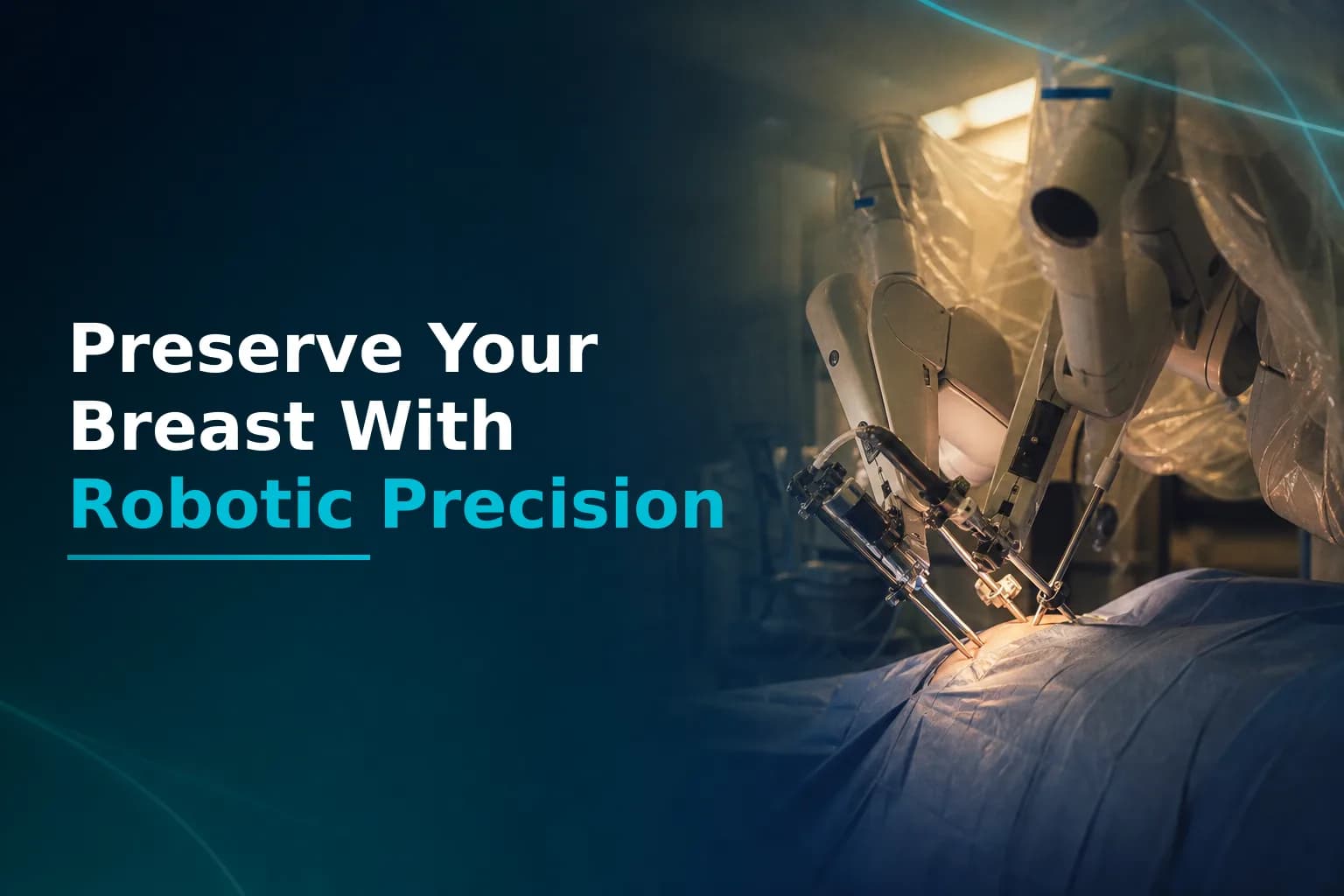
You may have heard of robotic mastectomy, where a surgeon uses a robotic system to remove the breast through very small cuts, often hidden in the armpit. Robotic-assisted breast-conserving surgery, including lumpectomy, is newer and still being developed. It is real, but it is not yet widely available.
The approach usually involves a small entry point — most often in the armpit — through which robotic tools are guided to remove the tumor. The breast surface itself may stay mostly untouched, which is one of the cosmetic benefits being studied in this technique.
Possible benefits of robotic breast-conserving surgery over open surgery include:
- A magnified, three-dimensional view of the operating area, giving the surgeon a clearer look at the tumor and surrounding tissue
- Tools with a wider range of movement than the human hand, allowing more precise tissue removal
- No hand tremor, which may improve accuracy during delicate removal
- Smaller or hidden cuts, potentially reducing visible scars on the breast
- Less blood loss and, in many cases, a shorter hospital stay and faster recovery
A comprehensive review of robotic innovations in breast surgery, published in Cancers, found that robotic systems offer up to seven degrees of movement, better three-dimensional viewing, and tremor filtering — features that may help surgeons remove tumors more precisely with better cosmetic results. You can read this review at PubMed Central.
Clinical trials of single-port robot-assisted breast-conserving surgery via an underarm approach are now running at specialist centers. Early evidence looks good on technical feasibility and cosmetic results, though this approach is not yet offered as a standard option in most hospitals.
Is Robotic Lumpectomy Right for Every HER2-Positive Patient?
Not necessarily. Robotic breast-conserving surgery is currently available only at a small number of specialist centers. Patient selection matters. A specialist surgeon will consider factors such as:
- The size and position of your tumor within the breast
- Whether the tumor has responded well to pre-surgery treatment
- The ratio of tumor size to overall breast size
- Your anatomy and whether the tumor can be reached via a small-cut approach
- The likelihood of getting clear surgical margins — meaning no cancer cells at the edge of the removed tissue
Robotic surgery is not automatically better than standard lumpectomy. It is a different tool with specific benefits for the right patient in the right hands. What matters most is that your surgeon is experienced, that clear margins are achieved, and that your full treatment plan — including post-surgery targeted therapy and radiotherapy — is properly coordinated.
Accessing Robotic Breast-Conserving Surgery: What Are Your Options?
In many countries, robotic breast-conserving surgery is currently available mainly through specialist oncology centers or private care. Access through standard public-health pathways is limited but slowly growing. If you are interested in this approach, ask your breast surgeon directly if robotic techniques are available at their center and if a referral to a specialist hospital is possible.
Some women are also exploring specialist centers abroad, where robotic oncology surgery is more established and may be available with a shorter wait. If you are thinking about this route, verify that the center has proper accreditation, has a full multidisciplinary team, and has a clear plan for your ongoing follow-up care.
Our guide on robotic breast surgery options for patients at home and abroad covers what to look for in a specialist center and how to evaluate your choices. If you are considering treatment in India, our article on robotic breast cancer surgery in India for UK patients provides a detailed overview of quality, expertise, and access considerations.
A Note on Surgical Margins and HER2-Positive Cancer
One issue that comes up often with HER2-positive cancer and lumpectomy is margin status. When a surgeon removes a tumor, a thin rim of healthy tissue around it — called the margin — is also removed. If cancer cells are found at the edge of this margin, another surgery to remove more tissue may be needed.
Research shows that HER2-positive tumors have a somewhat higher risk of a positive margin after initial lumpectomy. This is thought to reflect microscopic tumor spread beyond the visible boundary. This does not mean lumpectomy is not suitable for you. But it does mean careful surgical planning is important, using detailed imaging and, where available, precision tools such as robotic systems.
Effective neoadjuvant therapy can help reduce this risk. A strong tumor response before surgery may reduce microscopic spread and make margin clearance more reliable. If a positive margin is found after initial surgery, a second excision is a common and manageable step in the process. It is not a sign that something has gone wrong.
As you think ahead to recovery, our article on lifting and carrying after robotic breast cancer surgery may help with practical planning.
Questions Worth Asking Your Surgical Team
Going into your consultation prepared can help you feel more in control. Consider asking:
- Based on my tumor and my response to treatment so far, am I a candidate for breast-conserving surgery?
- Is robotic-assisted lumpectomy available at this center, and how much experience do you have with this technique?
- What is the realistic chance of needing a second operation to achieve clear margins?
- If lumpectomy is not possible, what are my mastectomy and reconstruction options — and could a robotic approach be used for those?
- What does my complete treatment plan look like after surgery, including radiotherapy and ongoing targeted therapy?
You also have the right to a second surgical opinion before making your decision. A second opinion is standard practice in breast oncology and can give you confidence that all your options have been fully considered.
When to Talk to Your Doctor
If you have been diagnosed with HER2-positive breast cancer and want to explore breast-preserving options, bring this up with your oncologist and breast surgeon as early as possible — ideally before your treatment pathway is finalized. Ask specifically about neoadjuvant therapy, whether breast-conserving surgery is feasible for you, and if robotic techniques are available to you. If you feel your questions are not being fully addressed, ask for a referral to a specialist breast center or request a second opinion.
This article is for general information and is not a substitute for medical advice. Always consult your oncologist or care team about your specific situation.