
Remove the cancer, preserve the breast
Robot-assisted nipple- and skin-sparing surgery with Firefly precision imaging and scarless reconstruction - so you walk in with breast cancer and walk out cancer-free, with a breast that looks and feels normal.
21+ yrs
Surgical experience
100%
Clear margins achieved
0%
Re-excision rate
How robotic surgery is changing breast cancer treatment
3D HD vision
Hidden incision
Sensate breast
Among India's largest robotic breast surgery experiences
CK Birla Hospital, New Delhi · da Vinci platform
Pioneering ICG-Firefly published research (2026)
Co-branded with AOHC
Success is not just removing the disease
Modern breast cancer surgery has moved far beyond merely removing the disease. The goal today is a functional breast - one that preserves its original skin, nipple, and sensation - without ever compromising oncological safety.
Four in every ten breast cancer patients experience high anxiety or depression, withdrawing into isolation as personal relationships suffer. The fear of losing or scarring the breast is a major reason women delay diagnosis - causing cancer to present later and ultimately affecting survival.
True success lies not just in removing the disease, but in rehabilitating the woman fully back into her life, her family, and her confidence.

What makes a breast functional
Sensation resides in the skin and nipple. To achieve a sensate, functional breast, the original skin envelope and nipple-areolar complex must be preserved - without compromising oncological safety.
Skin-sparing mastectomy
Removes the breast tissue with adequate margins while preserving the overlying skin envelope for immediate reconstruction.
Nipple-sparing mastectomy
Additionally preserves the nipple-areolar complex, with sub-areolar tissue sent for frozen section to confirm negative margins.
Oncologically proven
Large studies confirm skin- and nipple-sparing resections deliver equivalent local recurrence and survival to radical mastectomy in appropriately selected patients - with vastly superior cosmetic and psychological outcomes.
A higher level of precision and cosmesis
While these resections can be performed open, robotic assistance reaches angles the human wrist cannot, delivers 3D-magnified vision, and preserves the skin's blood supply better than open dissection allows.
3D magnified HD vision
The da Vinci system provides a three-dimensional, magnified view with superior resolution - enabling millimetre-level dissection that distinguishes cancer from normal tissue and protects the nipple's blood supply.
Seven degrees of freedom
Robotic arms articulate beyond the range of the human wrist. Inside the confined breast cavity, this means access at angles simply unreachable with conventional open retractors.
Tremor-free precision
The robot eliminates physiological tremor and filters hand movement for steady, precise dissection - while the ergonomic console reduces fatigue across long oncoplastic procedures.
Hidden incisions
Incisions are placed in natural creases - circumareolar, inframammary, or axillary - concealed in body folds and heal to become virtually invisible.
Preserved skin vascularity
Working from within the cavity, robotic dissection minimises traction on the skin flaps. This preserves the subdermal vascular plexus - healthier flaps, better nipple viability, enhanced sensation.
Evidence-based
The European Institute of Oncology (Milan) - among the largest published experiences - has established robot-assisted nipple-sparing mastectomy as safe, feasible, and oncologically sound.
Seeing cancer in a new light
A novel technique pioneered by Dr Malhotra: ultrasound-guided ICG injection combined with robotic excision and Firefly near-infrared fluorescence - so non-palpable lesions glow and can be removed with precision.
- 01
Pre-operative ICG injection
Under ultrasound guidance, ICG dye is injected perilesionally or at the clip site immediately before surgery, depositing in and around the target lesion.
- 02
Robotic access
A cosmetically concealed incision (circumareolar or inframammary) is made, the da Vinci system is docked, and a working space is created.
- 03
Firefly activation
Near-infrared fluorescence imaging is activated. The ICG-labelled lesion glows brightly, clearly delineating target tissue from normal parenchyma in real time.
- 04
Precision excision
Under continuous fluorescence guidance, the lesion is excised circumferentially with adequate margins and removed en bloc - including the localisation clip.
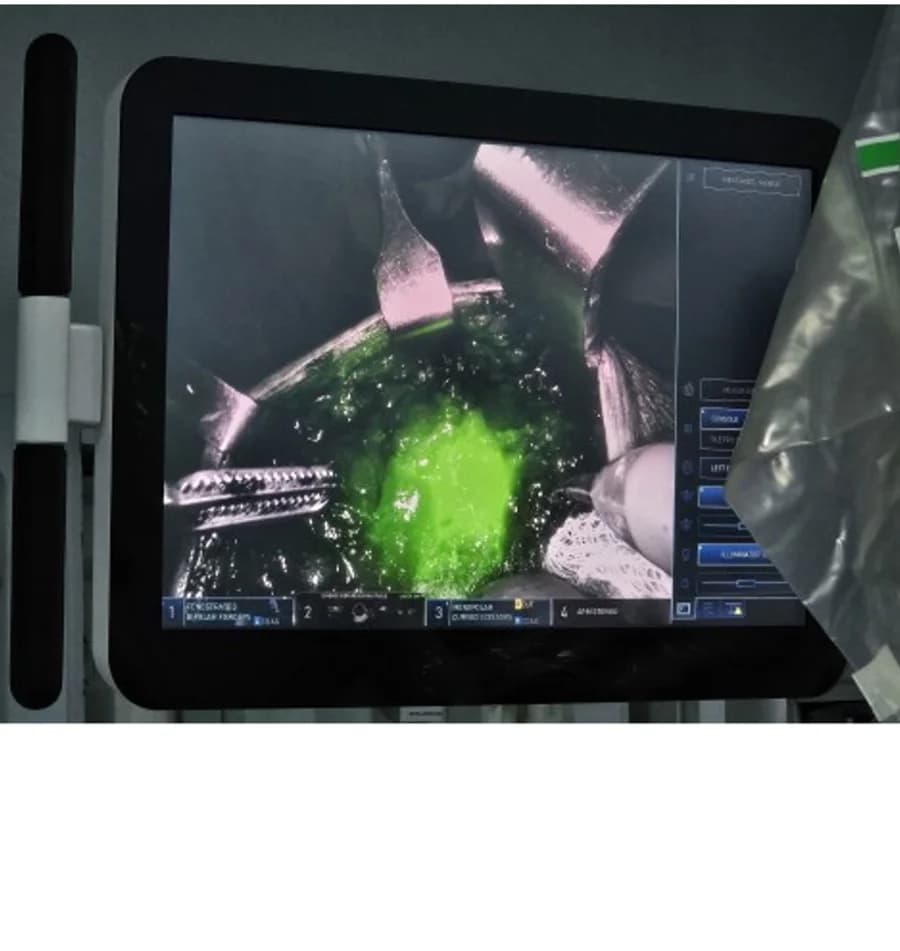
Published results · 9 patients (2026, under peer review)
The robotic LD flap - no cut in the back
The Latissimus Dorsi flap is the workhorse of breast reconstruction. Conventionally it leaves a 15-25 cm back scar and requires repositioning the patient mid-surgery. The robotic approach removes both.
The conventional problem
- A long 15-25 cm incision placed on the back
- Patient repositioned supine → lateral → supine, re-draped each time
- A conspicuous, permanent posterior scar
- Prolonged operative time and added surgical morbidity
The robotic advantage
- Accessed through the axillary incision alone - no back scar at all
- No repositioning or re-draping - done in a single supine position
- 3D vision precisely preserves the thoracodorsal neurovascular pedicle
- Selber et al.: robotic assistance roughly halves LD harvest time
The mobilised latissimus tissue is brought through the axilla into the breast defect and shaped to reconstruct the contour - reliable, well-vascularised tissue that heals well and integrates naturally, whether the defect is from a partial or complete mastectomy.
The majority of patients can benefit
The vast majority of breast cancer patients are candidates for Robot Assisted Functional Breast Preservation Surgery. These categories are eligible - though final candidacy is always confirmed on clinical evaluation.
Early-stage breast cancer
Tumours up to ~5 cm where the skin, nipple-areolar complex, and chest wall muscle are not involved - ideal candidates for upfront robotic nipple- or skin-sparing resection.
After neo-adjuvant therapy
Locally advanced, HER2-positive, or Triple Negative disease that responds well to neo-adjuvant chemo / targeted / immunotherapy. Good responders become excellent candidates.
Benign & borderline tumours
Large fibroadenomas, phyllodes tumours, and similar lesions requiring excision - complete removal with adequate margins while preserving aesthetics, especially in young patients.
Non-palpable lesions
Screen-detected cancers, DCIS, benign proliferative lesions, and post-NACT complete responders - precisely localised and excised with the ICG-Firefly guided technique.
Women of all ages
From a 15-year-old with a phyllodes tumour to a 58-year-old with multifocal cancer - loss of the breast is morbid at any age, and every woman deserves evaluation.
Not sure if you qualify?
Share your reports for a personal assessment of your breast-preservation options.
Request an assessmentSuperior cosmesis, with no compromise on safety
The pursuit of cosmesis never comes at the expense of oncological adequacy. The robotic approach is a superior means of executing the same proven operation.
100%
Negative surgical margins in the published series
0%
Re-excision rate - precision removes the guesswork
0%
Recurrence at follow-up in the published cohort
70 min
Mean operative time, with no intra-operative complications
Sentinel lymph node evaluation performed through the same incision for accurate axillary staging
Frozen-section analysis of sub-areolar tissue confirms negative margins in nipple-sparing cases
Conversion to skin-sparing mastectomy whenever oncological safety requires it
Faster recovery, minimal blood loss, and shorter hospital stay than open approaches
“The patient walks in with breast cancer and walks out cancer-free - with a breast that looks normal and feels normal.”
Rehabilitated fully back into life
The ultimate success of cancer treatment is a woman returning to her family, her relationships, and her confidence. These stories reflect the kinds of journeys this programme makes possible.
I was terrified I would lose my breast. Instead the scar is hidden, I have my sensation, and the cancer is gone. I feel whole.
My tumour had vanished on the scans after chemo. The glowing dye let them find exactly where it had been and remove it precisely.
They rebuilt my breast using tissue from my back - but there is no scar on my back at all. People cannot believe I had surgery.
At 19, the thought of a visible scar was devastating. The robotic approach removed the tumour and left almost nothing to see.
Illustrative patient experiences shared with consent. Individual results vary; outcomes depend on clinical circumstances and are discussed during consultation.
Led by Dr Mandeep Singh Malhotra
Surgical & Molecular Oncologist with specialisation in Head, Neck and Breast Oncology - Programme Director of one of India's first comprehensive programmes for robot-assisted breast cancer resection and immediate oncoplastic reconstruction.
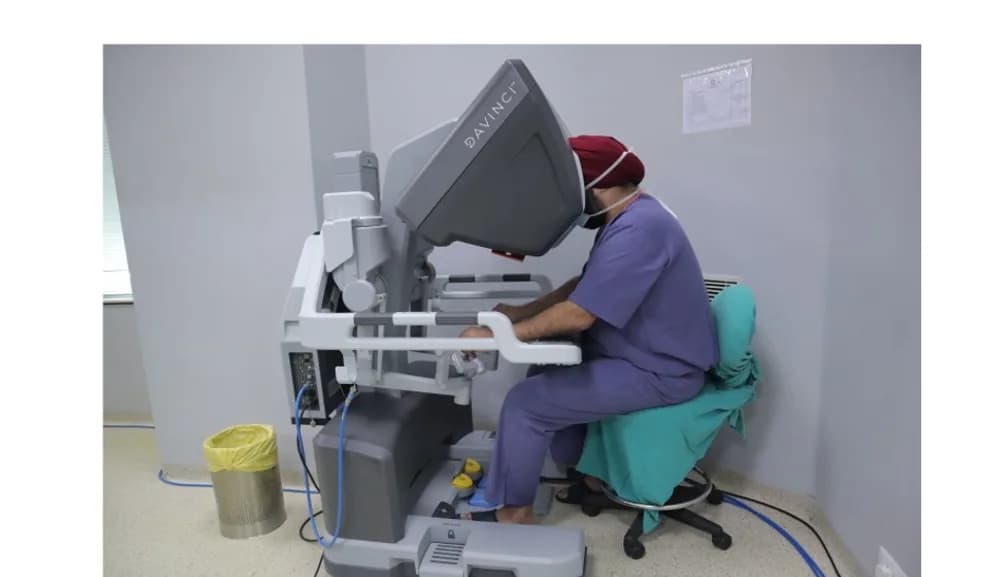
Dr Mandeep Singh Malhotra
Director, Surgical Oncology · 21+ years
Qualifications & Training
- MBBS, MS
- Surgical Oncology Residency - AIIMS, New Delhi
- Fellowship, Head & Neck Surgery & Microvascular Reconstruction - MSCC, Nagpur
- FUICC Breast Oncoplasty - St. Andrews, Chelmsford, UK
- Molecular Oncology - RGCC, Europe
- TORS & Robotic Surgery Training - UPENN, USA
- FMAS, FIAGES
Key Achievements
- Among the largest experiences in Robot Assisted Breast Surgery in India
- Pioneered ICG-guided Firefly imaging for non-palpable lesion excision
- Published original research on the novel robotic technique (2026)
- Initiated the Robotic Women's Oncology Initiative at CK Birla Hospital
The institution
CK Birla Hospital, Punjabi Bagh, New Delhi - equipped with the da Vinci robotic system and a dedicated multidisciplinary breast cancer team across surgical, medical, and radiation oncology, radiology, pathology, and plastic surgery.
Published research
“Robotic-Assisted Excision of Non-Palpable Breast Lesions Using ICG-Guided Firefly Imaging: A Novel Technique for Precision and Cosmesis.”
M. S. Malhotra, H. Singh · Dept. of Surgical Oncology, CK Birla Hospital, New Delhi (2026)
What patients ask us
Clear, honest answers about robot-assisted functional breast preservation surgery. Anything specific to your case is best discussed in a consultation.
Yes. The robotic approach does not change the fundamental oncological principles - it is a superior means of executing the same operation. Skin- and nipple-sparing resections have equivalent local recurrence and survival to radical mastectomy in appropriately selected patients, and the published series achieved 100% negative margins with 0% re-excision and 0% recurrence at follow-up.
Incisions are placed in natural skin creases - around the areola, in the inframammary fold, or in the armpit - and heal to become virtually invisible. For latissimus dorsi reconstruction, the tissue is accessed through the armpit, so there is no scar on the back at all.
In many cases, yes. Nipple Sparing Mastectomy preserves the nipple-areolar complex, with sub-areolar tissue checked by frozen section during surgery to confirm clear margins. If the margin is involved, the procedure is safely converted to skin-sparing - this is needed in only a small percentage of cases.
It is a technique pioneered by Dr Malhotra in which a fluorescent dye (ICG) is injected around the tumour and then made to glow under the da Vinci's near-infrared 'Firefly' camera. This is especially valuable for non-palpable lesions - including tumours that vanished on scans after chemotherapy - letting the surgeon find and remove exactly the right tissue with clear margins while sparing healthy breast.
Often, yes. Patients who respond well to neo-adjuvant chemotherapy (including HER2-positive and Triple Negative disease) frequently become excellent candidates for robotic functional breast preservation. The ICG-Firefly technique is particularly suited to locating tumours that are no longer palpable after treatment.
Breast preservation matters at every age. Candidates have ranged from a teenager with a phyllodes tumour to women in their late fifties with multifocal cancer. Loss of the breast is difficult at any age, so every woman deserves to be assessed for preservation options.
Surgery is performed at CK Birla Hospital, Punjabi Bagh, New Delhi, which is equipped with the da Vinci system and a full multidisciplinary breast team. You can begin by emailing your reports or messaging on WhatsApp for a confidential, no-obligation assessment of your options.
Take the first step toward a functional breast
Every eligible woman deserves the most advanced breast cancer surgery available today. Reach out to discuss your reports and your options - confidentially, and without obligation.
Request a consultation
Share a few details and our team will be in touch. Confidential, no obligation.