
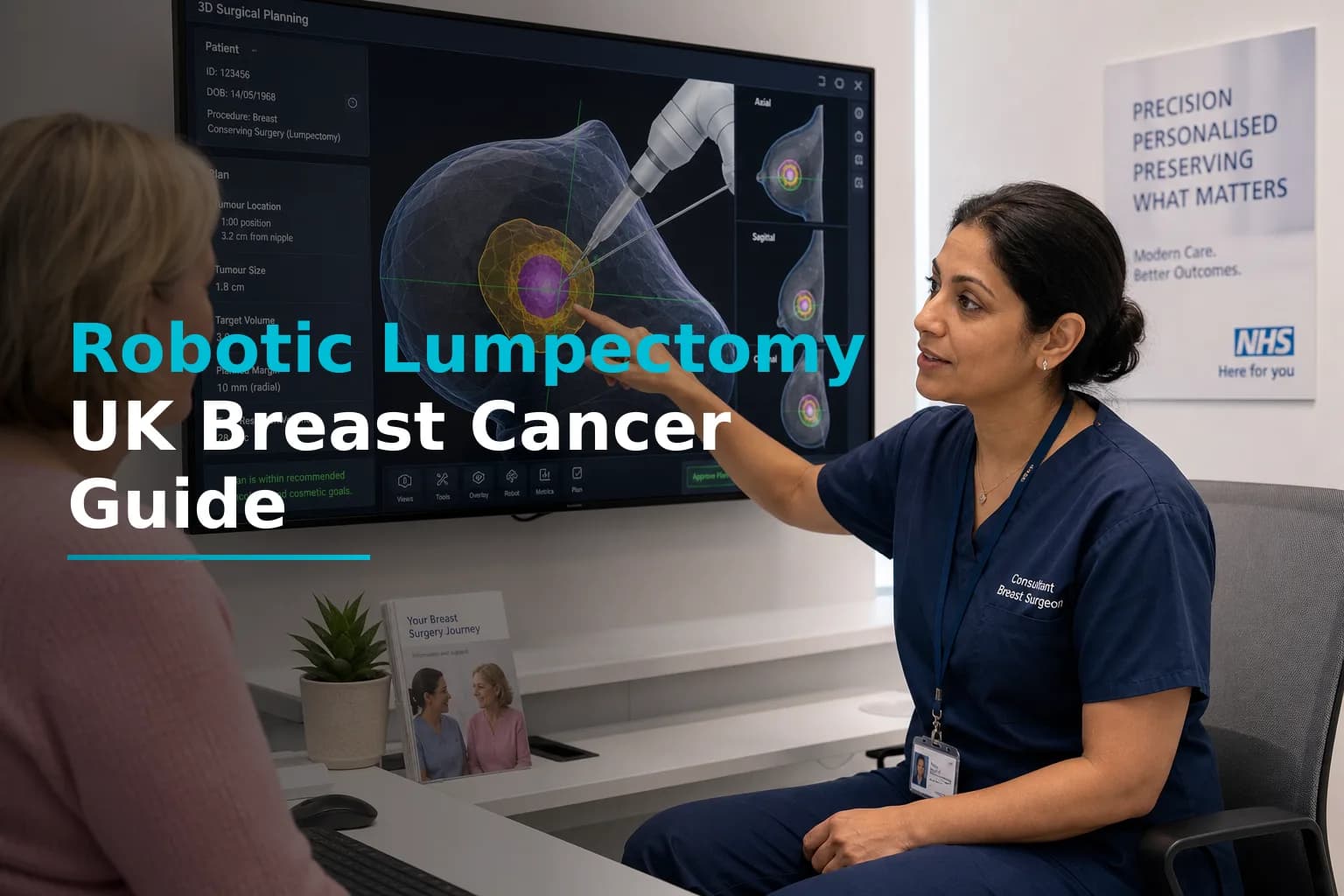
A Diagnosis That Changes Everything
Hearing the words 'you have breast cancer' is one of the hardest moments a person can face. Even when the cancer is caught early, the decisions ahead can feel enormous. Which surgery is right for you? Will you need to lose your breast? How long will you wait? Are there other options available somewhere else?
This guide is written for women in the UK who have been diagnosed with early-stage breast cancer and want to understand their surgical choices. We focus on one approach in particular: robotic lumpectomy, a minimally invasive technique that removes the tumour while preserving as much of the breast as possible. We also look at why some UK patients are choosing specialist care in India, and what the process is like.
What Is Early-Stage Breast Cancer?
Early-stage breast cancer typically means the cancer is contained within the breast or has spread only to nearby lymph nodes. This covers Stage I and Stage II disease. At this point, breast-preserving surgery is often a realistic option that's worth discussing with your care team.
NICE guideline NG101, which guides breast cancer treatment across England, recommends that clinicians offer breast-conserving surgery as an alternative to mastectomy for suitable patients. What makes a patient suitable depends on tumour size relative to breast volume, tumour type, and several other individual factors. This is always a decision made together with your surgical team.
Understanding Robotic Lumpectomy
A lumpectomy — sometimes called a wide local excision — removes the tumour and a small margin of surrounding tissue. The aim is to clear the cancer while leaving the breast largely intact.
In a robotic lumpectomy, the surgeon uses a robotic system to guide precision instruments through very small cuts. The surgeon sits at a console and controls robotic arms with tiny tools. A high-definition 3D camera shows a magnified view of the area. The surgeon is fully in control throughout. The robotic system makes finer movements than a surgeon's hands alone, which can help in complex cases.
A systematic review and meta-analysis comparing robot-assisted surgery with open surgery for early-stage breast cancer, published on PubMed, found that robotic approaches may offer advantages in precision and recovery. The researchers noted that further high-quality studies are needed to confirm long-term outcomes.
Why Patients Are Considering Robotic Surgery
For many women, keeping their breast is a deeply personal priority. It affects body image, emotional wellbeing, and confidence during and after treatment.
A large meta-analysis of 35 observational studies with 909,077 patients found that breast-conserving surgery with radiotherapy had comparable or better survival outcomes than mastectomy for early-stage breast cancer. However, one approach is not right for every person.
Beyond survival, breast-preserving approaches offer:
- A shorter recovery period in many cases compared with mastectomy
- No need for breast reconstruction in most patients
- Smaller scars and less damage to surrounding tissue
- Higher satisfaction with body image reported by some patients in research
Robotic lumpectomy improves surgical precision, may reduce damage to surrounding tissue, and can lead to better cosmetic results.
Robotic Lumpectomy vs Traditional Breast Surgery
The table below summarises the key differences between the main surgical options for early-stage breast cancer. This is a general comparison only — your surgeon will advise you on what is appropriate for your specific situation.
| Feature | Robotic Lumpectomy | Open Lumpectomy | Mastectomy |
|---|---|---|---|
| Breast preserved? | Yes | Yes | No, in most cases |
| Incision size | Very small (keyhole-style) | Moderate | Larger |
| Surgical visualisation | High-definition 3D magnification | Standard | Standard |
| Typical hospital stay | Often day-case or one night | Often day-case or one night | Two to five nights typically |
| Reconstruction needed? | Usually not | Usually not | Often yes |
| Radiotherapy after surgery? | Usually recommended | Usually recommended | Depends on individual staging |
Radiotherapy after lumpectomy is a standard part of the treatment pathway. It is designed to reduce the chance of any remaining cancer cells growing back in the breast. Your oncology team will plan a schedule suited to your needs.
For a more detailed comparison of surgical approaches, see our guide: Robotic Breast Surgery: A Complete Guide for UK Patients Exploring Your Options at Home and Abroad.
Why Some UK Patients Explore Treatment Abroad
The NHS provides dedicated, high-quality cancer care. However, some patients face real challenges — particularly when seeking access to specialist robotic surgery, or trying to reduce the time between diagnosis and treatment.
According to Cancer Research UK, the NHS aims for treatment to start within 62 days of urgent referral. This target has not been met consistently in recent years. Breast Cancer Now reported that only a small percentage of women are diagnosed within 28 days of urgent referral, falling short of the 75% target.
The NHS waiting times guide outlines what patients are entitled to — but entitlement and actual experience can differ. For some women, getting the surgery they want matters as much as the wait time. Robotic breast surgery is not available at every NHS trust. A patient may be told that mastectomy is the most practical local option, even when breast-conserving surgery might be achievable at a specialist centre.
Patients also consider treatment abroad for other reasons:
- The desire for a second opinion from a surgeon who specialises in robotic techniques
- A wish for more dedicated time with the surgical team to discuss options thoroughly
- The ability to plan and schedule surgery at a convenient time without uncertainty
- Access to care that integrates surgery, oncology input, and support services in one place
Why India Is Emerging as a Destination for Robotic Breast Surgery
India has become a destination for international cancer care, with several features that appeal to UK patients.
English-Speaking Medical Teams
Senior clinicians, nurses, and patient coordinators at India's major cancer hospitals are generally fluent in English. Communication barriers are rarely a concern for UK patients.
Experienced Breast Cancer Surgeons
Leading Indian hospitals have dedicated breast cancer units where surgeons perform high volumes of breast cancer procedures each year, including robotic approaches. Volume and specialisation matter in surgery. Surgeons who perform a procedure regularly tend to have refined technique and sound clinical judgement.
Advanced Technology and International Accreditation
Major Indian cancer centres use the same robotic surgical platforms as leading hospitals in the US and Europe. Many hold Joint Commission International (JCI) accreditation — a globally recognised standard for patient safety and quality. This is not a guarantee of results, but it shows the hospital meets high standards.
Comprehensive International Patient Services
Most large Indian cancer hospitals have dedicated international patient teams. These teams help with appointment scheduling, medical report review, visa support letters if needed, airport transfers, and accommodation close to the hospital. This helps reduce stress on the patient and family.
Cost as a Practical Consideration
Treatment costs in India are much lower than UK private healthcare. This matters for families who need a surgery not available on the NHS and can't afford UK private rates. However, cost should never be the deciding factor in a surgical decision. Clinical suitability, surgeon experience, and quality of care must come first. Always request a clear, itemised written quote before making any plans.
For more on what UK patients should consider before travelling, read: Robotic Breast Cancer Surgery in India: What UK Patients Should Know About Quality, Expertise, and Access.
What a UK Patient's Journey Might Look Like
Travelling abroad for breast cancer surgery can feel daunting. However, the process is well-structured at established international hospitals. Here is what typically happens.
Step 1: Online Consultation and Report Sharing
You share your medical documents with the overseas clinical team. A specialist reviews your case and gives an initial view on whether robotic lumpectomy may be appropriate for you.
Step 2: Personalised Treatment Plan
The surgical and oncology team review your full case and produce a written treatment plan. This covers the surgical approach, the expected timeline, and any additional tests or treatments that may be needed. This plan is discussed with you in detail before any commitment is made.
Step 3: Travel and Arrival
India's major cancer hubs — including Mumbai, Delhi, Chennai, and Bangalore — are well served by flights from the UK. Most journeys involve a direct or one-stop flight of seven to ten hours. Patient coordinators can assist with accommodation and logistical planning.
Step 4: Pre-Operative Assessment
On arrival, you meet your surgeon face to face. Pre-operative blood tests and any additional imaging are completed. You have the opportunity to ask questions and confirm you are happy with the plan before proceeding.
Step 5: Surgery and Recovery
Robotic lumpectomy is performed under general anaesthesia. Most patients stay in hospital for one to two nights, though this varies with individual circumstances. After surgery, the hospital team monitors your progress and gives you full written discharge instructions before you leave.
Step 6: Returning Home
Most patients are well enough to fly home within one to two weeks of surgery, subject to the surgical team's assessment. Your UK GP and oncologist continue your care on your return. The overseas team provides complete discharge documentation, pathology reports, and post-operative notes for your UK clinicians. Radiotherapy, if part of your treatment plan, is almost always arranged locally in the UK.
For a more complete account of how this journey works in practice, read: From Diagnosis to Surgery: A UK Breast Cancer Patient's Real-World Guide to Accessing Robotic Treatment in India.
Expert Perspective
Experts say the keys to good outcomes are careful patient selection, surgical precision, and a complete team of specialists. Technology alone doesn't change outcomes. How it's used, and by whom, is what matters most.
The growing interest in robotic approaches to breast-conserving surgery reflects a desire to achieve what open surgery sometimes cannot: better access to deep or difficult tumours, more precise movement in tight spaces, and better appearance. For women with early-stage breast cancer, the most important step is always a thorough assessment from a specialist who has reviewed your scans and reports, and who will discuss all your options honestly, including getting a second opinion.
Request a Personalised Robotic Surgery Assessment
If you are considering robotic lumpectomy and want to understand whether it may be an option for your specific case, the first step is a specialist review of your medical records. You can upload any or all of the following documents to receive a personalised assessment:
- Mammogram reports
- Biopsy reports
- PET-CT scans
- MRI scans
- Histopathology reports
- Any existing treatment plans from your current care team
A specialist will review your case and help you understand whether robotic breast-preserving surgery may be a realistic option — and what treatment in India might involve for someone in your situation. There is no obligation to proceed, and the assessment is confidential.
When to Talk to Your Doctor
Speak to your GP or oncologist straight away if you experience any new symptoms, if your current treatment plan feels unclear, or if you want to request a second opinion before making a surgical decision. You are entitled to ask for a referral to another specialist within the NHS. If you are considering treatment abroad, let your UK care team know — this allows your records to be kept up to date and ensures your care continues safely when you return home.
This article is for general information and is not a substitute for medical advice. Always consult your oncologist or care team about your specific situation.