
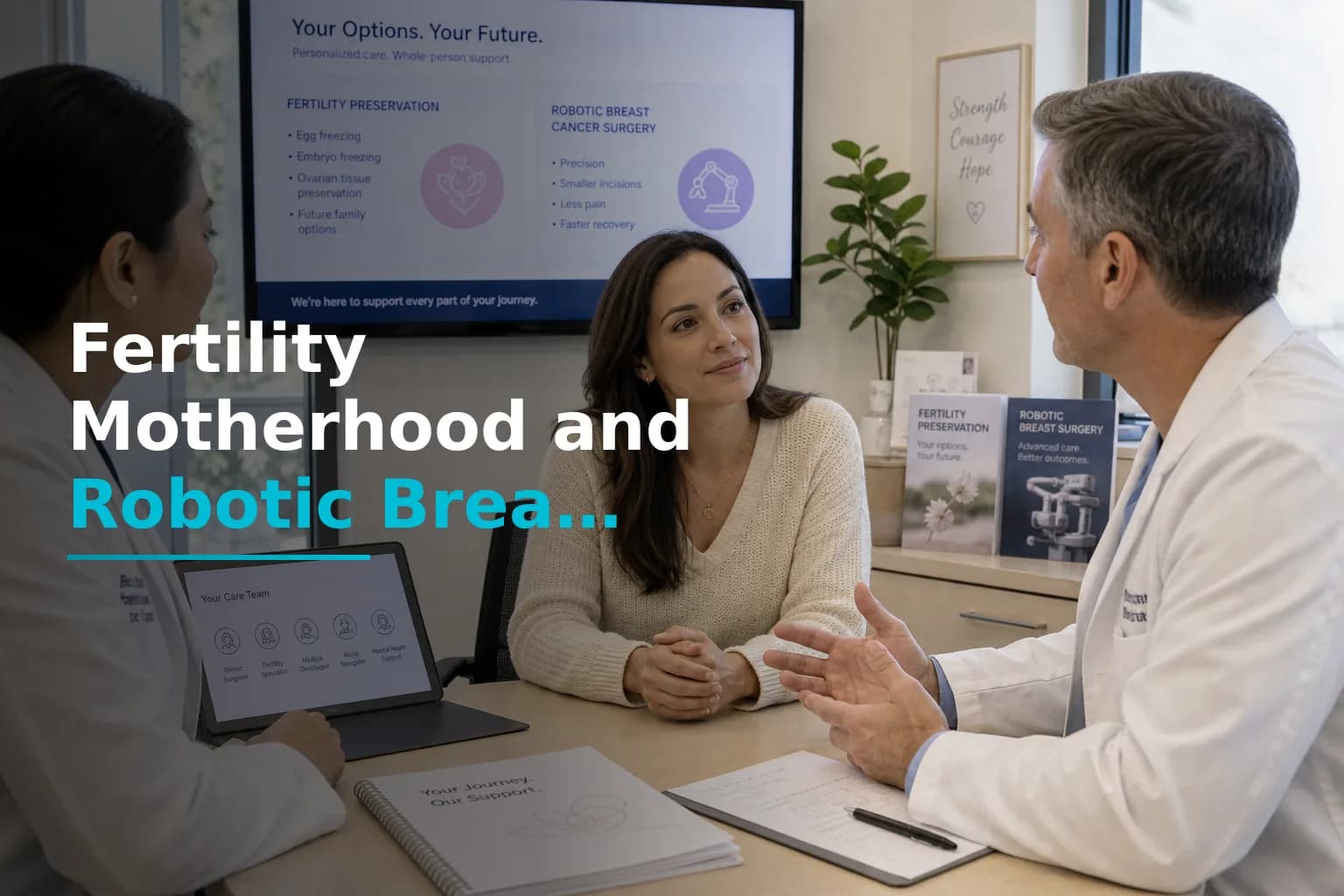
When a Diagnosis Meets a Dream
Hearing the words 'breast cancer' at a young age is frightening. For women who want to have biological children, a diagnosis can feel like it threatens two futures at once: your health and your family. The good news is that more women than ever are finishing breast cancer treatment and going on to have children. Advances in surgery and fertility medicine now give you real options, even after an early-stage diagnosis.
This guide is for women in the UK recently diagnosed with early-stage breast cancer who want to protect their fertility and are curious about robotic breast surgery. It also explains why some women choose to get this specialist care in India.
Understanding Robotic Breast Cancer Surgery
Robotic breast cancer surgery uses a surgeon-controlled system to carry out the operation. The surgeon sits at a console nearby and guides small robotic arms with precision. A high-definition camera shows a detailed, three-dimensional view of the surgical area. The robotic arms enter the body through very small incisions, usually placed in the armpit or along natural skin folds where they are least visible.
This approach may be used for two main types of breast cancer surgery:
- Robotic lumpectomy — the surgeon removes the tumour and a small margin of surrounding healthy tissue while keeping the breast intact.
- Robotic nipple-sparing mastectomy — the surgeon removes the breast tissue while keeping the skin and nipple intact, followed by reconstruction.
For young women who care about body image and motherhood, both options offer advantages over traditional open surgery.
Why Young Women Are Choosing Robotic Surgery
Young women with breast cancer often have concerns that extend well beyond the tumour itself. Body image matters. Feeling like yourself after treatment matters. And being able to have children matters too.
Robotic surgery may support these priorities in several ways:
- Smaller, better-placed scars. Incisions are tiny and usually hidden. You'll likely have far less visible scarring than with traditional surgery.
- Better cosmetic results. Women who had robotic nipple-sparing mastectomy reported greater satisfaction with their appearance and wellbeing than those who had conventional surgery.
- Faster recovery. Smaller incisions cause less disruption to surrounding tissue, so you recover faster. This means you can start chemotherapy sooner if you need it, which is important if you're also preserving fertility.
- Greater chance of preserving the breast. For early-stage breast cancer, robotic lumpectomy may let you keep your breast entirely. This can be very important, especially for women planning a family.
If your doctor said mastectomy is your only option, ask whether a breast-conserving approach might work. Read our guide: I Was Told Mastectomy Was My Only Option: A UK Patient's Guide to Robotic Lumpectomy and Getting a Second Opinion in India.
Robotic Surgery vs Traditional Breast Cancer Surgery
| Factor | Robotic Surgery | Traditional Open Surgery |
|---|---|---|
| Incision size | Small, often concealed | Larger, more visible |
| Scarring | Typically minimal | More prominent scar likely |
| Hospital stay | Often shorter | May be longer |
| Recovery time | May be faster | Typically longer |
| Surgical precision | 3D camera, tremor filtering | Depends on surgeon's view and hand control |
| Nipple preservation option | More feasible in selected patients | Possible but technically harder |
| Availability on NHS | Limited specialist centres | Widely available |
Every patient's case is different. Your surgical team will advise whether robotic surgery is appropriate for your tumour size, location, and overall treatment plan.
Fertility Preservation: What You Need to Know Before Treatment Starts
Breast cancer treatment, especially chemotherapy, can affect your ability to get pregnant. Chemotherapy may damage the follicles in your ovaries, which can lead to temporary or lasting changes to your fertility. This won't happen to everyone, but it's a real risk you should talk to your care team about before treatment begins.
Good news: fertility preservation options exist and work well. The main options are:
- Egg freezing (oocyte cryopreservation) — your eggs are collected and frozen before chemotherapy begins. Modern techniques mean this can be started at any point in your menstrual cycle, so delays to treatment are often minimal.
- Embryo freezing — eggs are fertilised with a partner's or donor's sperm and then frozen. This is considered the most established option for women who have a partner.
- Ovarian tissue freezing — a small piece of ovarian tissue is removed and stored. This may be used when there is not enough time for egg collection before treatment must start.
- Ovarian suppression with GnRH agonists — injections given during chemotherapy that may help to protect the ovaries. Research suggests these can help preserve fertility during treatment, though they are not a guarantee for every woman.
Your clinical team should discuss fertility preservation with you as soon as possible after diagnosis. The sooner you have this conversation, the more options you'll have.
Common fertility preservation methods are safe for young women with breast cancer and don't reduce survival rates. That's reassuring news as you think about your choices.
How Your Surgical Choice Connects to Your Fertility Plan
Your surgical choice won't directly affect your ability to conceive. Most women can safely have pregnancies after breast cancer, once treatment is complete and your oncologist says it's safe. However, your surgical choice matters in other ways:
- Body confidence. Feeling comfortable in your body after surgery helps as you move toward motherhood. Better-looking results can help you feel better overall during this time.
- Recovery timeline. Faster recovery means you can start fertility treatment or chemotherapy sooner, which means your overall treatment ends sooner and you can try to get pregnant earlier.
- Avoiding further surgery. A successful lumpectomy may mean you don't need complex reconstruction later, simplifying your care.
Talk with your oncologist and surgeon about your plans for a family before deciding on treatment. A skilled team will include your fertility goals in the plan from the start.
Why Some UK Patients Are Exploring Treatment Abroad
Most women in the UK get good breast cancer care through the NHS. However, only a few specialist centres in the UK offer robotic breast surgery. Some women have to wait to see a surgeon trained in robotic techniques. Others find their local centre doesn't offer the specific procedure they want, or doesn't have fertility specialists who work closely with the breast surgery team.
Some of the reasons women consider a second opinion or treatment abroad include:
- Wanting to see a surgeon who regularly performs robotic breast procedures on young patients with fertility concerns
- Seeking a centre where oncology, breast surgery, and fertility medicine are coordinated under one roof
- Wanting a faster specialist assessment after diagnosis
- Having been advised mastectomy is the only option and wanting another expert view before deciding
Seeking care abroad is a personal decision, not a criticism of any healthcare provider. Robotic breast surgery is only available at a few centres worldwide, and some women want to know all their options before choosing their treatment.
Why India Is Emerging as a Destination for Robotic Breast Surgery
India is becoming known for complex cancer surgery. For UK breast cancer patients, several things make India worth considering:
- Experienced surgeons. Many leading Indian oncology hospitals employ surgeons who trained internationally and carry out high volumes of robotic breast procedures annually.
- English-speaking care teams. Major hospitals serving international patients operate in English throughout your care, from first consultation to discharge paperwork.
- Integrated, comprehensive cancer care. Leading Indian cancer hospitals bring together oncologists, breast surgeons, fertility specialists, and reconstructive surgeons in one facility. This coordinated approach is valuable for young women who need both cancer care and fertility care working together.
- Modern robotic technology. Several Indian hospitals now operate the same advanced robotic surgical platforms used in leading centres across the UK, the US, and Europe.
- International patient services. Dedicated coordinators help manage travel, accommodation, medical record transfer, and communication with your UK GP or oncology team before and after surgery.
For a detailed guide to what the journey looks like from diagnosis to discharge, see: Early-Stage Breast Cancer and Robotic Lumpectomy: A UK Patient's Guide to Breast-Preserving Surgery in India.
What a UK Patient's Journey Typically Looks Like
- Online consultation. You share your medical reports with an international patient coordinator. A specialist reviews your case and advises whether you are a suitable candidate for robotic breast surgery.
- Medical report review. Your biopsy results, mammogram, MRI, and pathology reports are reviewed in detail. A personalised, fertility-aware treatment plan is proposed.
- Fertility coordination. If you want to preserve your fertility before surgery or chemotherapy, a fertility specialist within the same hospital or network is involved at this stage so both timelines are planned together.
- Travel arrangements. The international patient team helps coordinate flights, visa support letters, and accommodation near the hospital.
- Surgery. Your robotic procedure takes place with your dedicated surgical team. A hospital stay of a few days is typically expected.
- Recovery and discharge. You return home when your surgical team considers it safe to travel. A full written report is prepared for your UK GP and oncology team.
- Ongoing follow-up. Post-operative appointments can often be held via video call with your India care team, alongside your continuing NHS or private care in the UK.
For a real-world step-by-step view of this journey, visit: From Diagnosis to Surgery: A UK Breast Cancer Patient's Real-World Guide to Accessing Robotic Treatment in India.
An Expert Perspective
Specialists who work with young breast cancer patients say the surgical decision is only one part of a larger conversation. Doctors who treat cancer, deliver chemotherapy, and handle fertility need to work together. Your surgical approach — lumpectomy or mastectomy, robotic or open — must always follow what's best for your cancer first. But for young women, how surgery affects your looks, reconstruction, and family planning should be discussed from day one, not added later. A team that understands both your cancer care and your future is the right team to help you decide.
Conclusion
A breast cancer diagnosis when you want children is one of the hardest things a young woman can face. But you don't have to choose between your health and having a family. Robotic surgery, fertility preservation, and good teamwork between your doctors can help you reach both goals.
Whether you choose the NHS, private care in the UK, or a specialist centre in India, get the right information early and make sure your care team knows that your fertility matters to you.
Upload Your Reports for a Personalised Assessment
If you're a young woman recently diagnosed with breast cancer, you can submit your medical records for a specialist review. The reports that help most include:
- Mammogram reports
- Biopsy and histopathology reports
- MRI scans
- PET-CT scans
- Any existing treatment plan your team has already proposed
Uploading your reports doesn't commit you to any treatment. You'll get a specialist's view of your options so you can make the best choice for your care.
When to Talk to Your Doctor
Talk to your oncologist or breast care nurse as soon as possible if no one has talked to you about fertility preservation. The sooner you have this conversation, the more options you'll have. If you want a second opinion on your surgical options, you have the right to ask for one — your GP or nurse can help you get it.
This article is for general information and is not a substitute for medical advice. Always consult your oncologist or care team about your specific situation.