
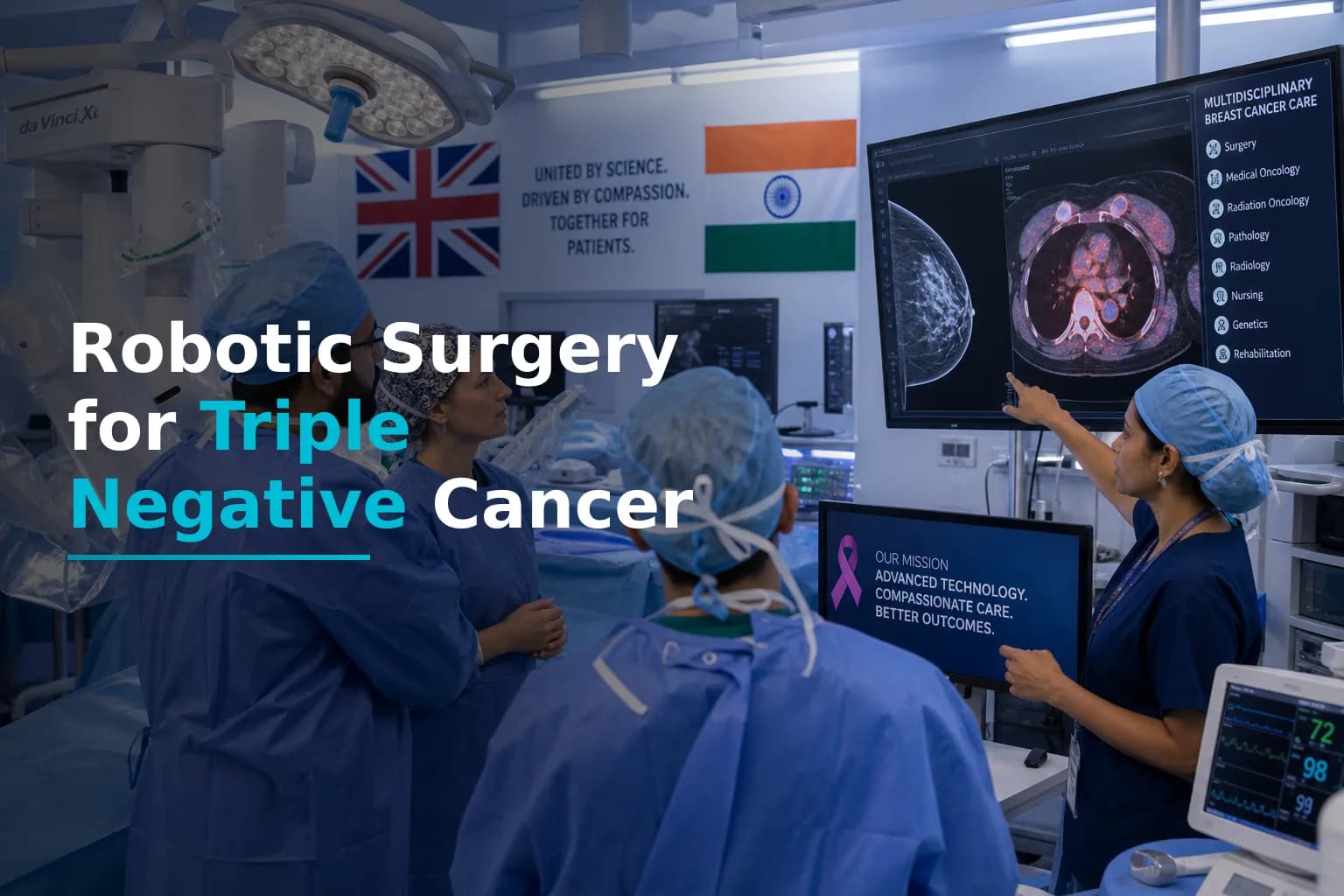
A Diagnosis That Raises Difficult Questions
Learning you have triple negative breast cancer can feel overwhelming. You may have just received your diagnosis and already face choices about surgery, chemotherapy order, and what your treatment will look like. And if you've been reading about your options, you may have come across robotic surgery — a newer approach that some women are seeking out.
This article explains what triple negative breast cancer is, how robotic surgery may fit into your treatment plan, and why some UK women are choosing specialist care in India. It is written for women who are recently diagnosed, actively researching their options, or supporting a loved one through this process.
What Is Triple Negative Breast Cancer?
Triple negative breast cancer (TNBC) is defined by what it lacks. A pathology test checks breast cancer cells for three specific receptors: oestrogen receptors (ER), progesterone receptors (PR), and the HER2 protein. In TNBC, all three tests come back negative.
According to Cancer Research UK, TNBC accounts for roughly 10 to 15 per cent of all breast cancers. It is more common in younger women, in those with a BRCA1 gene mutation, and in women of certain ethnic backgrounds. It tends to grow more quickly than some other breast cancer subtypes, which is why prompt action after diagnosis matters.
Because TNBC lacks the receptors that hormone therapies and HER2-targeted drugs act on, those treatments are not options. The main treatment pathways for TNBC are chemotherapy, surgery, and radiotherapy. For some patients, NICE has approved pembrolizumab, an immunotherapy used alongside and after chemotherapy to treat early or advanced TNBC at high risk of recurrence.
Macmillan Cancer Support notes that chemotherapy is often given before surgery in TNBC (neoadjuvant chemotherapy) to help shrink the tumour first. This can sometimes allow breast-conserving surgery for women who might otherwise need a full mastectomy.
Surgery as a Central Part of TNBC Treatment
Surgery to remove the tumour remains a core part of treating triple negative breast cancer. The two main surgical options are:
- Breast-conserving surgery (lumpectomy): The surgeon removes the tumour and a margin of surrounding healthy tissue, leaving most of the breast intact. Radiotherapy typically follows to reduce the risk of local recurrence.
- Mastectomy: The entire breast is removed. This may be a total mastectomy or a nipple-sparing mastectomy depending on tumour position and size, and is often combined with immediate reconstruction.
Research from the National Institutes of Health shows that breast-conserving surgery works for carefully selected TNBC patients, particularly those whose tumours have responded well to neoadjuvant chemotherapy. The choice between lumpectomy and mastectomy depends on tumour characteristics, genetics, personal preference, and clinical judgement. Your surgical team will help you weigh these factors for your specific situation.
Understanding Robotic Breast Cancer Surgery
Robotic surgery uses a system of small, precision instruments mounted on robotic arms. The surgeon doesn't operate the arms by hand. Instead, they sit at a nearby console and guide the instruments using joystick-style controls while viewing a magnified, three-dimensional image of the surgical field.
In breast surgery, this technology is most commonly used for nipple-sparing mastectomy. Robotic systems allow the surgeon to work through one or two small access incisions placed in the armpit or along the side of the chest, away from the breast surface. Breast tissue is carefully removed through these hidden entry points while the skin and nipple-areola complex are preserved where medically appropriate.
A review in PubMed Central lists several advantages of robotic breast surgery: better precision, a three-dimensional view that standard surgery cannot provide, less damage to surrounding tissue, and reduced strain on the surgeon during longer procedures. The same review notes that robotic breast surgery is still developing and that patient selection and surgeon experience matter for good outcomes.
Why Some Women Are Choosing Robotic Surgery
Women researching robotic mastectomy often highlight several reasons for their interest:
- Scar placement: Because the access incision is placed away from the breast, typically in the armpit, the resulting scar is hidden and often small. Many women say this matters to their body image during and after treatment.
- Nipple preservation: When medically safe, robotic nipple-sparing mastectomy preserves the nipple and areola. Studies have reported high patient satisfaction with cosmetic outcomes in suitable candidates undergoing this procedure.
- Precision: Robotic instruments can rotate beyond the range of the human wrist, enabling fine movement in confined spaces. This may reduce damage to nearby tissue, nerves, and lymphatic vessels, though individual outcomes vary.
- Recovery experience: Smaller access incisions may mean less post-operative discomfort for some patients, though evidence on this is still growing and recovery depends on many individual factors.
Robotic surgery is not suitable for every patient or every tumour. Tumour size, location, skin quality, and individual anatomy all affect whether someone is a good candidate. Your surgical team will weigh all of these carefully before recommending any approach.
Robotic vs Traditional Breast Surgery: Key Differences at a Glance
| Factor | Traditional Open Surgery | Robotic-Assisted Surgery |
|---|---|---|
| Incision location | Directly on or near the breast | Armpit or lateral chest wall |
| Visible scarring | Breast-area scar | Hidden or minimal scar |
| Surgeon's view | Direct or standard endoscopic | 3D magnified console view |
| Nipple preservation | Possible in selected cases | Optimised for suitable candidates |
| NHS availability | Widely available | Limited to specialist centres |
| Oncological safety | Well established | Comparable in reviewed studies for selected patients |
Why Some UK Patients Are Looking Beyond the NHS for Robotic Surgery
The NHS provides high-quality breast cancer care and its clinical teams are skilled and dedicated. However, waiting times for cancer treatment have been a growing concern. Breast Cancer Now has reported that the NHS 62-day target (85 per cent of patients should begin treatment after an urgent referral) has not been consistently met, and more patients wait longer than 104 days than in previous years.
For women with TNBC, a faster-growing cancer, waiting for treatment is stressful. Some women opt for private care within the UK for faster access to surgery. Others ask whether specialist robotic breast surgery might be available abroad at hospitals where the technology is more widely used and support for international patients is well established.
Seeking care abroad does not mean stepping away from NHS support. Many women use both: travelling for surgery and then returning to continue chemotherapy, radiotherapy, or other treatment under their NHS oncology team. Both care teams must coordinate and communicate clearly to keep you safe.
For a fuller picture of how to make this decision, see our guide: Robotic Breast Surgery: A Complete Guide for UK Patients Exploring Your Options at Home and Abroad.
Why India Is Emerging as a Destination for Robotic Breast Surgery
Several major Indian hospitals have invested in robotic surgery programmes over the past decade. Hospitals in Mumbai, Delhi, Bengaluru, and Chennai now treat many international patients and have systems to support them.
UK patients exploring India for robotic breast surgery often highlight these factors:
- English-speaking teams: Most senior clinicians at major Indian hospitals speak English fluently, and dedicated patient services coordinators help with communication throughout your care.
- Specialist surgical experience: A number of breast surgeons at leading Indian centres have trained or worked internationally and have special expertise in robotic techniques.
- Comprehensive care pathways: Major centres offer end-to-end planning, including pre-operative assessments, surgery, in-hospital recovery, and detailed discharge documentation to help with continuity of care when you return to the UK.
- International accreditation: Several leading Indian hospitals hold Joint Commission International (JCI) accreditation, a widely recognised quality standard for hospital care.
- Cost: Surgical fees for robotic breast surgery at accredited Indian private hospitals are often substantially lower than equivalent private-pay procedures in the UK. Costs vary, and patients should always obtain a written cost estimate before making any commitment.
To learn what to look for in hospitals and surgeons, see our in-depth guide: Robotic Breast Cancer Surgery in India: What UK Patients Should Know About Quality, Expertise, and Access.
What a UK Patient's Journey Might Look Like
Women travelling from the UK to India for robotic breast surgery typically follow a structured pathway:
- Online consultation: A video call with the surgeon or specialist team to discuss your diagnosis, reports, and whether robotic surgery is right for you — no travel needed at this stage.
- Medical record review: Sharing your mammogram, biopsy report, PET-CT or MRI scan reports, histopathology findings, and any existing treatment plan for detailed clinical assessment.
- Personalised treatment plan: The surgical team prepares a recommendation specific to your case, including pre-operative steps and, where relevant, guidance on timing around neoadjuvant chemotherapy.
- Travel logistics: The hospital's international patient team typically helps with visa invitation letters, accommodation near the facility, and arrival coordination.
- Surgery and in-hospital recovery: Most patients remain in hospital for two to five days following robotic mastectomy, though this varies by procedure and individual circumstances.
- Local recovery period: A short stay near the hospital, typically one to two weeks, before flying home, subject to the surgeon's guidance.
- UK follow-up: A comprehensive discharge report is provided for your UK oncologist or GP to ensure continuity for any ongoing treatment such as radiotherapy, chemotherapy, or immunotherapy.
For a step-by-step walkthrough of the full process, see: From Diagnosis to Surgery: A UK Breast Cancer Patient's Real-World Guide to Accessing Robotic Treatment in India.
Request a Personalised Robotic Surgery Assessment
Every woman's TNBC diagnosis is different. Tumour characteristics, genetic markers, chemotherapy response, and personal preferences all shape the surgical options available to you. A generic answer will not serve your situation as well as a review of your own reports by a specialist team.
If you're thinking about robotic breast surgery and want to know if it's right for you, you can share any of the following for assessment:
- Mammogram reports
- Biopsy reports
- PET-CT scans
- MRI scans
- Histopathology reports
- Existing treatment plans
A specialist team member will review your information and provide an honest, personalised assessment of your surgical options — with no obligation to proceed.
When to Talk to Your Doctor
Talk to your oncologist or breast surgeon if you want to know whether robotic surgery is right for you, are concerned about delays in your treatment plan, were told mastectomy is your only option and want to explore other choices, or are considering treatment abroad and need to know about follow-up care.
This article is for general information and is not a substitute for medical advice. Always consult your oncologist or care team about your specific situation.