
Skin-Sparing Mastectomy with Robotic Surgery: A UK Patient's Guide to Cosmetic Preservation and Reconstruction in India
If you have been told you need a mastectomy, one of the first questions that often follows is: what will I look like afterwards? That question is not vanity. It's a natural response to a serious diagnosis.
Skin-sparing mastectomy, and the robotic techniques now used to perform it, exist because surgeons and patients both recognized that cancer safety and cosmetic outcome don't have to conflict. This guide explains what skin-sparing mastectomy is, how robotic surgery changes the approach, what reconstruction looks like, and why some UK women are choosing to access this surgery in India.
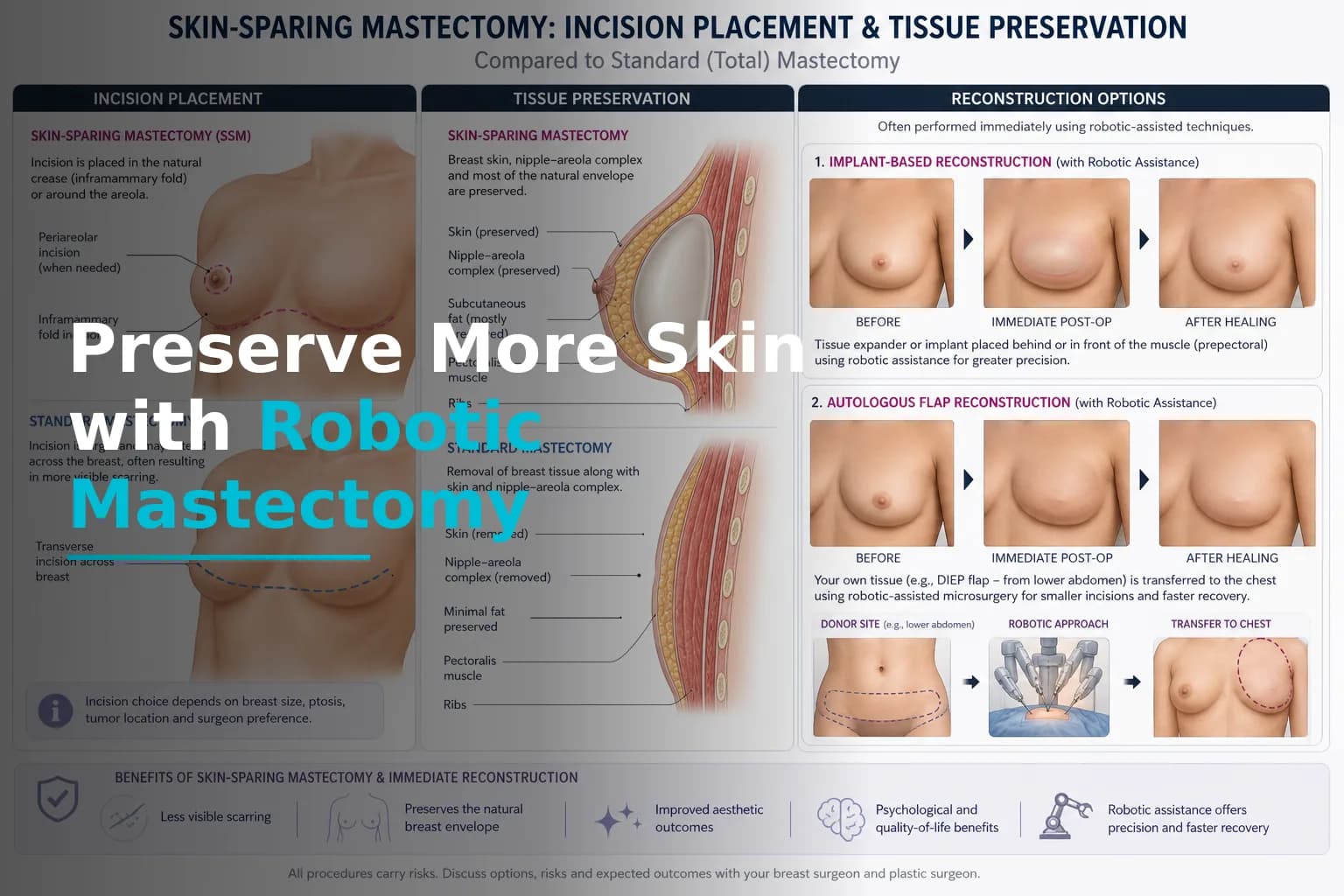
Quick answer: Skin-sparing mastectomy (SSM) removes all breast tissue and the nipple-areola complex but keeps most of the natural breast skin intact. This preserved skin envelope allows reconstruction to look and feel more natural. When performed with robotic assistance, the incision can often be hidden in the armpit, leaving the breast surface largely scar-free.
What exactly is skin-sparing mastectomy?
In a standard mastectomy, a significant amount of breast skin is removed along with the breast tissue. In a skin-sparing mastectomy, the surgeon removes the breast tissue, the nipple, and the areola (the darker circle of skin around the nipple) but preserves the rest of the skin that covered your breast. That skin creates a pocket, sometimes called an envelope, that a reconstructive surgeon can fill to rebuild the breast shape.
This usually looks more natural than if you had reconstruction later, when the skin has already been removed and must be replaced or stretched back. According to Breast Cancer Now, when you have immediate reconstruction alongside mastectomy, the skin-sparing approach means less overall scarring compared to reconstruction done at a later date.
You may have also heard of nipple-sparing mastectomy (NSM). This is a related but distinct procedure: in NSM, the nipple and areola are kept along with the surrounding skin. Whether nipple-sparing is oncologically safe depends on where your tumor is and whether cancer cells are in the nipple tissue. If your surgeon has recommended skin-sparing rather than nipple-sparing, it is usually because the nipple needs to be removed to keep you safe from cancer. You can read more in our dedicated guide to nipple-sparing mastectomy with robotic reconstruction.
How does robotic surgery change the approach?
In conventional skin-sparing mastectomy, your surgeon typically makes the incision around the edge of the areola. This allows the surgeon to remove the nipple and access the breast tissue beneath. It leaves a circular scar on the front of the breast.
With robotic assistance, the surgeon can place the incision somewhere far less visible, most often in the armpit (axilla) or along the natural fold beneath the breast. The robotic system consists of small, flexible arm instruments that a surgeon controls from a console nearby. This setup creates enough reach and precision to remove the breast tissue entirely through a remote, more discreetly placed incision.
A study published via the National Institutes of Health described doing skin-sparing mastectomy with immediate latissimus dorsi-flap reconstruction through a single armpit incision. Researchers reported that the approach was feasible, safe, and reproducible, and noted that the breast surface had no long visible scar.
A broader review of robotic approaches in breast surgery, also available through the National Institutes of Health, found that robotic skin-sparing mastectomy produced favorable cosmetic outcomes and shorter hospital stays compared with conventional open mastectomy in the studies reviewed. The authors noted that robotic breast surgery remains a specialist technique with a developing evidence base, not universally available, and with outcomes closely linked to surgical experience and volume.
The robotic system also gives the surgeon a magnified, three-dimensional view of the operating area. This level of precision matters in breast tissue, where preserving the blood supply to the overlying skin is critical for the reconstruction to heal well.
What reconstruction options are available after skin-sparing mastectomy?
The preserved skin envelope from SSM gives your reconstructive surgeon good material to work with. The three main reconstruction routes are:
Implant-based reconstruction
A silicone or saline implant fills the space left behind after the breast tissue is removed. This is typically the fastest reconstruction option, with shorter operating time and a quicker recovery than flap-based methods. In some cases, a temporary tissue expander is placed first and gradually inflated over several weeks to stretch the remaining skin before a permanent implant replaces it. The intact skin envelope from SSM holds an implant naturally, which can produce good shape and symmetry.
Latissimus dorsi (LD) flap reconstruction
Muscle, fat, and skin from the upper back (the latissimus dorsi muscle) are used to build the new breast. This technique uses your own body tissue rather than a foreign implant, which many women prefer. When performed robotically, your surgeon can harvest the LD muscle through the same small armpit incision used for the mastectomy, avoiding a large scar across the back. The Mayo Clinic describes the LD flap as a reliable, well-established technique with a low complication rate when an experienced surgeon does it.
DIEP flap reconstruction
Deep inferior epigastric perforator (DIEP) flap reconstruction uses skin and fat from your lower abdomen to form the new breast. Unlike older abdominal techniques, your surgeon doesn't remove any muscle, which helps preserve core strength. The National Cancer Institute describes DIEP flap as a well-established option for women who want a natural-feeling, long-lasting result using their own tissue. The operation is longer and more complex than implant reconstruction, and not everyone has enough abdominal tissue to make it work. But for those who do, it is often considered the closest match to a natural breast in terms of feel and movement.
The right reconstruction for you depends on your body type, whether you'll have radiotherapy, and your personal priorities. Macmillan Cancer Support's guide to deciding about breast reconstruction walks through the key factors to weigh when comparing these options.
Who is a good candidate for skin-sparing mastectomy with robotic surgery?
Not every woman who needs a mastectomy can have a skin-sparing or robotic approach. Honest information about who's a good candidate matters. It helps you ask the right questions of your surgical team and understand which options actually work for your situation.
Based on published evidence and clinical criteria, the approach usually works for women who:
Have early-stage breast cancer, typically Stage 0, I, or II
Have a tumor that is not directly beneath or involving the nipple-areola complex
Do not have inflammatory breast cancer, where the skin itself is involved by the cancer
Are in good enough general health to undergo a longer procedure under general anesthetic
Want immediate reconstruction at the time of mastectomy
The approach doesn't work well if the cancer involves the overlying breast skin, if you had radiotherapy recently, or if you smoke. Smoking significantly raises the risk of wound complications and flap failure. Many specialist centers ask patients to stop smoking for at least six weeks before any reconstructive surgery.
These are general indicators only. Your surgical team will assess your imaging, biopsy results, and overall health before making any recommendation. If your doctor says you're not a candidate, you can ask for a full explanation, or you can seek a second surgical opinion.
What does the UK pathway currently look like?
NHS guidance supports the principle that anyone having a mastectomy should learn about reconstruction, including immediate reconstruction if it's appropriate for you. In practice, though, the availability of robotic skin-sparing mastectomy on the NHS varies. It is a specialist technique, and not every center that performs mastectomy also runs a robotic breast surgery program.
UK private hospitals offer access to a broader range of specialist surgeons, but the cost for mastectomy with immediate reconstruction in the private sector is often very high. For women weighing their NHS pathway against private or international options, our article on robotic breast cancer surgery across NHS, private, and international care sets out the full landscape in one place.
Why some UK women choose to travel to India for this surgery
This isn't the right choice for everyone, and good guides don't suggest it is. But for a growing number of UK women, traveling to India for skin-sparing mastectomy with robotic reconstruction makes sense for several reasons.
Access to specialist surgical volume
The quality of outcomes from robotic breast surgery depends on how many of these procedures a surgeon performs each year. Specialist centers in Indian cities such as Mumbai, Delhi, and Bengaluru specialize in robotic breast surgery. Women who travel to these centers are typically assessed, operated on, and followed up by teams whose primary focus is exactly this kind of surgery, rather than waiting for a slot at a center where robotic breast surgery is just one of many programs they run.
Cost
The cost of mastectomy with robotic reconstruction at a JCI-accredited hospital in India is typically a fraction of equivalent UK private care. Transparency about costs matters. Any reputable center should provide a written, itemised estimate before you make any decisions.
Timing
After a breast cancer diagnosis, waiting weeks for a specialist surgical appointment can feel unbearable. Some women find that arranging an initial assessment with a specialist in India can be done within days, and that a surgery date follows sooner than the equivalent NHS or UK private pathway. This does not mean rushing a decision, it means that access to the specialist you need may simply be faster.
Female surgeon and coordinator options
Concerns about privacy and dignity are completely valid when it comes to breast surgery. Many patients ask whether a female surgeon is available, or whether there will be a dedicated female coordinator managing the process. Reputable hospitals that work with international patients can often confirm both. If this matters to you, raise it directly when you first make contact.
For a practical, step-by-step account of what the process looks like from UK diagnosis to surgery in India, our complete patient journey guide covers what to expect at every stage.
What to expect: recovery after skin-sparing mastectomy
Recovery from skin-sparing mastectomy with immediate reconstruction varies depending on which reconstruction method you choose. As a general guide:
Implant-based reconstruction: Most patients go home within one to three days. You usually need to avoid lifting for four to six weeks. Many women can return to desk-based work after three to four weeks.
LD flap reconstruction: Hospital stay usually lasts three to five days. Return to normal activity takes approximately six to eight weeks. Specific back-mobility exercises are important for recovery.
DIEP flap reconstruction: Hospital stay usually lasts four to seven days. Full recovery may take eight to twelve weeks. You generally shouldn't fly for at least two to four weeks after DIEP reconstruction. Your surgeon will advise based on your individual recovery progress.
If you are traveling to India for surgery, building adequate recovery time into your plans before your return flight is essential. No responsible surgeon will clear you for travel before you're ready. Most international patients plan for a total in-country stay of two to four weeks, depending on the procedure chosen and how recovery progresses.
When to talk to your doctor
Speak to your breast surgeon or oncologist before making any decisions about surgical approach or timing. Ask specifically whether skin-sparing mastectomy will work for your tumor type and location, which reconstruction method would suit your body type and health, and how any planned radiotherapy might affect your reconstruction timeline.
If you want to explore robotic techniques or seek a second opinion on a surgery plan you have already received, you can absolutely do so. Most surgeons will support that request. Getting a second opinion is a normal, sensible part of making an informed surgical decision.
If you would like a private, free initial consultation to understand whether skin-sparing mastectomy with robotic reconstruction in India could be right for you, HealthUnwired can connect you with specialist surgeons and, if preferred, a female coordinator who manages the process from first contact through to follow-up care.
This article is for general educational purposes and is not a substitute for personalised medical advice from a qualified oncologist. Always consult your oncologist or care team about your specific situation.