A Breast Cancer Diagnosis Does Not Always Mean Losing Your Nipple
Hearing that you may need a mastectomy is frightening. For many women, the fear of losing their nipple and the natural shape of their breast makes an already overwhelming time harder. Surgical techniques have improved in recent years. Nipple-sparing mastectomy (NSM) - combined with robotic-assisted reconstruction - is now an option for a selected group of women with invasive breast cancer. This guide explains the technique in plain terms, who it may suit, and why some UK women are exploring this approach at specialist centres in India.
What Is Nipple-Sparing Mastectomy?
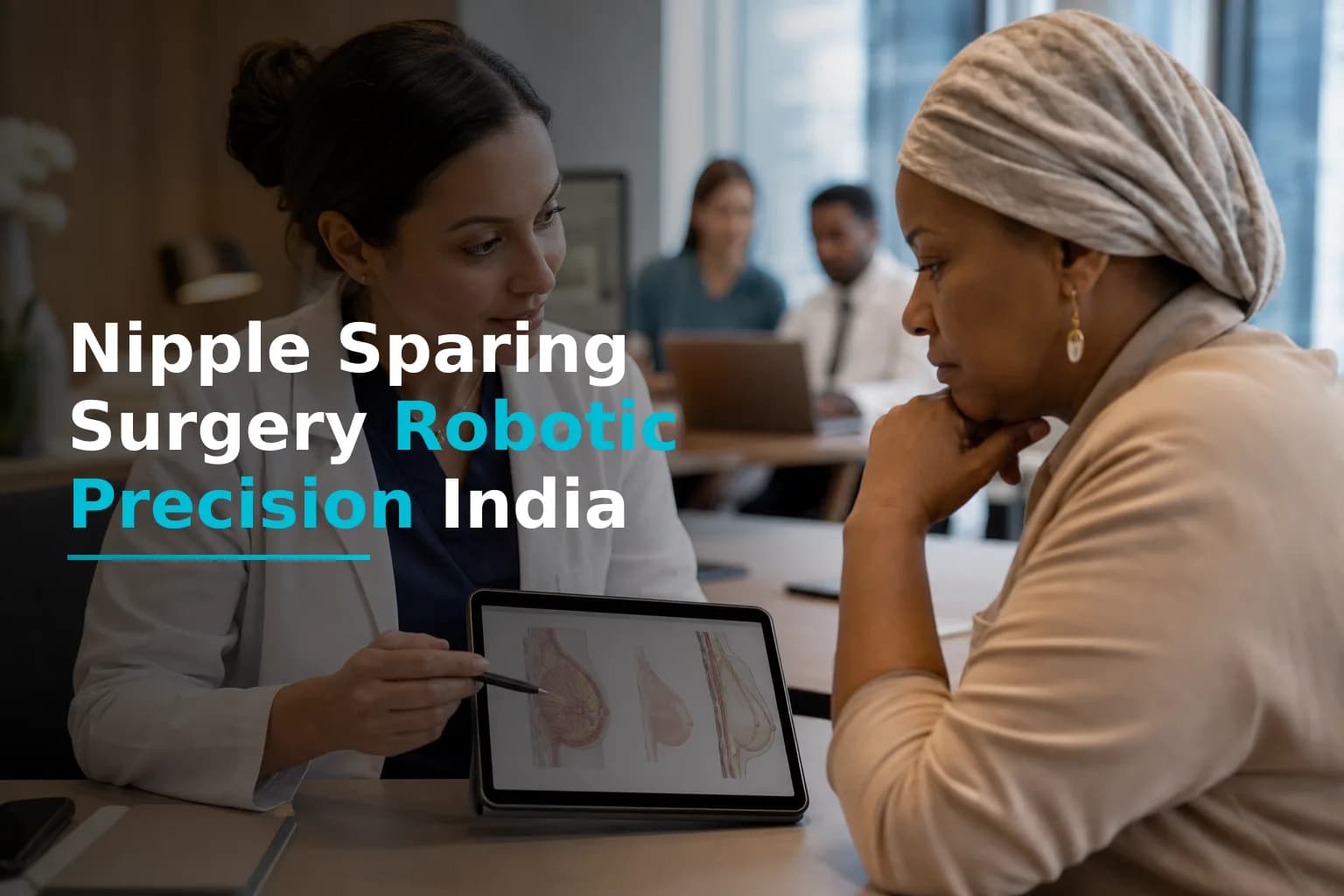
A standard mastectomy removes the breast tissue, the nipple, and the areola - the darker skin surrounding the nipple. A nipple-sparing mastectomy removes the breast tissue beneath the skin but leaves the nipple and areola in place, provided the cancer has not reached them. The surgeon takes a small biopsy of tissue directly beneath the nipple at the time of surgery to confirm there are no cancer cells present. If cancer cells are found there, the nipple is removed for safety.
Cancer Research UK explains that breast reconstruction after mastectomy can use implants or a patient's own body tissue, such as tissue from the back or abdomen. Keeping the natural nipple and the skin envelope can produce a result that looks and feels much closer to a natural breast than a mastectomy that removes the nipple entirely.
Where Does Robotic Technology Fit In?
Robotic-assisted surgery uses a system of thin robotic arms controlled by a surgeon at a console. Small incisions - often hidden in the armpit or the natural fold beneath the breast - allow instruments to reach the breast tissue with precision. The surgeon views a magnified, three-dimensional image of the operating area during the procedure. There is no independent robot. The surgeon remains in full control at all times.
For nipple-sparing mastectomy, the robotic approach allows the surgeon to work through tiny incisions that are not visible on the front of the breast. This means the nipple, areola, and breast skin can be preserved without a large scar across the chest. A systematic review and meta-analysis published via the National Institutes of Health found that robotic nipple-sparing mastectomy was associated with reduced complication rates and reduced blood loss compared with traditional nipple-sparing mastectomy, though operating time was longer with the robotic approach. Robotic surgery is a tool - not a guarantee. The surgical team's experience matters as much as the technology.
Why Some Women Choose Nipple-Sparing Mastectomy With Robotic Reconstruction
The reasons women consider this approach usually fall into a few key areas.
- Body image and wellbeing. For many women, keeping the nipple matters. Research published in an international oncology journal found that nipple-sparing mastectomy may help with psychological wellbeing and body image, with higher patient satisfaction scores reported compared with nipple-removing mastectomy.
- Smaller, hidden scars. Because the robotic approach uses small incisions in discreet locations, visible scarring on the breast surface is minimal. Many women say this is an important factor in their decision.
- Faster return to daily life. Smaller incisions generally mean less tissue disruption. Some women who undergo robotic NSM report a faster return to light daily activities, though individual recovery times vary depending on the type of reconstruction and whether additional treatments are needed.
- Reconstruction in one procedure. When it works well, reconstruction - using an implant or the patient's own tissue - can be performed at the same time as the NSM. This may avoid a second surgery at a later date.
Is Nipple-Sparing Mastectomy Right for Everyone?
NSM is not suitable for every woman. Suitability depends on several factors that a surgical team will assess carefully. In general, NSM may be considered when the cancer does not involve the nipple or the skin of the breast, when the tumour is not positioned directly beneath the nipple, and when there is no sign of inflammatory breast cancer. Women with larger or more drooping breasts may find that NSM with implant-based reconstruction alone is less likely to achieve a good cosmetic result.
Your surgeon will consider your overall health, breast size and shape, cancer location, tumour size, and the results of your imaging and biopsy. If your doctor says NSM won't work for your case, it is reasonable to ask whether a second specialist opinion is worth seeking. Our guide for women told mastectomy is their only option explains how to approach a second specialist opinion and what questions to ask.
Robotic NSM vs Traditional Open Mastectomy: A Side-by-Side View
The table below compares the two approaches. Individual results always depend on the surgical team, the patient's specific anatomy, and the details of the cancer.
| Feature | Robotic Nipple-Sparing Mastectomy | Traditional Open Mastectomy |
|---|---|---|
| Nipple preserved | Yes - if no cancer involvement confirmed at biopsy | No - nipple is removed as standard |
| Incision location | Armpit or breast fold - not on the breast front | Typically across or around the chest |
| Visible scarring on breast | Minimal | More prominent scar on chest wall |
| Estimated blood loss | Generally lower in published studies | Higher in published comparison studies |
| Operating time | Typically longer | Typically shorter |
| Specialist training required | Steep learning curve - requires dedicated robotic training | Well-established, widely taught technique |
| Current UK availability | Limited to a small number of specialist centres | Available at most breast surgery units |
Sources: Comparison of robotic, conventional, and endoscopic nipple-sparing mastectomy with immediate prosthetic reconstruction (NIH, 2025); Robotic NSM complication rate meta-analysis (NIH).
Why Some UK Patients Are Exploring Treatment Abroad
The NHS provides high-quality breast cancer care across the United Kingdom. However, some women face challenges that lead them to consider private or international options. These include the following.
- Limited access to robotic NSM. Robotic nipple-sparing mastectomy is not yet widely available across the NHS or in many UK private hospitals. Women who specifically want this technique may find that specialist centres abroad have more experience and shorter waiting times for a first consultation.
- Treatment timelines. Some women feel that waiting several weeks or months for a surgical date is not right for their situation. This is a personal decision that should involve your NHS breast cancer team.
- Personalized surgical planning. At some international centres, patients receive a detailed individual consultation that reviews all imaging and pathology before any surgical plan is finalized. Women often feel more involved in the decision-making process.
- Specialist teams. Some specialist centres bring together oncological breast surgeons and plastic reconstructive surgeons who work as a joint team, focused on complex breast cases including robotic NSM with immediate reconstruction.
Choosing to travel for treatment is a big step. If you are considering it, stay in touch with your NHS team and make sure you know how you'll get care at home before you travel. Our comparison guide covering NHS, UK private, and international robotic surgery options can help you think through the questions you need to ask.
Why India Is an Option Worth Understanding
A growing number of UK women are looking at robotic breast cancer surgery in India. This is about getting specialist expertise while keeping quality high. Several factors explain this trend.
- High-volume specialist surgeons. Leading Indian cancer hospitals have breast cancer surgeons who have trained internationally and who perform robotic NSM with immediate reconstruction regularly. High surgical volumes help build the experience that matters for outcomes.
- Modern robotic technology. Top-tier Indian hospitals use the same robotic surgical systems as leading centres in Europe and the United States. Equipment is not the barrier it once was.
- English-speaking care teams. For UK patients, communication is rarely a challenge. Consultations, consent discussions, post-operative instructions, and medical summaries are provided in English.
- International patient services. Major Indian cancer hospitals have teams that support overseas patients with treatment coordination, local accommodation near the hospital, and preparation of follow-up care documents to share with the patient's GP and oncologist at home.
- Cost considerations. While clinical quality and surgical expertise should always be the primary reasons for choosing a centre, the cost of robotic NSM and reconstruction at a leading Indian private hospital is typically much lower than at a UK private hospital. This makes the option accessible to women who could not afford UK private rates.
What a UK Patient's Journey Looks Like
Every patient's pathway is different. But a typical journey for a UK woman exploring robotic NSM in India involves these steps.
- Online consultation. You share your medical reports - mammogram, biopsy report, MRI scan, PET-CT scan, and histopathology results - with the specialist team. A video consultation is arranged to review your case, answer your questions, and discuss whether you may be a good candidate for robotic NSM.
- Treatment planning. If you decide to proceed, the team creates a detailed, personalized surgical plan. You will know what type of reconstruction is planned, where incisions will be placed, and what the expected recovery involves before you commit to anything.
- Travel arrangements. The international patient team helps with practical logistics, including guidance on accommodation near the hospital and information about visa requirements for travelling from the UK to India.
- Surgery. Robotic NSM with immediate reconstruction typically takes several hours in theatre. You will remain in hospital for several days following surgery while the team monitors your recovery closely.
- Recovery in India. Most patients stay near the hospital for one to two weeks after surgery before they are medically cleared to fly. During this period the team manages wound care, drain removal, and any early post-operative concerns.
- Follow-up at home. A full medical summary, surgical report, and pathology findings are sent to your GP and oncologist in the UK. Your UK care team can then manage any additional treatment - such as radiotherapy or hormone therapy - and oversee your long-term recovery.
If a partner or family member is helping you with this decision, our caregiver guide for partners supporting someone through robotic breast cancer surgery may help them too.
What to Upload for a Personalized Assessment
If you would like to explore whether robotic nipple-sparing mastectomy with reconstruction may be suitable for your situation, you can upload the following reports for a specialist review:
- Mammogram report and images
- Biopsy or histopathology report
- MRI scan of the breast
- PET-CT scan (if one has been performed)
- Any existing surgical plan or oncologist's letter
- Current treatment plan or referral documents
A specialist will review your case and respond with a personalized assessment of whether robotic NSM may be appropriate for you, along with information about what a treatment pathway in India could look like for your specific situation.
A Specialist Perspective
Robotic nipple-sparing mastectomy is an important step forward in what can be offered to women who need mastectomy. The technique allows surgeons to remove breast tissue while preserving the nipple and skin, with incisions placed where they will not be visible on the front of the breast. For the right candidate, this may make a difference to how a woman feels about her body during and after treatment. The foundation is thorough assessment before surgery - confirming the cancer has not spread to the nipple and that the patient's anatomy suits the approach. At centres with good experience in robotic NSM and high procedure volumes, the evidence base continues to grow and the results are encouraging for selected patients.
When to Talk to Your Doctor
If you are considering nipple-sparing mastectomy - whether through your NHS team, a UK private centre, or a specialist hospital abroad - start by speaking with your oncologist or breast surgeon. Ask whether NSM has been considered for your specific case. Ask what reconstruction options are available to you and at what timing. Ask whether a joint consultation with a plastic surgeon would help. If you feel you need more information before making a decision, you can seek a second specialist opinion. This is major surgery and you deserve to feel confident in your path before you proceed.
This article is for general information and is not a substitute for medical advice. Always consult your oncologist or care team about your specific situation.