
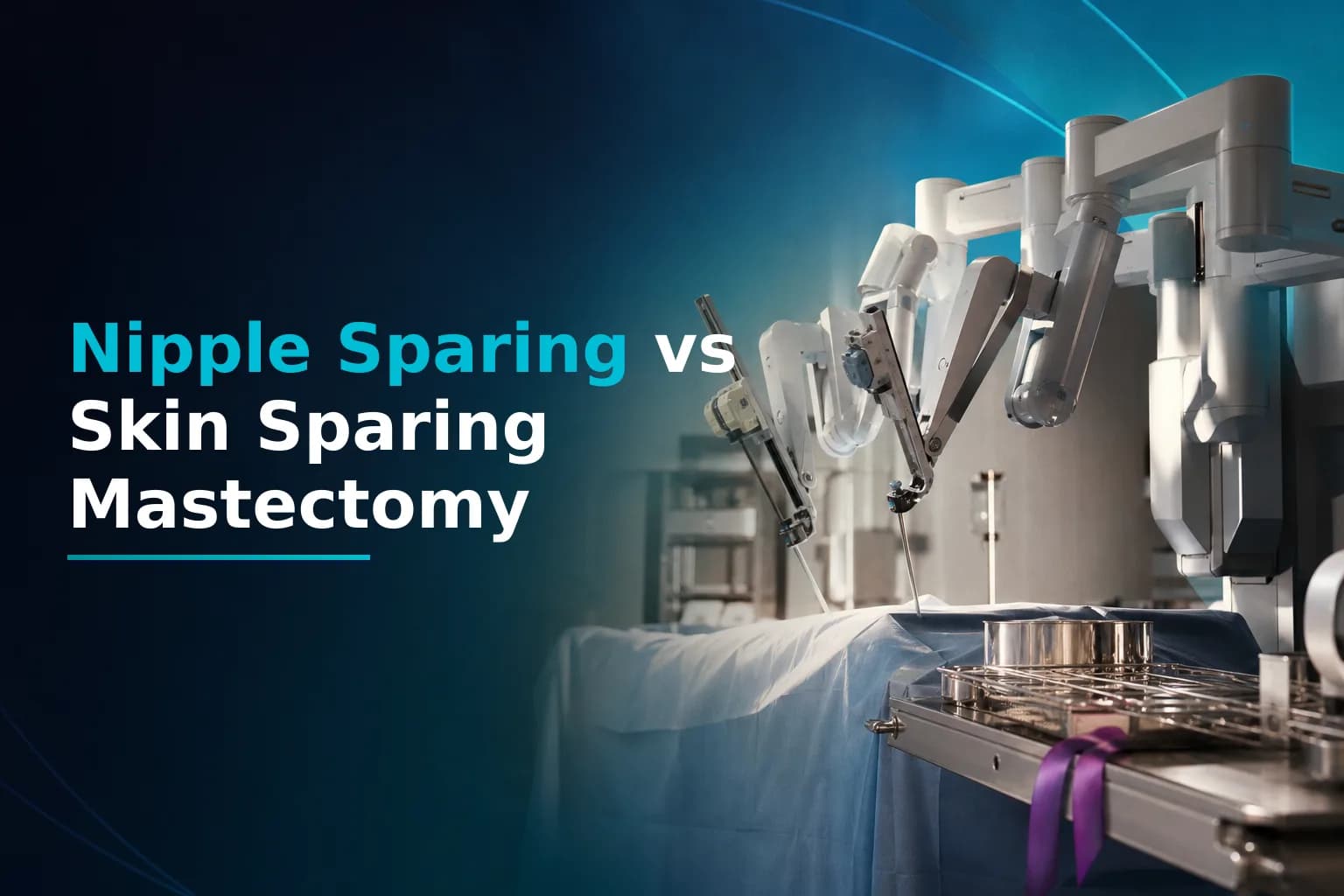
In brief: Nipple-sparing mastectomy (NSM) and skin-sparing mastectomy (SSM) have similar rates of local cancer recurrence when the right patient is chosen for each. The differences between them are mainly cosmetic and eligibility-based, not about cancer safety. Robotic surgery can be used for both approaches, allowing smaller hidden scars and, in NSM specifically, lower risk of nipple damage.
What Are Nipple-Sparing and Skin-Sparing Mastectomy?
When a surgeon removes all the breast tissue, one of the first decisions is how much outer breast skin to keep. Both NSM and SSM keep the breast skin envelope intact so that reconstruction - whether with an implant or your own tissue - looks natural afterwards.
In a skin-sparing mastectomy, the surgeon removes all breast tissue along with the nipple and areola (the dark ring of skin around the nipple). The rest of the breast skin stays. A reconstruction is then placed inside that skin pocket on the same day or shortly afterwards.
In a nipple-sparing mastectomy, the surgeon goes one step further. All the breast tissue is removed, but the nipple and areola stay in place. When reconstruction follows right away, the result can look very close to your natural breast. This approach is only safe when the tumor is not near or touching the nipple.
Both procedures have been used for many years, but how surgeons perform them keeps changing. Robotic-assisted versions now allow the entire operation through a single small cut - often placed in the armpit or the fold beneath the breast - keeping the main chest area free of visible scarring. This is sometimes called a hidden-scar or minimal-access mastectomy.
How Do Nipple-Sparing and Skin-Sparing Mastectomy Compare?
| Factor | Nipple-Sparing Mastectomy (NSM) | Skin-Sparing Mastectomy (SSM) |
|---|---|---|
| What is preserved | Breast skin and the nipple-areola complex | Breast skin only; the nipple-areola complex is removed |
| Patient eligibility | Tumor well clear of the nipple; no nipple involvement; small to medium breast with limited droop | Broader eligibility; does not require the nipple to be disease-free |
| Local recurrence | Approximately 3.9% in comparative studies | Approximately 3.3% in comparative studies |
| Cosmetic result | Natural appearance; nipple stays in place | Good result with reconstruction; nipple rebuilt or tattooed later if wanted |
| Main complication risk | Nipple necrosis (tissue damage at the nipple site) | Standard skin-flap healing concerns; no nipple complication risk |
| Robotic advantage | Reduces nipple necrosis risk; hidden scar option in armpit or breast fold | Precise skin-flap dissection; smaller hidden incision option |
Local recurrence figures are from a systematic review comparing therapeutic NSM and SSM, published in the British Journal of Surgery (2019). No statistically significant difference was found between the two groups for local recurrence, disease-free survival, or mortality.
The main finding is clear: when the right patient is chosen, NSM and SSM have a similar risk of local cancer recurrence. The differences are cosmetic and eligibility-based. NSM gives the most natural-looking outcome; SSM opens the door to women whose tumor location or breast anatomy means the nipple cannot safely be kept.
Who Is a Good Candidate for Nipple-Sparing Mastectomy?
NSM is not suitable for every woman having a mastectomy. Your surgeon will consider several factors before recommending it.
- Your tumor is well clear of the nipple - typically at least 2 cm away on MRI or ultrasound imaging.
- There is no sign of cancer in the nipple or areola on imaging or clinical exam. During the operation, the surgeon usually takes a small piece of tissue from directly behind the nipple and sends it for immediate testing. If cancer cells are found, the nipple is removed and the procedure continues as an SSM.
- You do not have inflammatory breast cancer or Paget's disease of the nipple - a form of cancer that affects the skin of the nipple and areola.
- Your breasts are small to medium in size with little droop. Larger, heavier breasts put more tension on the blood vessels that supply the nipple, raising the risk of nipple necrosis - where tissue at the nipple site loses its blood supply and does not heal properly.
- You do not smoke heavily, and any long-term health conditions such as diabetes are well controlled before surgery.
Women with BRCA1 or BRCA2 gene variants who are having a risk-reducing mastectomy can often still be considered for NSM, provided the eligibility criteria above are met. Your surgical team and a genetic counselor can advise on the best approach for your situation.
Who Is a Good Candidate for Skin-Sparing Mastectomy?
SSM has a wider pool of eligible patients because the nipple does not need to be free of disease. It is often the preferred choice when:
- The cancer is close to or touches the nipple-areola complex, or cancer cells are found in the tissue behind the nipple during surgery testing.
- You have a larger or heavier breast where the risk of nipple necrosis would be high.
- You have had previous radiation to the chest, which can affect how tissue heals after surgery.
- You prefer to have a nipple reconstructed or tattooed at a later date as a separate procedure - some women like this staged approach because it gives them more control over the final appearance.
SSM still gives a good cosmetic result. The reconstruction sits inside your own skin, which means it tends to match your natural breast shape and sit naturally on the chest wall. The nipple can be built later using a small piece of local skin folded into shape, or created with specialist medical tattooing. Many women are pleased with this outcome.
Does Adding Robotic Surgery Change the Outcomes?
Robotic assistance does not determine whether you have NSM or SSM - that decision is based on your tumor position and anatomy. What it changes is how the surgeon reaches the breast and how visible the scar is afterwards.
In a conventional NSM or SSM, the incision runs around the areola or along the breast fold. In a robotic approach, a single cut of around 3 to 4 centimeters is placed in the armpit or another discreet site. A high-definition camera and tiny robotic instruments work through this opening, giving the surgeon a magnified view inside a small space under the skin. The breast tissue is removed without a large scar on the chest.
Research combining seven studies and 1,674 patients found that robotic NSM had fewer overall complications than conventional NSM. Nipple necrosis was significantly reduced in the robotic group, with an odds ratio of 0.54 (p=0.03). Blood loss was also lower by approximately 53 ml on average, though the operation took around one hour longer. For most patients, a longer operating time is worth it for a smaller scar and less nipple damage risk.
Lower nipple necrosis matters for NSM, where preserving blood flow to the nipple is one of the key technical challenges. The robotic technique allows more precise dissection close to the nipple without the pulling and tension that can come with a conventional open approach.
For more on what robotic mastectomy can and cannot offer, see our article on what robotic breast surgery can and cannot do.
What About Reconstruction After Each Procedure?
NSM and SSM are almost always paired with immediate reconstruction - on the same day or very shortly after. Your reconstruction plan may influence which mastectomy approach suits your body and your goals.
After NSM, the natural nipple is already there, so the reconstruction focuses on filling and shaping the skin envelope. Both implant-based and tissue-flap options work well in this setting. The retained nipple and skin tend to give a natural contour without further procedures.
After SSM, the same implant or flap choices are available. The nipple is absent, so if you want one, it is built at a later stage - usually three to six months after the main surgery, once the reconstructed breast has settled into its final shape. This staged approach allows the nipple to be positioned accurately. Nipple reconstruction adds a short recovery period but is a relatively minor procedure compared with the main surgery.
Research found that women who had NSM followed by immediate reconstruction reported better body image and aesthetic satisfaction than those who had SSM. However, both groups felt much better than women who had mastectomy without reconstruction. Crucially, the review found no significant difference in major complication rates between NSM and SSM when results were pooled across multiple studies.
For a detailed look at implant-based versus tissue-flap options after robotic mastectomy, see our article on implant vs autologous reconstruction after robotic mastectomy.
Does the Choice Affect Your Cancer Safety?
Most women ask this first. Here's the answer.
The review in the British Journal of Surgery found local recurrence rates of 3.9% for NSM and 3.3% for SSM, with no statistically significant difference between the two groups. Five-year disease-free survival and mortality were also comparable. Both NSM and SSM are full mastectomies - all breast tissue is removed in both procedures - so neither leaves breast tissue behind.
A 2023 review of 17 studies with 7,107 patients looked at NSM for breast cancer. The weighted mean local recurrence rate was 5.4%, and recurrence specifically at the nipple-areola complex occurred in approximately 1.3% of cases. The authors concluded that NSM is oncologically safe in carefully selected patients.
The word "carefully" matters here. If testing during surgery finds cancer cells behind the nipple, the surgeon removes it right then. If pre-operative imaging suggests the tumor is too close to the nipple, the team may recommend SSM from the start. This is not a failure - it's the safety check that keeps recurrence low and explains why NSM outcomes are good when patient selection is rigorous.
Both NSM and SSM are types of mastectomy. If you are at an earlier stage in your decision and still weighing mastectomy against breast-conserving surgery (lumpectomy), that is a different conversation. Ask if lumpectomy is an option before assuming you need a mastectomy.
What UK Patients Need to Know About Access
Both NSM and SSM are available through NHS breast cancer services and UK private hospitals. Conventional versions of each procedure are widely offered. However, robotic-assisted NSM and SSM are available at only a few specialist centers in the UK, and waiting times for robotic surgery can be much longer than for conventional open mastectomy. If timing matters to you - or if you want a surgeon who has performed a large volume of robotic NSM cases - it may be worth reviewing your options before committing to a plan.
You can arrange a confidential review of your reports by Art of Healing Cancer, whose surgical team has experience in robotic breast cancer surgery and can advise on whether NSM or SSM is right for you and where specialist robotic expertise is available.
More UK women are traveling to India for robotic breast cancer surgery. Specialist breast units there offer high-volume robotic NSM and SSM programs, with shorter waiting times and costs that are typically a fraction of UK private rates. Our guide on nipple-sparing mastectomy and robotic reconstruction for UK patients in India covers the practical steps involved, including how to coordinate follow-up care with your NHS or private team when you return home.
When to Talk to Your Doctor
Talk to your breast surgeon about NSM versus SSM before your surgical plan is set. Ask if your tumor and breast shape make nipple-sparing surgery possible, and whether robotic assistance is available at your center. If you have already been given a recommendation and want a second perspective, getting a second opinion from a surgeon experienced in robotic NSM is fine and won't slow your treatment.
This article is for general information and is not a substitute for medical advice. Always consult your oncologist or care team about your specific situation.