
If you've recently been diagnosed with breast cancer and are researching surgical options, you've probably heard about robotic breast surgery. It can produce smaller scars, preserve the nipple, and allow faster recovery. These results are possible for the right patient. But robotic breast surgery outcomes are more complex than the headlines suggest.
The technique works well for some things. Other things - like nipple sensation, perfect symmetry, and the natural feel of your original breast - no surgery can reliably restore. Understanding this difference before you decide is important for you.
Quick answer: Robotic breast surgery, particularly robotic nipple-sparing mastectomy, may reduce visible scarring, preserve the nipple and surrounding skin, and lower certain surgical risks compared with conventional open approaches. It cannot guarantee normal nipple sensation, perfect symmetry, or the natural feel of your original breast. The final cosmetic outcome depends on your reconstruction technique, body type, and how you heal.
What does robotic breast surgery actually involve?
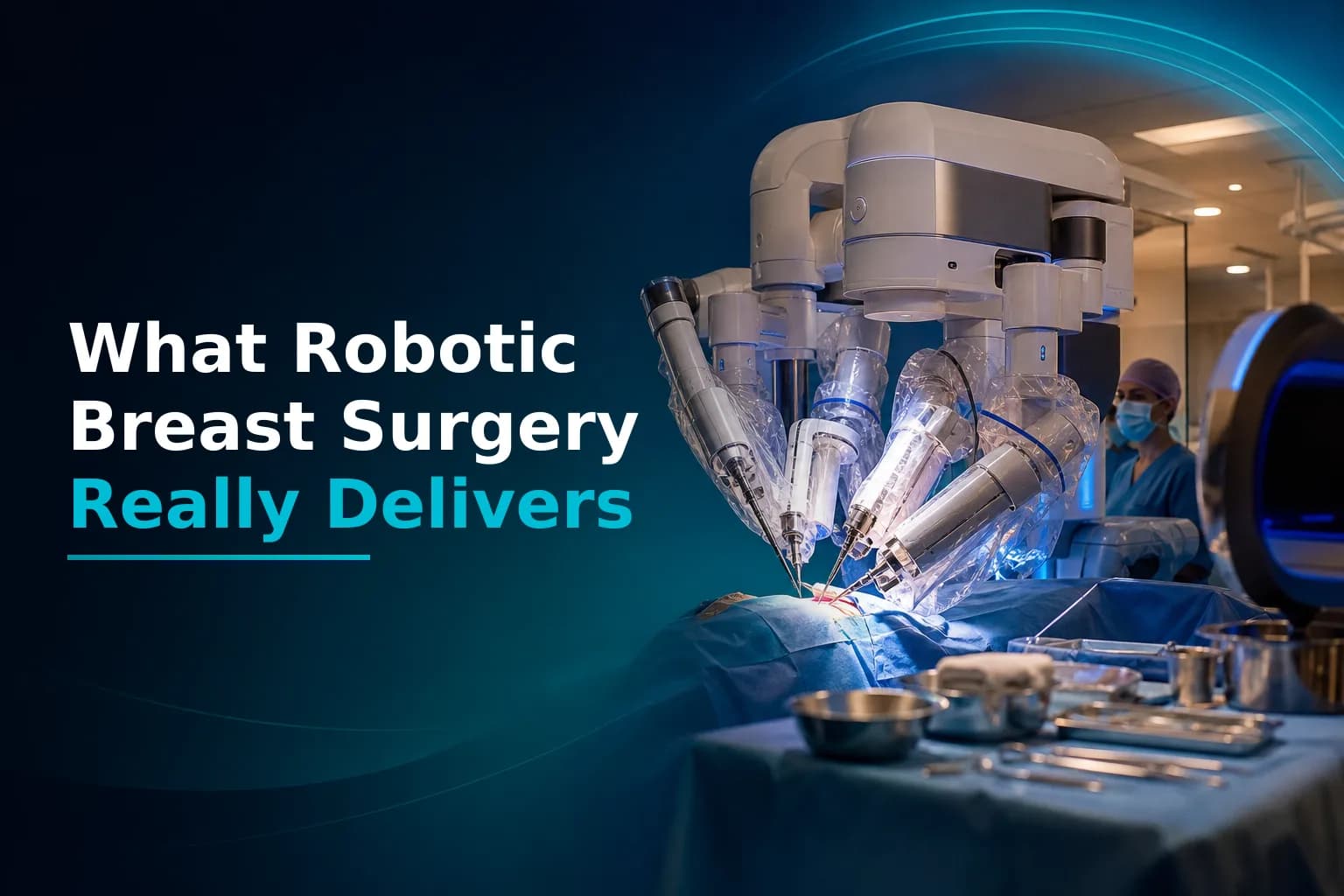
In robotic breast surgery, the surgeon uses small incisions, usually hidden in the armpit or along the breast fold, instead of making a long cut across the breast. A robotic system, controlled by the surgeon from a nearby console, holds small instruments and a 3D camera inside the breast.
The most common robotic approach is robotic nipple-sparing mastectomy (RNSM). The surgeon removes the breast tissue but leaves the nipple, areola, and skin intact. This provides a good foundation for reconstruction. When a woman is a good candidate, the result can look much more natural than conventional mastectomy.
The robotic system doesn't work on its own. It amplifies and refines the surgeon's movements, reduces hand tremor, and magnifies the area more than the human eye can. Your surgeon's skill and experience are still the biggest factor in your outcome.
What can robotic breast surgery achieve - and what are its limits?
| Outcome area | Robotic nipple-sparing mastectomy | Conventional open mastectomy |
|---|---|---|
| Scar placement | Incision usually hidden in the armpit or breast fold; minimal visible scarring on the chest wall | Incision runs across the breast; scar visible on the chest wall when undressed |
| Nipple and skin preservation | May preserve the nipple-areola complex when eligibility criteria are met and tumor position allows | Possible with open nipple-sparing technique; depends on tumor location and surgical assessment |
| Nipple sensation after surgery | Often reduced or absent; some partial return reported in early research - not guaranteed for any individual | Often reduced or absent; improvement is variable and may not return for many women |
| Surgical precision | 3D magnification and tremor-filtered instruments may allow more precise tissue handling near the nipple | High precision achievable by experienced surgeons; standard visualization without 3D magnification |
| Short-term cancer safety | Current published evidence suggests outcomes comparable to conventional approaches | Well-established evidence base spanning many years; the benchmark for comparison |
| Reconstruction and final appearance | Mastectomy creates the skin envelope; reconstruction shapes the final result and is a separate step | Same principle applies; reconstruction is planned separately or simultaneously regardless of mastectomy technique |
Sources: Postoperative complications and surgical outcomes: robotic versus conventional nipple-sparing mastectomy, meta-analysis (PMC 2024); What to expect after breast reconstruction, Macmillan Cancer Support.
The clearest advantage of the robotic approach is scar placement. A conventional mastectomy leaves a scar across the chest wall that is visible when undressed. Robotic nipple-sparing mastectomy can move that scar to the armpit or another discreet site. What the table also shows is that neither approach can guarantee the return of nipple sensation - a point worth examining in detail below.
What can robotic breast surgery reliably deliver?
Scar placement and concealment. The clearest advantage in published evidence is where scars are placed. With conventional mastectomy, the incision typically runs across the front of the chest. With robotic nipple-sparing mastectomy, the main incision is usually in the armpit or along the breast fold. It's shorter and hidden. For women who want privacy in changing rooms, at the pool, or in intimate moments, this can make a real difference.
Nipple and skin preservation. When a woman is a good candidate, robotic nipple-sparing mastectomy removes the breast tissue but leaves the nipple-areola complex and overlying skin intact. A 2024 meta-analysis published in PubMed Central found that robotic nipple-sparing mastectomy has complication rates similar to conventional nipple-sparing mastectomy, with better scar hiding.
Precision in the operating field. The robotic system provides high-definition 3D viewing and instruments that reduce the natural movement in a surgeon's hands. This may allow more careful work close to the skin and around the nerves that supply the nipple.
Comparable cancer safety in current evidence. Short-term cancer outcomes with robotic nipple-sparing mastectomy appear similar to conventional approaches, according to an evidence review from Mayo Clinic. Researchers are still collecting longer-term data.
What can robotic breast surgery not guarantee?
Normal nipple sensation. This is the biggest expectation gap. Many women think that because the nipple stays in place, it will feel and respond like before. But removing the breast tissue also removes many of the nerves that supply the nipple. Even with very careful surgery, the nipple and reconstructed breast usually feel different. Breast Cancer Now says numbness or changed sensation is common after reconstruction, and many women don't fully recover it.
Perfect symmetry. If you're having surgery on one breast only, matching the other side is a real challenge. The reconstructed breast may look different in certain positions, with certain clothes, or after weight changes. A second balancing procedure is sometimes discussed later, but that's a separate choice.
A fully natural feel. Implant-based reconstruction creates shape but feels different from natural tissue. Autologous reconstruction, which uses your own tissue from the belly or back, feels softer and more natural over time. But it's a longer and more complex surgery with a different recovery. Neither option feels exactly like your original breast.
Scar elimination. Robotic surgery makes scars less visible and shorter, but doesn't eliminate them. You'll have scars at all incision sites. How they heal depends on your skin type, genetics, aftercare, and whether you need radiation. Our guide on scar healing after robotic breast cancer surgery covers what to expect at each stage of recovery.
Will I lose nipple sensation after robotic mastectomy?
Loss of sensation in the nipple and breast is a major change after mastectomy, whether robotic or conventional. It's important to understand this before you choose a surgical plan.
During a nipple-sparing mastectomy, the nerves running through the breast tissue to the nipple are cut when that tissue is removed. The nipple stays, but loses many of its nerves. Some women regain partial sensation over months or years. Others have permanent numbness or an altered feeling.
A technique called nipple neurotisation, where surgeons reconnect nerves during reconstruction, may restore some sensation in some patients. Results vary, and it's not standard practice everywhere. If sensation is important to you, ask your surgical team if they offer this or can refer you to someone who does.
Robotic approaches may help with sensation because the main incision isn't at the nipple. The surgical path can be less disruptive to nearby structures. Early research is promising, but don't expect sensation to be preserved in any predictable way. Talk directly with your surgeon about your individual anatomy and what to expect.
Who is a realistic candidate for robotic nipple-sparing mastectomy?
Not every woman with breast cancer is suitable for robotic surgery. This matters because the best cosmetic results happen when the technique is matched to the right patient.
Robotic nipple-sparing mastectomy usually works best for women whose tumor isn't directly under the nipple or attached to it, with no involvement of the skin, and whose breast size and shape fall within certain ranges. Smaller to medium-sized breasts with little sagging are usually better suited. Active smoking, uncontrolled diabetes, and very high BMI may increase complications, and surgeons consider these factors individually.
It's also used for risk-reducing mastectomy in women with BRCA gene mutations or a very strong family history of breast cancer, to prevent cancer rather than treat it.
Inflammatory breast cancer, tumors directly involving the nipple (Paget's disease), or imaging showing nipple-areola complex involvement rule out a nipple-sparing approach, regardless of surgical technique.
Your surgical team will review your imaging, pathology, and anatomy before recommending an approach. For details about who qualifies, see our guide to who is a candidate for robotic breast cancer surgery.
How does reconstruction shape the final cosmetic result?
Robotic mastectomy and breast reconstruction are two separate steps, and the final cosmetic result depends on both.
Mastectomy removes the breast tissue. Reconstruction fills and reshapes the space. Your choice of reconstruction - implant-based or autologous (your own tissue) - significantly affects how the result looks and feels, now and over time. Our guide to implant vs autologous reconstruction after robotic mastectomy walks through the key trade-offs in plain language.
Macmillan Cancer Support says it can take several months for a reconstructed breast to heal and settle, and for scars to fade. Physical and sexual well-being may change after surgery, but both often improve with time.
Before you commit to a surgical plan
If you're weighing your options - which technique is best, where to get it, and what's realistic for your situation - an independent clinical review before surgery can be valuable. Some women in the UK find their initial plan doesn't include robotic or nipple-sparing options because they're not available locally or candidacy wasn't fully explored. A second opinion can reveal options you didn't know about.
You can get a second opinion from the Art of Healing Cancer team before committing to a surgical plan - they offer a remote review of your pathology and imaging to help you understand which robotic techniques may work for your case, with female surgical coordinators available.
When you meet with a surgical team, bring your imaging reports and pathology results. Ask how many robotic nipple-sparing mastectomies they do each year. Ask if you can speak with a nurse coordinator or a patient who's had the procedure. It's reasonable to ask to see results from patients with similar anatomy.
When to talk to your doctor
Talk to your breast surgeon or breast care nurse if you haven't received a clear explanation of which surgical approaches you're eligible for and why. Ask about cosmetic and functional outcomes for your tumor type and anatomy. If you feel uncertain about your plan, requesting a second opinion is normal and supported in UK breast cancer care.
This article is for general information and is not a substitute for medical advice. Always consult your oncologist or care team about your specific situation.