
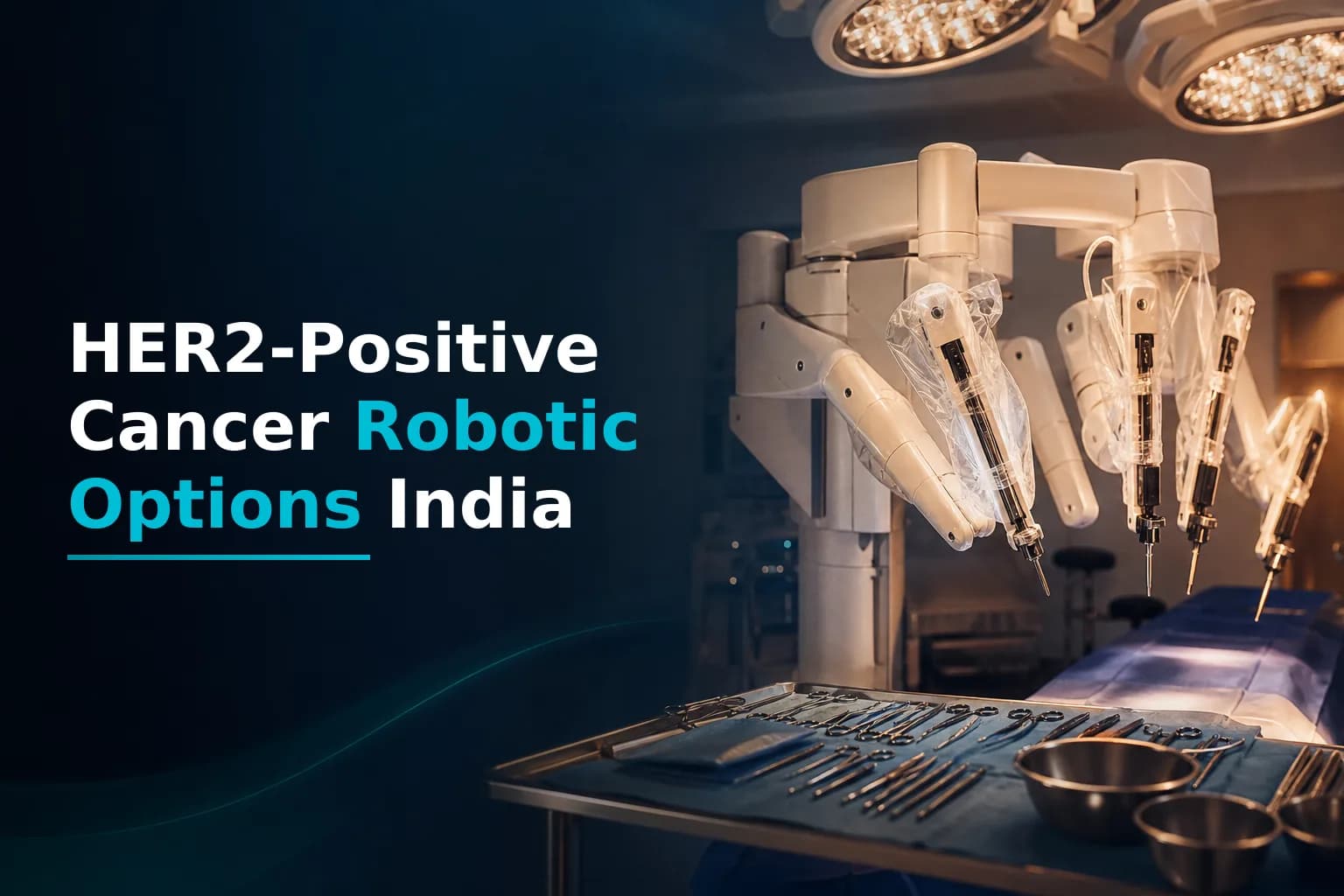
HER2-Positive Breast Cancer and Robotic Surgery in India
A diagnosis of HER2-positive breast cancer brings a lot of information at once. Your oncologist may mention targeted drug therapy, neoadjuvant chemotherapy, surgical margins, and reconstruction - sometimes all in the same appointment. One important question is: what happens to your breast?
If you are a woman in the UK who has recently been diagnosed with HER2-positive breast cancer, this guide explains what your HER2 status means for surgery, why breast-conserving surgery may be possible when you might not expect it, and how robotic surgical techniques available in India allow smaller scars and faster recovery.
What does HER2-positive mean for your surgery options?
HER2 stands for human epidermal growth factor receptor 2. Some breast cancer cells have this protein on their surface. It signals cancer cells to grow and divide more rapidly. According to the American Cancer Society, around 15 to 20 percent of invasive breast cancers are HER2-positive. Breast Cancer Now explains that your HER2 status is determined through your pathology report after a biopsy, and it directly shapes which treatments you will be offered.
HER2-positive cancers grow more quickly than hormone-receptor-positive cancers. Doctors historically recommended mastectomy more often for HER2-positive cancer. However, targeted anti-HER2 drug therapy - treatments that work against HER2-driven cancer cells - has significantly changed treatment options. Cancer Research UK notes that these therapies have significantly improved outcomes for HER2-positive breast cancer. These drugs can shrink tumors substantially before surgery. This shrinkage allows some women to have breast-conserving surgery instead of mastectomy.
Understanding your full pathology report - including your hormone receptor status, tumor grade, lymph node findings, and HER2 result - matters for any surgical decision. Our guide on what your breast cancer pathology report means for surgery explains each result and what it means for your options.
Is breast-conserving surgery safe for HER2-positive breast cancer?
Breast-conserving surgery (sometimes called lumpectomy or wide local excision) removes the tumor and tissue around it, leaving the rest of the breast. For many years, doctors recommended mastectomy for most women with HER2-positive breast cancer because these cancers grow so quickly. Treatment options have changed.
A study published via PubMed Central (NIH) followed patients with early-stage HER2-positive breast cancer through pre-surgery drug treatment. It found that breast-conserving surgery had the same long-term survival rates as mastectomy, and better rates in some groups. Another study published on PubMed (NIH) used matching methods to compare groups fairly. It found that breast-conserving surgery may offer a survival benefit for most women with early-stage HER2-positive breast cancer.
A review published on PubMed (NIH) looked at surgery after anti-HER2 drug treatment for advanced HER2-positive breast cancer. The authors found that patients who responded well to drugs before surgery could usually have breast-conserving surgery. They said mastectomy should be reserved for specific cases, like when lumpectomy leaves cancer at the edges.
Breast conservation is not right for everyone. It depends on tumor size, whether cancer is in one area or multiple areas, skin or nipple involvement, and whether you carry BRCA1 or BRCA2. But current evidence shows many women who are initially told they need mastectomy can actually have breast-conserving surgery, especially after responding well to drug treatment first.
How does robotic technique change your breast-conserving options?
Robotic breast surgery uses a surgeon-controlled system (usually da Vinci) where the surgeon works from a console with 3D magnified vision. Tiny robotic instruments go through one or two small cuts, usually hidden under the arm or along the breast fold. This causes less scarring, less tissue damage, less bleeding, and usually shorter hospital stays than traditional open surgery.
For women with HER2-positive cancer who can have breast-conserving surgery, robotic lumpectomy removes the tumor and surrounding tissue with precise 3D vision. For women who need mastectomy, robotic nipple-sparing and skin-sparing techniques keep the natural breast skin for reconstruction, producing better results than traditional open mastectomy. Our guide on what robotic breast surgery can and cannot do explains what robotic techniques can and cannot do.
Robotic breast surgery is not routinely available on the NHS. UK private practice offers it at a few specialist centers. In India, major cancer hospitals offer robotic breast surgery routinely, including robotic lumpectomy, robotic nipple-sparing mastectomy, and robotic-assisted reconstruction.
How does robotic breast conservation in India compare to UK options?
| Factor | Robotic surgery in India | UK Private (conventional) | NHS |
|---|---|---|---|
| Robotic technique availability | Widely available at specialist cancer hospitals in major cities | Available at a small number of specialist centres; not universal | Not routinely offered; conventional open surgery is standard |
| Nipple- and skin-sparing options | Available for suitable candidates at experienced robotic centres | Available at select centres; not standard practice | Limited; depends on local surgical expertise and individual case |
| Time from inquiry to surgery | Typically within a few weeks at major centres | Varies by centre; enquire directly | Subject to NHS cancer pathway waiting times |
| Female surgeon or coordinator | Available on request at most specialist hospitals | Depends on centre staffing; cannot always be guaranteed | Depends on NHS allocation; not always requestable |
| Approximate cost | Significantly lower than UK private; request a written quote | Varies widely; request a written quote from your chosen centre | Covered for NHS-eligible patients |
| Post-surgery UK follow-up | Requires coordination back to your UK oncologist; manageable with early planning | Coordinated within your UK private team | Coordinated within the NHS pathway |
Cost row: no specific figures are given because costs depend on individual case complexity, the hospital, and the procedures involved. Request a detailed written quote from any centre you are considering. For a detailed cost comparison, see our article on what UK women really save on robotic breast surgery in India.
The main point is simple: women with HER2-positive cancer who want robotic breast-conserving surgery have more options in India than in the UK. The trade-off is coordinating your UK drug therapy and radiation therapy around your surgery abroad. With good planning, this is manageable.
How does anti-HER2 drug therapy affect surgical timing?
HER2-positive cancer almost always needs anti-HER2 drug therapy alongside or after surgery. Many women get drug treatment before surgery to shrink the tumor first. This affects both when you have surgery and whether you can have breast-conserving surgery.
If pre-surgery drug treatment is recommended, it usually takes several months. Women whose tumors shrink significantly on imaging can often have breast-conserving surgery, even if mastectomy seemed necessary at first. Our article on whether your breast cancer needs chemotherapy first explains whether you need drug treatment first and what it means for your surgery timing.
For women considering travel to India for robotic surgery, one common sequence is: drug treatment in the UK; robotic breast surgery in India; return to the UK for more drug therapy, radiation, and follow-up. Our guide on splitting your breast cancer care across two countries covers how this coordination works in practice and what your UK oncologist will need from the surgical team in India.
What does travelling to India for robotic breast surgery actually look like?
Major cancer hospitals in India have robotic breast surgery programs. Surgeons at these centers do many breast procedures - and volume matters. Centers that do a lot of breast surgery are usually better at complex cases and precise robotic techniques.
The process starts before you travel. You send your biopsy report, breast imaging (mammogram, ultrasound, and MRI if available), and staging scans to the surgical team for review. If you are a good candidate, the team plans the surgery and advises on timing with your drug therapy. Robotic breast surgery usually means one to three days in the hospital, and most women can fly home within two to three weeks, depending on recovery.
Many UK women ask about privacy and the gender of their care team. Good hospitals in India that treat international patients can arrange a female surgeon and female coordinator. If this matters to you, tell the hospital when you first contact them.
Who is the right candidate for this approach?
Robotic breast-conserving surgery in India works best for women with early-stage single-site HER2-positive cancer where doctors can achieve good surgical margins without a high-risk BRCA mutation. Women whose tumors have shrunk significantly from pre-surgery drug treatment are usually the best candidates.
Robotic surgery is not right for everyone. If cancer is in multiple areas, involves the skin, or if mastectomy is medically better, a good surgeon will tell you clearly. An honest assessment of what you can and cannot have shows a trustworthy team.
If you have been told mastectomy is your only option and want another view, a second opinion is smart and encouraged in good cancer care. If you would like to consult the Art of Healing Cancer team before committing to a UK surgical plan, a confidential review can be arranged using your existing reports. No new tests or appointments are needed.
If you are ready to explore robotic breast-conserving surgery in India for your situation, submit an inquiry through the contact form at BreastCancer.One and request a female coordinator. The team will review your reports and give you an honest assessment of your options.
When to talk to your doctor
Talk to your oncologist or breast surgeon if you do not understand what your HER2 status means for surgery, if you want to know whether pre-surgery drug treatment could help you have breast-conserving surgery, or if you are thinking about a second opinion. If you explore robotic surgery abroad, bring your pathology report, all breast imaging, and a summary letter from your UK team so the surgeon has a complete picture.
This article is for general information and is not a substitute for medical advice. Always consult your oncologist or care team about your specific situation.