
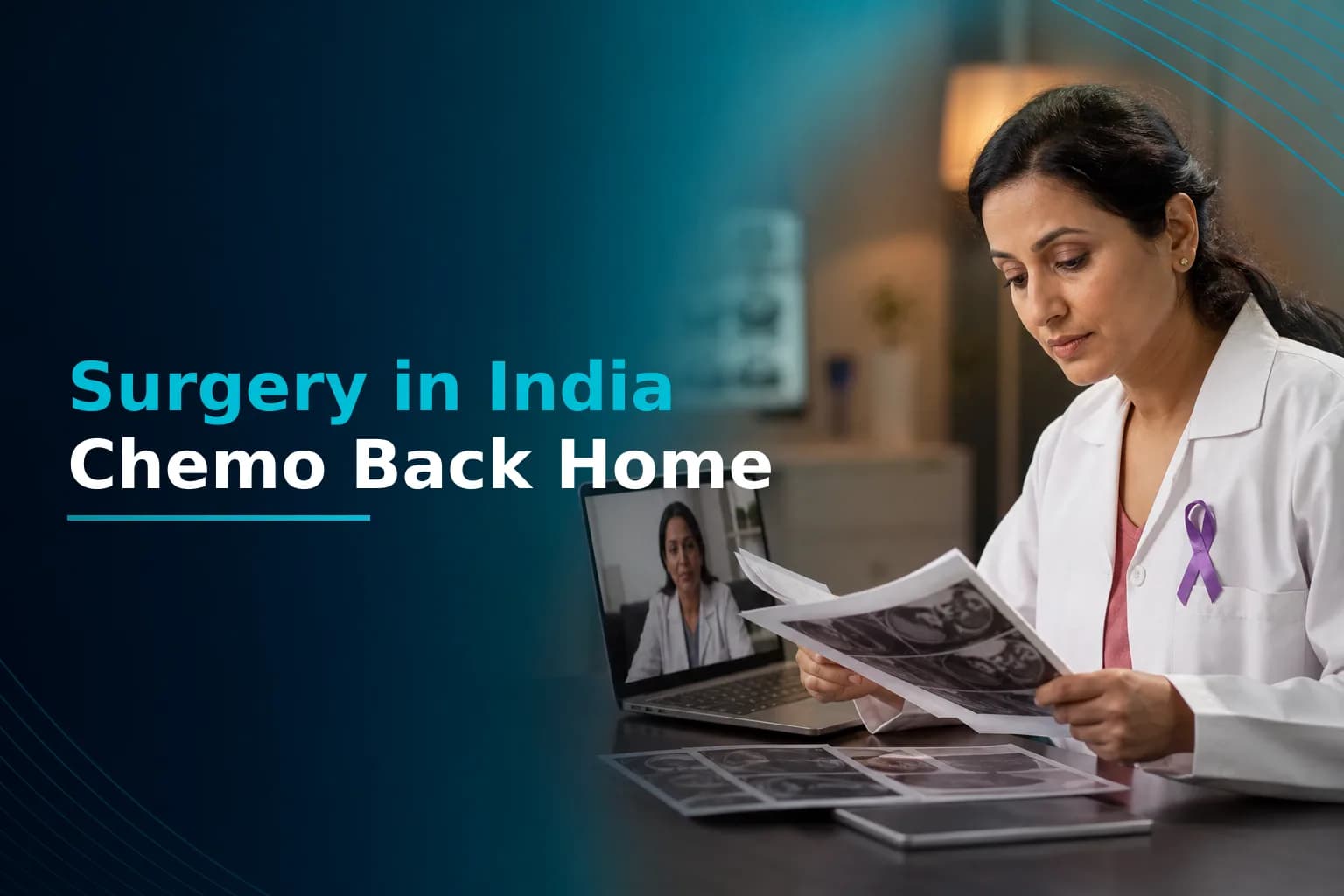
Splitting Your Breast Cancer Care Across Two Countries: How to Coordinate Surgery in India with Chemo and Radiation in the UK
You can have robotic surgery in India and receive chemotherapy or radiotherapy at home. Some UK women choose this path. With careful planning, it can work well. This guide covers timing, practical steps, and what to discuss before you travel.
How does splitting your breast cancer care compare to keeping everything in the UK?
| What you are comparing | All care in the UK | Surgery in India, adjuvant treatment in the UK |
|---|---|---|
| Access to robotic breast surgery | Available at selected NHS and private centres; referral to a specialist unit is often needed | Robotic techniques available at specialist cancer centres in India; no referral waiting list |
| Time from diagnosis to surgery | Subject to NHS waiting times; the 62-day first-treatment target has not been consistently met for breast cancer since late 2020 (Breast Cancer Now) | Surgery can often be arranged within weeks of confirming candidacy, once UK pathology and staging reports are ready |
| Adjuvant chemotherapy | Delivered by your NHS or private oncology team in the UK | Delivered by your UK NHS or private oncology team - no change to this part of your care |
| Radiotherapy | Typically starts 6 to 8 weeks after surgery if no chemotherapy is needed (Cancer Research UK) | Same timeline applies once you are home; a CT planning appointment needs to be booked before you travel |
| Medical record transfer | Managed internally within NHS systems | Requires a planned transfer of surgical reports, pathology results, and imaging from India to your UK team before adjuvant treatment starts |
| Best suited for | Patients with timely access to a specialist robotic surgeon within an acceptable waiting period | Patients seeking robotic or minimally invasive techniques, faster surgical access, or specialist expertise not available locally - who still want adjuvant treatment close to home |
The key point: chemotherapy and radiotherapy are delivered in the UK regardless of where the surgery happens. What changes is where - and how fast - you have the operation. Keeping your adjuvant treatment at home means your oncologist, your GP, and your support network are all close by when you need them most.
Why do some UK women choose surgery in India?
Robotic breast surgery uses a specialized machine to let the surgeon work through very small cuts. This can mean less blood loss, a shorter hospital stay, and a smaller scar compared with open surgery. Some techniques, such as nipple-sparing mastectomy with a hidden-scar approach or robotic-assisted reconstruction, are available at only a handful of centres in the UK. For some women, a combination of waiting times and cost puts those centres out of reach.
Timing matters. Research published in BMC Cancer (2021) shows that for most breast cancer types, adjuvant chemotherapy works best when it starts within roughly 12 weeks of surgery. The study found the best outcomes when chemotherapy began at 31 to 60 days after the operation. Delays beyond 12 weeks are linked to worse outcomes, especially in triple-negative breast cancer. For women facing a long wait for surgery in the UK, having the operation sooner in India and starting chemotherapy promptly on return may help meet that window.
If you are weighing your options, consider speaking with your oncologist, particularly if you have been offered a conventional operation but would prefer a minimally invasive approach.
The timing window between surgery and adjuvant chemotherapy
This is the section you most need to read if you are considering split care.
After surgery, your body needs time to heal before chemotherapy can begin. Most women start adjuvant chemotherapy four to six weeks after their operation. Research through NIH PubMed Central shows that delaying the start of adjuvant chemotherapy beyond 12 weeks after surgery is linked with worse survival outcomes. That 12-week mark is the outer limit you and your UK oncologist need to plan around.
For split care to work, you need to leave enough time to:
- Recover from surgery in India and be declared fit to fly - typically two to three weeks after an uncomplicated robotic procedure (see our guide on when it is safe to fly home after robotic breast surgery in India)
- Travel back to the UK
- Attend your first appointment with your UK oncologist with your full surgical and pathology reports in hand
- Complete any blood tests or imaging your oncologist requests before starting chemotherapy
- Begin your first cycle of chemotherapy - ideally by week four to six after surgery, and certainly before week 12
This timeline is achievable with careful planning. It becomes much harder if complications arise and your recovery in India runs two or more weeks longer than expected. That is why having a clear contingency plan before you travel matters.
How radiotherapy fits into the plan
If you need both chemotherapy and radiotherapy, the standard approach is to complete chemotherapy first and then begin radiotherapy. Breast Cancer Now explains that if you are having chemotherapy after surgery, radiotherapy will usually start after you finish chemotherapy. If chemotherapy is not part of your plan, Cancer Research UK notes that radiotherapy typically begins six to eight weeks after surgery.
For women following a split-care path, radiotherapy planning appointments (called CT planning scans) need to be booked with your UK radiotherapy department. Ask for a provisional planning date before you travel so there is no unnecessary delay when you return. Let your surgical team in India know this date so they can time your discharge with it in mind.
For more details on how adjuvant chemotherapy and your wider care plan work together after surgery abroad, read our guide on chemotherapy timing and recovery coordination after robotic breast surgery.
A step-by-step guide to splitting your care
These steps assume you have confirmed that robotic surgery in India is the right path for you and that your UK oncology team knows you are planning to travel.
- Share your full UK diagnostic workup with the surgical team in India. This means your pathology report, receptor status (oestrogen, progesterone, HER2), tumour imaging, and any staging scans. A responsible surgical team will not accept a booking without these.
- Get a written surgical plan before you book flights. Ask the Indian surgical team to confirm in writing the proposed operation, the expected hospital stay, and their discharge criteria. This lets your UK oncologist review the plan and raise any concerns before you travel.
- Tell your UK oncologist you are going. Most oncologists want to know in advance because they need to plan your adjuvant treatment schedule around your surgery date. Bring the written surgical plan to this appointment.
- Book provisional adjuvant treatment appointments before you fly. Even a pencilled-in chemotherapy start date helps. Your UK team can adjust it once they receive the final pathology from India, but having a slot reserved means you are not starting from scratch when you return.
- Arrange for all surgical documents to be sent to your UK oncologist before you leave hospital in India. This includes the operation note, the final histopathology report, details of any lymph-node procedure, and your discharge summary. Electronic transfer is faster than post.
- Have a fit-to-fly assessment in India. Your surgical team should confirm in writing that you are well enough to travel. Airlines sometimes ask for this documentation, and it is essential for your travel insurance if a delay occurs.
- Attend your UK oncology appointment with all documents. Bring both printed and digital copies. Your oncologist will use the final pathology to confirm your chemotherapy regimen and may order a blood count before your first cycle.
For more on what to expect at follow-up appointments after returning, see our guide on coordinating your oncology follow-up after robotic surgery in India with your UK doctors.
Keeping your UK oncologist informed from the start
The biggest risk in split care is a communication gap between your surgical team in India and your medical team at home. You need to manage this actively.
Before you travel, ask your UK oncologist these questions:
- What pathology information do you need from the Indian surgical team before you can confirm my chemotherapy regimen?
- What is the latest date I can start chemotherapy while staying within the recommended window for my cancer subtype?
- Who at your department should the Indian surgical team contact if my operation changes in a significant way?
- Can you give me a named contact for questions while I am abroad?
Some UK oncology teams have experience with split-care arrangements. Others are less familiar with the logistics. If your team seems uncertain about how to coordinate international care, it may be worth getting a second opinion from a team with experience in this process.
What can disrupt your plan - and how to prepare
Complications after surgery are uncommon but they do happen. A seroma (a collection of fluid under the wound), a wound infection, or a delayed drain removal can extend your hospital stay in India. If your stay runs significantly longer than planned, you may need to adjust your UK chemotherapy start date. Build in buffer time: if your oncologist recommends starting chemotherapy at week five after surgery, and your planned return to the UK is week three, you have two weeks of cushion. If you plan to return at week five with chemotherapy booked for week six, there is almost no room for delay.
Travel insurance is essential. Make sure your policy covers in-patient care in India, medical repatriation if needed, and delays to your journey caused by medical reasons. Declare your cancer diagnosis and all planned procedures honestly when you apply. Policies taken out after a diagnosis require specific oncology cover - check this carefully before purchasing.
Macmillan Cancer Support notes that radiotherapy may be delayed if a wound has not fully healed or if a seroma is present. This applies whether surgery took place in the UK or abroad. Building enough recovery time into your plan protects your radiotherapy slot as well as your chemotherapy start date.
Is splitting your care right for you?
Split care tends to work well for women who:
- Want a robotic or minimally invasive surgical technique that is not readily available to them locally
- Are otherwise healthy and a good candidate for surgery followed by prompt travel home
- Have a UK oncology team who is aware of the plan and has confirmed the adjuvant treatment schedule
- Can arrange comprehensive travel insurance that covers the full clinical journey
- Have a support person who can travel with them or who will be available on their return
Split care is less suited to situations where surgical and medical oncology decisions are closely intertwined; for example, if there is uncertainty about whether neoadjuvant (before surgery) chemotherapy might be recommended first, or if staging is not yet fully confirmed. In those situations, having your whole team in one place during the decision-making phase is generally better.
If you want to explore whether this could work for you, you can contact BreastCancer.One for guidance.
When to talk to your doctor
Speak to your UK oncologist before making any firm booking for surgery abroad. Share the surgical plan you have received, ask for the chemotherapy timing window that applies to your specific cancer subtype, and confirm exactly what documentation you need to bring back. If you have not yet received your full pathology results (including your oestrogen-receptor, progesterone-receptor, and HER2 status), wait for those before setting a travel date.
This article is for general information and is not a substitute for medical advice. Always consult your oncologist or care team about your specific situation.