
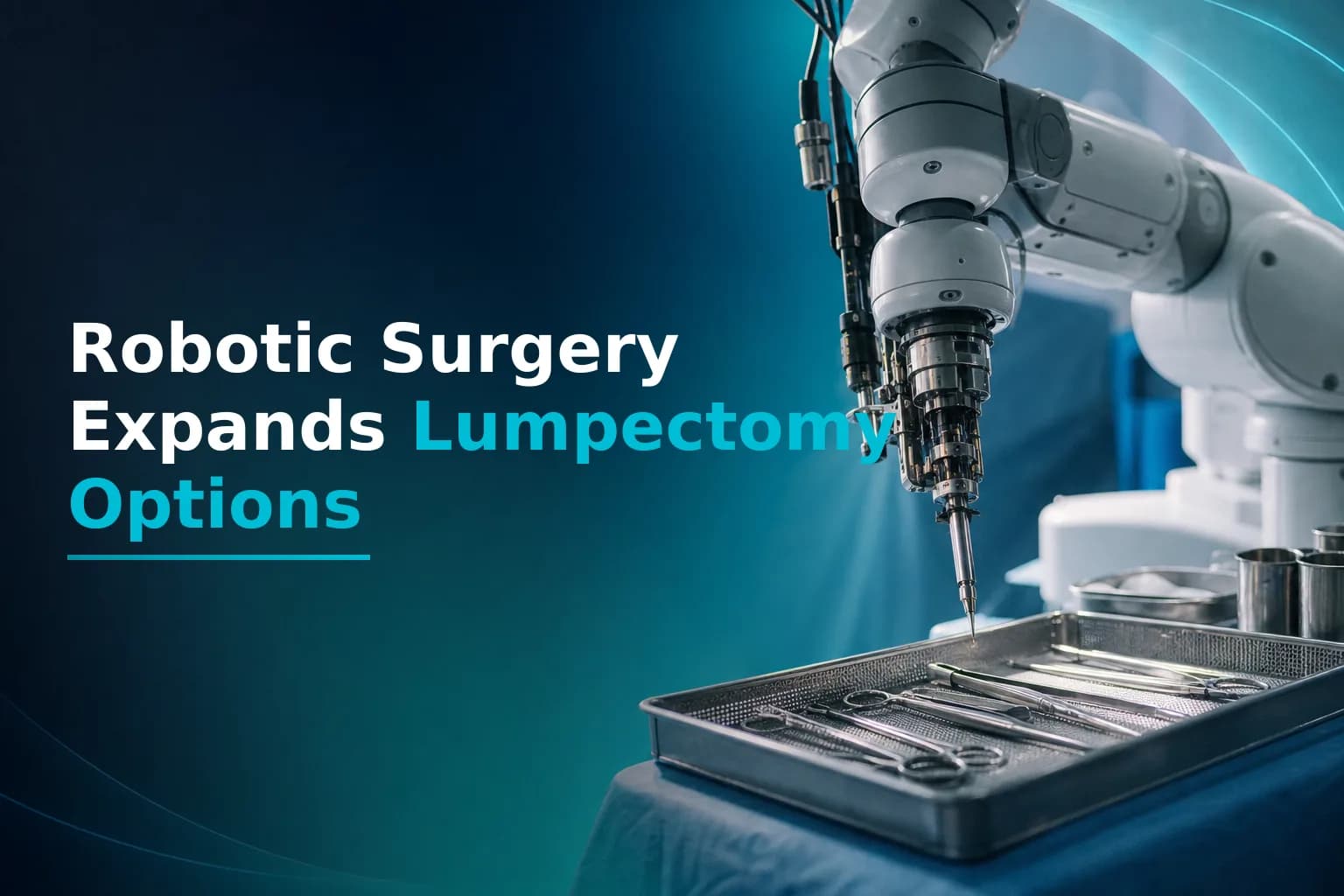
If your surgeon says your tumour is too large or awkwardly placed for a standard lumpectomy, you may be described as a borderline candidate for breast conservation. Robotic and oncoplastic techniques often re-open that door by combining precise tumour removal with reshaping of the remaining breast tissue.
What 'Borderline for Breast Conservation' Actually Means
Breast-conserving surgery - sometimes called a lumpectomy or wide local excision - removes the cancer while leaving most of the breast intact. For many women with early-stage breast cancer, studies show it is associated with the same long-term survival as mastectomy. A 2024 meta-analysis found that breast-conserving surgery with adjuvant radiotherapy was associated with comparable overall survival to mastectomy in early-stage disease, and in some analyses showed a survival advantage. (PMC, 2024)
But conservation is not straightforward for everyone. Surgeons consider several factors before recommending it. If one or more of those factors doesn't fit the standard pattern, you may be described as borderline - meaning conservation is not automatically ruled out, but it does present extra challenges.
The most common reasons a patient is considered borderline include:
- A tumour that is large relative to overall breast size
- A tumour in a technically difficult location - such as directly behind the nipple, or in the lower pole of the breast
- Multiple small tumours in the same breast
- Dense breast tissue that makes imaging and margin assessment harder
- A predicted tight surgical margin - meaning little healthy tissue separates the tumour from the skin or chest wall
Being described as borderline does not mean mastectomy is inevitable. It means a standard lumpectomy approach may struggle to achieve clear margins reliably, or may leave the breast looking noticeably deformed. Modern surgical techniques have shifted what borderline means in practice.
How Does Robotic or Oncoplastic Lumpectomy Compare to Standard Lumpectomy for Borderline Cases?
| Factor | Standard Lumpectomy | Robotic or Oncoplastic Approach |
|---|---|---|
| Tumour-to-breast ratio | High ratio often makes conservation unsuitable - large-volume removal risks visible deformity | Volume reshaping techniques may allow more tissue to be removed while preserving breast shape |
| Difficult tumour location | Central or lower-pole tumours are harder to excise with a good cosmetic result | Robotic precision improves surgical access to technically challenging locations |
| Scar placement | Incision typically placed near the tumour - may be visible | Hidden-scar techniques can place the incision at the areola edge or a natural skin crease |
| Cosmetic outcome | Risk of visible deformity rises when significant breast volume is removed | Tissue rearrangement after excision reduces deformity risk (PMC review) |
| Risk of second operation | Re-excision needed if surgical margins are not clear | Oncoplastic approach is associated with lower re-excision rates in selected patients |
| Survival outcomes | Equivalent to mastectomy for eligible patients - multiple studies confirm comparable overall survival with adjuvant radiotherapy |
In many borderline cases, the key question is not whether the cancer can be removed safely, but whether the breast can be reshaped acceptably afterwards. Oncoplastic and robotic techniques directly address that second challenge. A patient who would have a poor cosmetic result with standard lumpectomy may achieve a good result when reshaping is built into the surgical plan from the start.
Why the Tumour-to-Breast Ratio Matters
Surgeons think in terms of the tumour-to-breast ratio - the proportion of the breast's total volume that needs to be removed to achieve clear margins. When this proportion is small, the breast looks much as it did before surgery. When it is large, the result can look pulled, uneven, or noticeably smaller on one side.
Studies show that tumour-to-breast volume ratio directly affects how satisfied patients are with their cosmetic result and surgical planning. (PubMed, 2024) Surgeons use it alongside imaging and tumour biology to decide whether conservation is feasible and which reshaping technique is most appropriate for each case.
Oncoplastic breast surgery has two main types. Volume displacement moves the remaining breast tissue to fill the gap left by the excision. Volume replacement brings tissue in from a nearby area to fill a larger gap. For borderline candidates with small breasts or a large tumour-to-breast ratio, volume replacement may make conservation possible where it would otherwise not be. (PMC)
How Robotic Precision Changes the Calculation
Traditional lumpectomy involves a direct incision near the tumour. The surgeon removes the cancer plus a rim of healthy tissue around it - the margin - then closes the wound. For a borderline candidate, this approach may produce inconsistent margins or leave a visible deformity, particularly when the tumour sits in an awkward position.
Robotic-assisted breast surgery uses small instrument arms controlled by a surgeon at a console. The system filters out natural hand tremor and allows precise movement in confined spaces that are difficult to reach by hand. This is particularly valuable for tumours close to the chest wall, directly behind the nipple, or in the lower curve of the breast - the locations where standard lumpectomy is most difficult, and where robotic assistance offers the most benefit. Our guide to robotic lumpectomy for centrally located breast tumours explains this in more detail.
When robotic precision is combined with oncoplastic reshaping, the two approaches work together. The robotic system removes the tumour with fine control and a better ability to see the margins. The oncoplastic step then corrects the volume deficit, giving the breast a natural shape without an obvious scar. For eligible patients, this combination can give a natural-looking result.
For a full overview of how oncoplastic reshaping works alongside tumour removal, see our article on oncoplastic breast surgery for cancer removal and cosmetic reshaping.
When Neoadjuvant Chemotherapy Opens the Door
Some women are not borderline - they have been told their tumour is clearly too large for conservation at this point. For them, one pathway worth discussing is neoadjuvant chemotherapy: chemotherapy given before surgery, with the aim of shrinking the tumour first.
Studies show that modern neoadjuvant chemotherapy allows some patients who were initially not eligible for breast-conserving surgery to become eligible. (PMC) In patients with HER2-positive or triple-negative breast cancers - tumour types that respond well to systemic treatment - shrinkage can be substantial.
When neoadjuvant therapy reduces the tumour to a manageable size, robotic and oncoplastic techniques can then be used for the surgical step - combining the benefit of shrinkage with precision removal and reshaping. This pathway is explained in full in our article on neoadjuvant chemotherapy before robotic breast surgery.
Being told "the tumour is too large for conservation right now" is not the same as being told "conservation is permanently off the table." That distinction matters, and it is worth raising with your team early in the treatment planning process.
Being Honest: Who These Techniques Do and Do Not Help
Not every borderline candidate will become a clear conservation candidate through robotic or oncoplastic surgery. Building unrealistic expectations serves no one, and honest surgical assessment is the foundation of a good outcome.
Robotic and oncoplastic approaches are less likely to change the outcome if:
- The cancer is spread across multiple separate areas of the breast - known as multifocal disease
- There is involvement of the skin or chest wall
- Genetic testing - such as a BRCA1 or BRCA2 result - suggests a high lifetime recurrence risk where mastectomy is the safer long-term choice
- The breast is very small, leaving little tissue to rearrange after excision
- Previous radiotherapy has already been given to that breast, ruling out further radiation treatment
Your surgeon will assess your imaging, tumour biology, and breast anatomy together. There is no single measurement that definitively decides the answer for every patient. Modern techniques expand who can have conservation. More women can choose conservation today than ten years ago.
Getting a Second Opinion Before You Decide
If you have been told mastectomy is the only option and that does not feel right to you, you have every right to seek a second opinion before consenting to surgery. Many breast cancer charities, including Breast Cancer Now, encourage women to take time before making a final surgical decision.
One practical complication is access. Not all hospitals - including many NHS trusts and UK private hospitals - have a robotic programme for breast conservation. If robotic-assisted conservation is not available at your current centre, it may not be offered as an option because the equipment and specialist training are not there, not because it wouldn't work for your case. Seeking a second opinion at a specialist centre, or exploring whether expertise is available internationally, is a reasonable and well-established step. Women in this position sometimes consult the Art of Healing Cancer team before committing to a UK surgical plan - to get a specialist view on whether robotic conservation is feasible for their specific case.
When asking for a second opinion, bring your full pathology report, your imaging results, and a clear summary of what surgery has been recommended and why. Being specific - asking whether robotic or oncoplastic techniques have been considered, and whether neoadjuvant therapy could change your options before surgery is scheduled - will help you make the most of that conversation.
When to Talk to Your Doctor
Consider speaking to your breast surgeon or oncologist sooner rather than later if:
- You have been told mastectomy is needed but want to know whether all conservation options have been reviewed
- Your surgeon has not mentioned oncoplastic or robotic techniques
- You want to understand whether neoadjuvant chemotherapy could change your surgical options before an operation is booked
- You would like a referral to a specialist centre with a dedicated robotic breast programme
If you want to explore your options discreetly before your next appointment, you can send a private inquiry through BreastCancer.One - a female coordinator is available to help you clarify what questions to ask and which specialist services may be relevant to your case.
This article is for general information and is not a substitute for personalised medical advice. Always consult your oncologist or care team about your specific situation.