
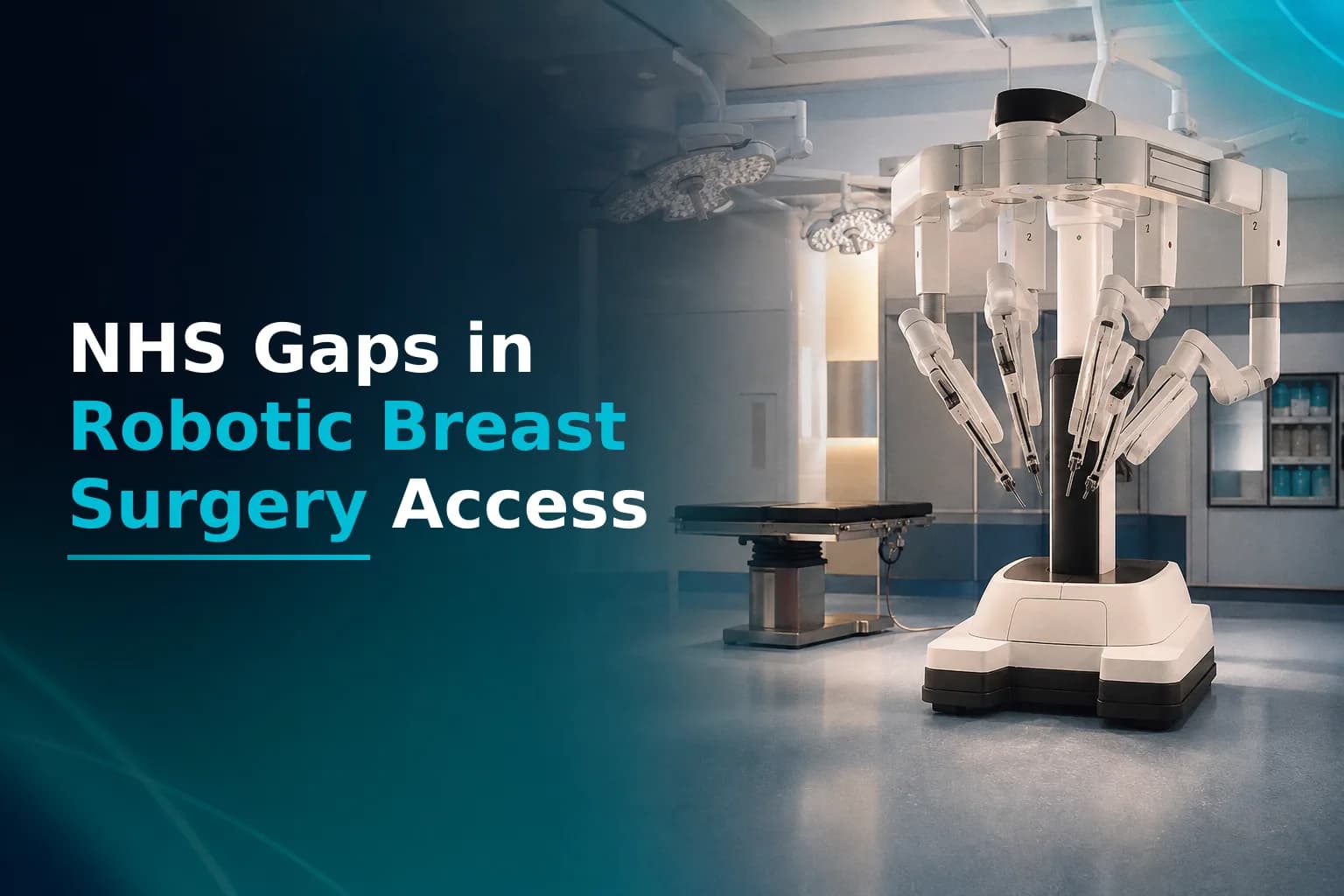
Robotic breast surgery is available at only a small number of NHS trusts in England, Scotland, and Wales. The reasons come down to equipment cost, surgical training, and the current evidence base. But if robotic-assisted surgery is something you want to explore, you have more routes available than you may realise - through NHS specialist centres, UK private hospitals, or surgery abroad.
What is robotic breast surgery?
Robotic breast surgery uses a computer-controlled system - most commonly the da Vinci platform - to let a surgeon operate through much smaller incisions than are possible with conventional techniques. The surgeon sits at a console and guides robotic arms that carry miniature instruments. The result is less disruption to surrounding tissue and, in many cases, scars that are hidden in the armpit rather than across the breast itself.
Two procedures are most often performed this way: robotic nipple-sparing mastectomy, which removes the breast tissue while preserving the skin and nipple, and robotic-assisted lumpectomy, which removes the tumour and a margin of healthy tissue around it. Our guide to robotic nipple-sparing vs skin-sparing mastectomy outcomes explains the differences in cosmetic and oncological results in detail.
Why can most NHS trusts not offer robotic breast surgery?
Several factors explain why this surgery is still rare under NHS care.
Equipment cost. A robotic surgical system requires a large upfront cost as well as significant ongoing maintenance and per-procedure instrument costs. Running this equipment is only financially sustainable when a hospital can spread those costs across high case volumes in multiple surgical specialties.
Training requirements. Robotic breast surgery is technically demanding. Surgeons need specialist training, and trainees need supervised practice on robotic cases before operating independently. Building that expertise inside an NHS trust takes years and requires protected theatre time that is already under pressure across the system.
Where robotic surgery is introduced first. Where NHS trusts do have robotic systems, they typically introduce them for urology, gynaecological oncology, and colorectal surgery first, because those specialties have a longer track record and higher case volumes for this technology. Robotic breast surgery is a newer application. A 2022 case at Hillingdon Hospital NHS Foundation Trust was reported as a UK first for robotic breast reconstruction in that clinical setting, which shows how recently this technology began entering NHS breast services.
The evidence base is still growing. A recent systematic review noted that robot-assisted mastectomy shows promise but that long-term oncological outcome data and direct head-to-head randomised trials are still limited, as the authors of that review describe. Without established national guidance recommending robotic breast surgery for routine NHS use, many trusts cannot yet justify the upfront cost.
Waiting times across the board. Even for conventional breast cancer surgery, NHS capacity is under pressure. The 62-day standard - which sets a target for 85% of patients to start treatment within two months of an urgent referral - has not been met for breast cancer since November 2020, according to Breast Cancer Now analysis of NHS England data. When overall surgical capacity is stretched this far, specialist procedures such as robotic mastectomy struggle to find theatre slots even where the equipment exists.
How does access to robotic breast surgery compare across your options?
| Factor | NHS Pathway | UK Private | India (specialist centres) |
|---|---|---|---|
| Robotic breast surgery offered | At a small number of trusts; most NHS robotic programmes focus on other specialties first | Available at selected London and major-city private hospitals | Widely available at accredited specialist oncology centres |
| Typical wait from urgent referral to first consultation | Up to 28 days under the NHS Faster Diagnosis Standard; often longer in practice | Usually days to one or two weeks | Often within days of initial contact |
| Cost to patient | Free for eligible UK residents, but robotic breast procedures may not be available at your nearest trust | Varies by centre and procedure - request a written quote | Substantially lower than UK private - request a written quote for direct comparison |
| Nipple-sparing and hidden-scar options | Rare and trust-dependent | Available at some private centres | Widely available with experienced specialist teams |
| Female surgeon available on request | Depends on the individual trust | Available at some hospitals on request | Can be arranged through your care coordinator at the time of booking |
Sources: NHS England Cancer Waiting Times statistics; Breast Cancer Now, Missed targets and longer waits. Cost and timing figures for India are indicative - hospital quotes vary and should be requested in writing before any decision is made.
The main gap is specialist availability. NHS trusts do own robotic systems, but most have not yet extended those programmes to breast surgery. UK private hospitals fill part of that gap, at significantly higher out-of-pocket cost. Specialist centres in India, where robotic programmes for breast cancer are more established, offer another route, often with shorter waits and substantially lower costs than self-funding in the UK.
Can you access robotic breast surgery through the NHS?
Yes. But you may need to ask specifically for it. Your GP or oncologist can refer you to an NHS trust that does offer robotic breast surgery if your case is clinically appropriate. This is sometimes called a specialist or tertiary referral. Asking about regional cancer centres with dedicated robotic breast programmes is a reasonable starting point.
If you have already seen a surgeon who recommends conventional mastectomy, that recommendation does not automatically mean robotic surgery is ruled out for your specific case. A second opinion from a surgeon experienced in robotic techniques at another NHS centre, a UK private hospital, or an accredited overseas facility can give you a clearer picture of what is possible for your tumour. Our article on seeking a second opinion after a mastectomy recommendation explains how to approach this without disrupting your existing NHS care.
Going private in the UK: what to expect
A small number of UK private hospitals have surgeons who have trained in robotic breast techniques. Centres affiliated with major NHS teaching hospitals in London are the most likely to offer this. Waiting times are much shorter than on the NHS, typically measured in weeks rather than months.
The main barrier is cost. Private mastectomy and reconstruction in the UK typically runs well into five figures, and robotic-specific fees add further to that. If you hold health insurance, check whether your policy covers newer robotic procedures - many older policies do not. Our guide to what UK women really save on robotic breast surgery in India sets out the full cost landscape and what a detailed written quote from an overseas centre should include.
The weeks between a diagnosis and a final surgical decision can be difficult. If disturbed sleep or anxiety is affecting you during this period, it may help to know that non-prescription support exists alongside your clinical care. For over-the-counter options in this area, see the Sleep and Stress range at Ayurnomics.
What India offers UK patients
Several accredited oncology centres in India have run dedicated robotic breast surgery programmes for a number of years, giving their surgical teams experience that is still uncommon in the UK. Nipple-sparing mastectomy, hidden-scar techniques, and same-admission reconstruction using your own tissue are routinely available at these centres.
The typical pathway for UK patients involves sharing your imaging and pathology reports for a remote clinical review, having a video consultation with the surgical team, travelling to India for the procedure and initial recovery - often seven to ten days in total - and then returning home to complete any adjuvant treatments such as radiotherapy or chemotherapy with your NHS team. If you are weighing this against your current plan, it may be worth taking the time to consult the Art of Healing Cancer team before committing to a UK surgical plan. They can review your reports remotely and help clarify which robotic options may realistically apply to your tumour type and anatomy, with no obligation on your part.
How to take the next step
Whichever route you are considering, the practical sequence is broadly similar.
- Gather your current imaging, biopsy report, and any written surgical recommendations you have received.
- Ask your oncologist or breast surgeon directly whether your tumour size, location, and type make you a candidate for robotic-assisted surgery - not every diagnosis is suitable for this approach.
- If your NHS trust does not offer robotic breast surgery, ask about a specialist referral to a centre that does, or explore a private or overseas second opinion.
- If you are considering travelling for surgery, let your NHS team know early so that post-surgery treatments - radiotherapy or chemotherapy - can be planned and coordinated in advance of your return.
- Ask about female surgeon and female care-coordinator options from the outset if privacy and dignity are priorities for you.
If you would like to explore your options with a specialist team, you can make a discreet enquiry through the contact form at BreastCancer.One, where female care coordinators are available to help guide your next steps without any obligation.
When to talk to your doctor: If your surgeon has recommended mastectomy and you want to know whether robotic or nipple-sparing techniques might apply to your case, raise this at your next appointment or ask for a referral to a surgeon with robotic experience. If you are being treated under an NHS pathway, you have the right to a second opinion and to ask about accessing care at a different NHS trust.
This article is for general information and is not a substitute for medical advice. Always consult your oncologist or care team about your specific situation.