
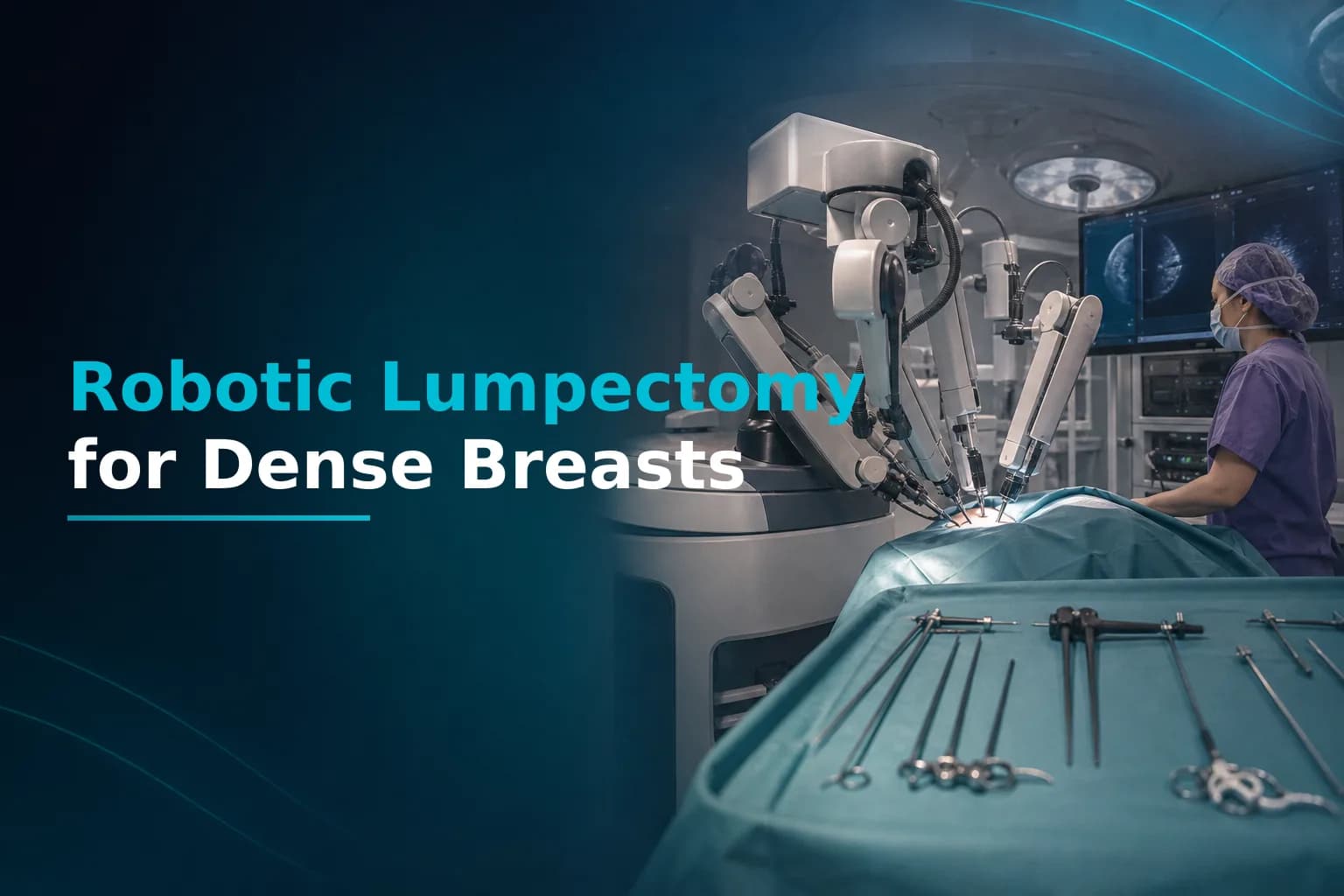
Dense breast tissue does not automatically mean you need a mastectomy. For many women with early-stage breast cancer, breast-conserving surgery - which removes only the tumour and a clear border around it - is an option. Robotic lumpectomy is a newer approach that can improve precision and help preserve the breast even in dense tissue. We explain what dense breast tissue means, how it affects your surgery choices, and what robotic lumpectomy is.
What Dense Breast Tissue Means on Your Mammogram Report
All breasts contain a mix of fatty tissue and fibro-glandular tissue, which includes milk ducts, lobules, and supportive connective tissue. Breast density describes how much of each type is present. Radiologists grade density on a four-category scale, from mostly fatty at one end to almost entirely dense at the other. The two denser categories are called dense or very dense breasts.
On a standard mammogram, both dense breast tissue and cancerous tissue appear white. This overlap can make small tumours harder to spot, which is why women with denser breasts are sometimes advised to have additional imaging such as ultrasound or MRI alongside their mammogram. Research from Cancer Research UK found that offering enhanced screening alongside standard mammography could detect an estimated 3,500 additional breast cancers each year in the UK among women with dense breasts currently missed by standard screening.
Dense breast tissue is also associated with a small increase in breast cancer risk over time. This does not mean every woman with dense breasts will develop cancer, but it does explain why monitoring and imaging choices matter for this group.
Does Dense Tissue Change What Surgery You Can Have?
It does not, on its own. Many women with dense breast tissue and an early-stage tumour remain good candidates for breast-conserving surgery, commonly called a lumpectomy. This involves the surgeon removing the tumour and a clear border of healthy tissue around it, leaving the rest of the breast in place.
Dense tissue can make surgery more technically demanding. The surgeon needs to achieve clear margins, meaning no cancer cells are found at the edge of what is removed. When breast tissue is dense and fibrous, the boundary between normal and cancerous tissue can be harder to judge from imaging alone. Dense tissue makes the surgery harder, but it is not a reason to remove the whole breast.
According to Cancer Research UK, the main reasons a surgeon may recommend mastectomy over lumpectomy include a large tumour relative to breast size, more than one area of cancer in the breast, difficulty achieving clear margins, and in some cases genetic factors such as BRCA gene mutations. Dense breast tissue alone does not appear on that list.
What the Evidence Says About Breast-Conserving Surgery
For most women with early-stage breast cancer, the evidence supports breast-conserving surgery as an oncologically sound choice. Large studies have found that women who have a lumpectomy followed by radiotherapy have similar long-term survival to women who have a mastectomy.
A meta-analysis drawing on data from hundreds of thousands of patients, published in BJS Open and available on PubMed Central, found that breast-conserving surgery with adjuvant radiotherapy had comparable overall survival to mastectomy in early-stage disease. Local recurrence rates - the chance of cancer returning in the same breast - may be slightly higher after conservation, but survival rates are similar. When local recurrence does occur, it can often be managed effectively.
Breast Cancer Now notes that where both options are medically suitable, the choice between lumpectomy and mastectomy is ultimately a personal decision you should make with your care team. For more details about what the recurrence data means for early-stage patients, the article What's Your Recurrence Risk After Robotic Lumpectomy vs Mastectomy? covers the evidence in detail.
What Is Robotic Lumpectomy?
Robotic lumpectomy is a breast-conserving procedure that uses a robotic surgical system. The most common approach makes a small incision in the armpit, through which a camera and fine instruments are inserted. The surgeon sits at a console nearby and controls these instruments using a high-definition, magnified view of the tissue inside the breast.
Because the incision is in the armpit rather than on the breast itself, robotic lumpectomy is a hidden-scar technique. Most women have no visible scar on the breast. For women concerned about body image after a cancer diagnosis, this can be important.
A review of robotic innovations in breast surgery, published in the peer-reviewed journal Cancers and available on PubMed Central, describes how robotic systems give surgeons greater precision and a wider range of motion within confined spaces, including parts of the breast that are harder to reach through standard open techniques. The review shows that hidden-scar and minimally invasive approaches offer advantages in breast surgery.
How Robotic Surgery May Help With Dense Tissue
Dense breast tissue is firm and fibrous. In open surgery, this firmness can make it harder to separate and remove the tumour cleanly. The robotic system's multi-jointed instruments can move within a tighter space, and the magnified camera gives the surgeon a more detailed view of the tissue than the naked eye provides through an open incision.
Surgeons can also combine robotic access with intraoperative imaging - scans taken during the operation to confirm margins are clear before the incision is closed. This real-time feedback is especially useful in dense tissue, where the visual difference between normal and cancerous tissue can be subtle and difficult to assess by feel alone.
An ongoing clinical trial registered as NCT06738654 on the US National Library of Medicine's trials database is studying single-port robotic-assisted breast-conserving surgery via an axillary approach. The trial notes that minimally invasive robotic techniques can achieve the same tumour-removal effect as open surgery while reducing disruption to surrounding tissue - an advantage that may be especially relevant for women with denser breast anatomy.
Robotic lumpectomy is not right for every case. The technique is not yet standard care, and the evidence base is still growing. Not every surgeon is trained in it, and not every centre offers it. Whether you are a candidate depends on your individual tumour characteristics and anatomy, not on breast density alone.
How Does Robotic Lumpectomy Compare to Mastectomy for Dense Breast Tissue?
| Factor | Robotic Lumpectomy | Mastectomy |
|---|---|---|
| Breast preserved | Yes - tumour and margins removed; rest of breast stays | No - all breast tissue removed from the chest wall |
| Scar on breast | None when axillary (armpit) incision is used | Chest wall scar present; additional scars if reconstruction is performed |
| Recovery time | Typically shorter; many return to light activities sooner than after mastectomy | Longer, particularly when immediate reconstruction is included |
| Radiotherapy after surgery | Yes - standard part of breast-conserving treatment in most cases | Not always required; depends on nodal involvement and staging |
| Dense tissue as a challenge | Addressed using magnified robotic imaging and intraoperative scanning | Less of a factor once the whole breast is removed |
| Survival (early-stage) | Comparable to mastectomy when followed by radiotherapy | Similar overall survival; slightly lower local recurrence rate |
Survival outcome data based on the PubMed Central meta-analysis published in BJS Open, 2024. Recovery timelines are approximate and will vary by individual, surgical complexity, and whether additional procedures are performed.
The table shows that robotic lumpectomy and mastectomy differ in meaningful practical ways - not just in what is removed, but in recovery time, radiotherapy requirements, and how your body looks and feels afterwards. Mastectomy removes the question of margins entirely, which is why it may remain the right choice for some women with dense breasts. For others with a single, localized tumour in a dense but proportionate breast, robotic lumpectomy offers a path to keeping the breast without compromising oncological outcomes.
Who Is - and Is Not - a Candidate for Robotic Lumpectomy?
You might be a good candidate if you have an early-stage, single-area tumour that is small enough relative to your breast to allow the surgeon to achieve clear margins while preserving a good cosmetic result. You also need to be willing and able to have radiotherapy after surgery, as this is a standard part of the breast-conserving approach and an important step in reducing local recurrence risk.
You may not be a candidate if your tumour is large relative to your breast size, if there are multiple areas of cancer in the same breast, if you have inflammatory breast cancer, or if you are unable to have radiotherapy for medical reasons. Women who carry high-risk gene mutations such as BRCA1 or BRCA2 may be advised to consider mastectomy regardless of breast density, because of the ongoing elevated risk to the remaining breast tissue. Previous radiotherapy to the same breast would also typically rule out another lumpectomy.
If your surgeon has recommended mastectomy and you want to understand whether breast conservation may still be possible in your case, getting a second opinion is reasonable and widely supported. The article You've Been Recommended Mastectomy: Why You Should Get a Second Opinion on Robotic Surgery Options explains how to approach this without disrupting your existing care.
Access to Robotic Lumpectomy in the UK and Beyond
Robotic breast-conserving surgery is not yet widely available across NHS hospitals. Most centres in the UK that offer it are specialist private units or academic hospitals with dedicated robotic programmes. This means many women who want robotic surgery may face a wait, a long journey, or a private fee.
Some women at this stage get a specialist opinion before committing to a surgical plan at their local hospital. If you want a second opinion from a surgeon experienced in robotic breast-conserving surgery, you can consult the Art of Healing Cancer team before committing to a UK surgical plan. Their team works at specialist centres where robotic lumpectomy - including for women with dense breast tissue - is part of routine surgical practice.
For background on why robotic breast surgery is less available on the NHS, the article Why Most NHS Hospitals Cannot Offer Robotic Breast Surgery covers the practical reasons and what your options may be if you cannot access it locally.
For women who want to ask questions in private, BreastCancer.One offers a private way to review your options before committing to any plan. You can submit a private inquiry at any time through their contact form.
When to Talk to Your Doctor
Speak to your surgical team or request a referral to a specialist if any of the following apply to you:
- You have been told mastectomy is your only option and want to understand the specific reasons, and whether breast conservation may still be possible.
- Your mammogram report has flagged dense breast tissue and you are unsure how this affects your surgery choices.
- You are interested in a robotic or minimally invasive approach and want to know whether you are a candidate for it.
- You would like a second opinion from a surgeon experienced in breast-conserving techniques before agreeing to any operation.
This article is for general information and is not a substitute for medical advice. Always consult your oncologist or care team about your specific situation.