
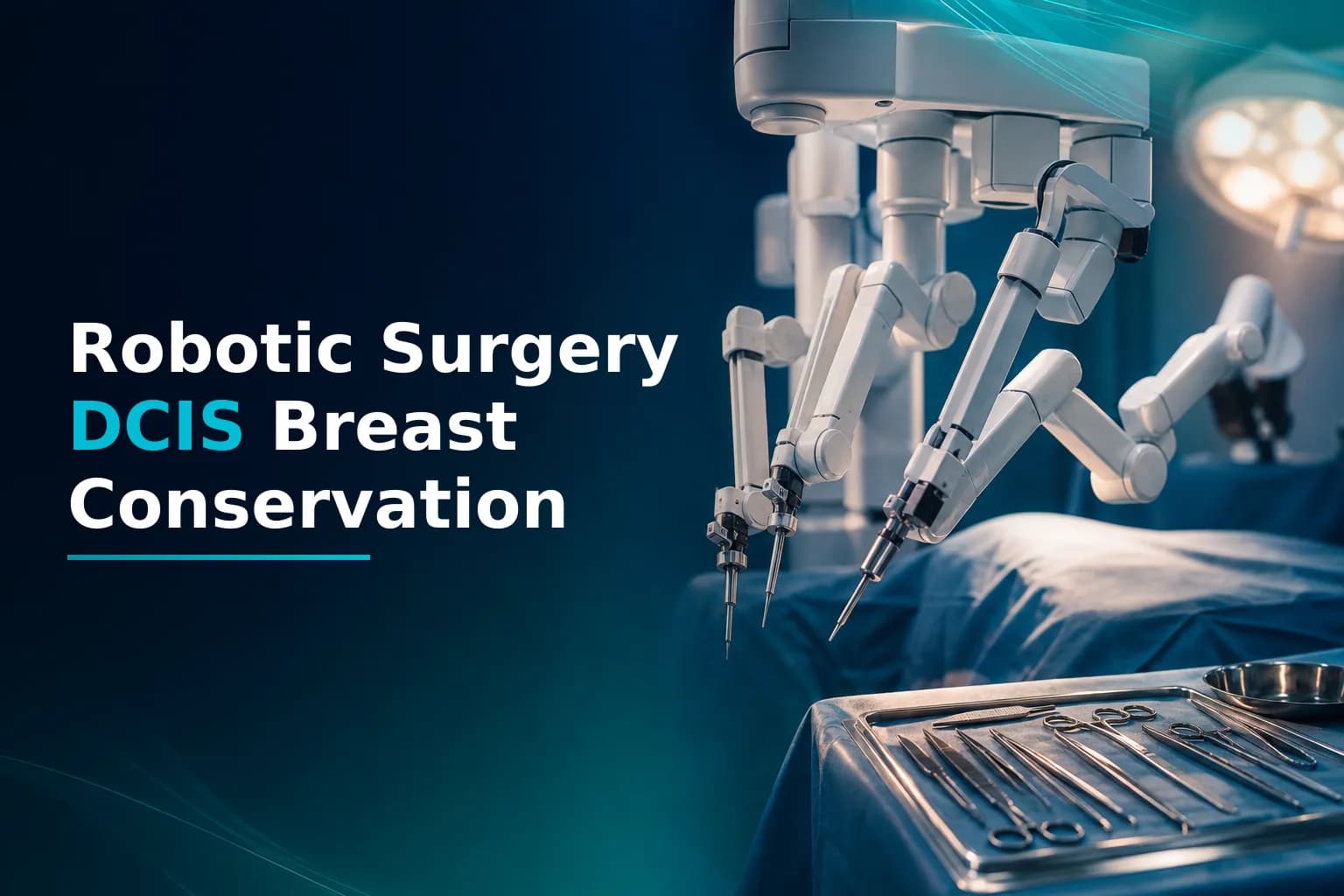
Quick answer: For most women with DCIS, breast-conserving surgery followed by radiotherapy is the standard approach. Robotic techniques may improve precision and reduce visible scarring for suitable candidates. Mastectomy remains appropriate for more extensive DCIS. Whether robotic surgery is an option depends on the size, grade, and location of your DCIS, and access to a trained surgeon.
What is DCIS and why does it need treatment?
DCIS stands for ductal carcinoma in situ. The cells have changed abnormally, but they are still contained inside the milk ducts of the breast. They have not spread into the surrounding breast tissue or beyond. For that reason, DCIS is sometimes described as a pre-cancer or a very early form of breast cancer.
Without treatment, DCIS can progress to invasive breast cancer over time. That is why most clinicians recommend surgery rather than watchful waiting. According to Cancer Research UK, DCIS is the most common type of non-invasive breast cancer in the UK and is most often found through the NHS breast screening programme before a woman has any symptoms.
Being told you have DCIS can feel alarming, especially when surgery is recommended. Understanding what that surgery involves and what your choices are will help you make the best decision.
Surgery is the main treatment for DCIS
The primary treatment for DCIS is surgery to remove the area of abnormal cells. Your team will also discuss radiotherapy to the remaining breast tissue and, if your DCIS is oestrogen receptor-positive, possibly hormone-blocking tablets such as tamoxifen.
As Macmillan Cancer Support explains, there are two main surgical approaches for DCIS: breast-conserving surgery (also called a wide local excision or lumpectomy, where the DCIS and a rim of healthy tissue around it are removed) and mastectomy (removal of the whole breast). The right choice depends on how much of your breast is affected, whether clear margins can be achieved, and what matters most to you personally.
One important point is that long-term breast cancer survival outcomes are similar whether women have breast-conserving surgery or mastectomy for DCIS. A systematic review published on PubMed Central found breast cancer death rates in the region of 1.3 to 2.0% across both surgical approaches. The main differences are in what is removed, what treatment follows, and how the breast looks and feels afterwards.
How do the main surgical options for DCIS compare?
| Factor | Traditional Lumpectomy | Robotic Lumpectomy | Simple Mastectomy |
|---|---|---|---|
| Incision and scarring | Visible scar on the breast surface | Small incisions in the armpit or near the areola; visible breast scar may be avoided | Larger chest-level scar; reconstruction may be offered |
| Breast tissue retained | Most breast tissue kept | Most breast tissue kept, with enhanced precision around the margins | Entire breast removed |
| Radiotherapy after surgery | Usually recommended | Usually recommended | Generally not required |
| Effect on local recurrence | Radiotherapy after lumpectomy reduces local recurrence by approximately 50% | Similar to traditional; precision margin control may support clearer excision | Chest wall recurrence approximately 1-5% at 10 years |
| Best suited for | Localised DCIS where clear margins are achievable | Localised DCIS where cosmetic outcome and minimal visible scarring are priorities | Extensive or multifocal DCIS, or where radiotherapy is not possible |
Recurrence figures: radiation after lumpectomy reduces local recurrence by approximately 50% - PMC: The Impact of Adding Radiation After Breast-Conserving Surgery for DCIS. Mastectomy chest wall recurrence rate 1-5% at 10 years - PMC: Resection Margins and Chest Wall Recurrence After Mastectomy.
The key finding is that breast-conserving surgery and mastectomy produce similar survival outcomes for DCIS. The main trade-off is between keeping your breast tissue (which usually means radiotherapy is needed afterwards) and having a mastectomy (which generally avoids radiotherapy). Robotic lumpectomy sits within the breast-conserving group and adds precision and, for suitable candidates, a better cosmetic outcome.
What does robotic surgery actually add for DCIS?
Robotic-assisted breast surgery uses small robotic arms, controlled by the surgeon, working through tiny incisions. These are usually placed in the armpit or at the edge of the areola, not on the visible surface of the breast. The surgeon views the operating field through a high-definition 3D camera that magnifies the area significantly.
A peer-reviewed review published on PubMed Central found that robotic breast surgery offers improved precision, three-dimensional visualisation, and a lower rate of postoperative complications compared with traditional open surgery. The same review reported a complication rate of 3.9% for robotic surgery versus 7% for conventional open surgery in the studies examined.
For DCIS, precision matters a lot. Surgeons aim to remove the abnormal area with a clear border of healthy tissue around it, known as a clear margin. A clear margin means no DCIS cells were found at the edge of what was removed. Achieving this reduces the chance that cells remain in the breast. Robotic instruments can make finer, more controlled movements inside the breast, which may support margin accuracy in suitable patients.
The cosmetic difference also matters to many women. Because robotic incisions go in the armpit or near the areola, the breast surface itself may show little or no visible scar after surgery. For women with a DCIS diagnosis, keeping the look of their breast can help them feel more confident during recovery.
To be clear about the limits: robotic breast surgery is a specialist technique. Not every hospital offers it, and not every surgeon is trained in it. Within the NHS, access to robotic lumpectomy for DCIS is still limited and is not consistent across trusts. This is one reason some UK women look at private care or specialist surgery abroad, where robotic breast-conserving surgery may be more readily available.
Who is a candidate for robotic breast-conserving surgery with DCIS?
Robotic lumpectomy may be appropriate if your DCIS is localised, meaning it is in one area of the breast rather than spread through it. You may also be a suitable candidate if:
- The DCIS is small enough that a clear margin is achievable without removing too much breast tissue.
- Your breast anatomy allows robotic instruments to reach the area effectively.
- You are in good general health and fit for surgery under general anaesthetic.
- Cosmetic outcome is a priority, and visible scarring on the breast would significantly affect your wellbeing.
- You have access to a surgeon with specific training and experience in robotic breast techniques.
Robotic surgery is less likely to be the right fit if your DCIS is extensive, involves multiple separate areas, or if previous lumpectomy attempts have not achieved clear margins. In those situations, mastectomy typically offers more certainty. The guide to what robotic breast surgery can and cannot do covers candidacy in more detail and is worth reading before your next surgical consultation.
When is mastectomy the better choice for DCIS?
Mastectomy is not a sign of a worse situation. For some women, it is simply the most reliable way to remove all the DCIS and reduce the risk of it returning. Your care team may recommend mastectomy for DCIS in these circumstances:
- The DCIS covers a large portion of the breast (extensive DCIS).
- DCIS is present in more than one separate area of the breast (multifocal DCIS).
- Clear margins were not achieved after a reasonable number of lumpectomy attempts.
- You are unable to have radiotherapy, for example because of a previous course of chest radiotherapy.
- You carry a BRCA1 or BRCA2 gene variant that significantly raises your lifetime risk, making a more extensive operation preferable.
Even when mastectomy is recommended, your appearance and sensation options are still available. Nipple-sparing mastectomy, skin-sparing mastectomy, and immediate reconstruction are possible for many women with DCIS. Robotic techniques can also support certain types of mastectomy, offering finer incisions and more precise skin preservation. Understanding how tumour grade and the extent of DCIS affect your options is explored in the article on how grade and stage shape your breast cancer surgery.
Radiotherapy after breast-conserving surgery for DCIS
If you have a lumpectomy for DCIS, radiotherapy to the remaining breast tissue is almost always recommended. The aim is to destroy any DCIS cells that may not have been visible or fully removed during surgery.
Research published on PubMed Central found that adding radiotherapy after breast-conserving surgery reduced the rate of invasive breast cancer at 8 years from 13.4% to 3.9%. Four randomised clinical trials showed radiotherapy reduces local recurrence by approximately 50%. These are among the most replicated findings in DCIS research.
You normally get radiotherapy at a local NHS hospital over several weeks. If you have your lumpectomy abroad, you can return to the UK for your radiotherapy course. Many women who travel for surgery in India follow this pattern and report that coordinating the two - with clear written documentation from the surgical team - is manageable. If you are weighing a split-care pathway, it is worth reading about radiotherapy after robotic breast cancer surgery: India to UK to understand how this works in practice.
In a minority of cases, your oncologist may discuss whether radiotherapy could be omitted. This is generally considered only for very low-risk, small, low-grade DCIS detected through screening and excised with adequate margins. It is not the standard approach and requires careful individual assessment.
DCIS grade and what it means for your surgical decision
Your pathology report will classify your DCIS as low, intermediate, or high grade. The grade describes how abnormal the cells look under a microscope. It does not mean the DCIS has spread - by definition it has not. But it gives your team a sense of how the cells are likely to behave if left untreated.
High-grade DCIS tends to progress more quickly and carries a greater risk of becoming invasive. Low-grade DCIS behaves more slowly, though it can still develop over time. Grade influences how urgently your team wants to act, and sometimes whether they lean toward conservation or a more extensive operation. If your pathology report feels confusing, the guide to what your breast cancer pathology report means for surgery explains each term in plain language.
What UK women should know about access to robotic DCIS surgery
NHS pathways for treating DCIS are well established, and standards of care are high across the UK. However, robotic-assisted lumpectomy for DCIS is not yet consistently available across NHS trusts. Most standard lumpectomies in the NHS are performed using conventional open surgery. If robotic breast conservation is specifically what you want, you may need to seek it through UK private hospitals or consider a specialist centre abroad.
India has become a recognised destination for women seeking robotic breast surgery. Several specialist centres in cities such as Mumbai, Chennai, and Delhi offer robotic-assisted breast-conserving procedures with dedicated female surgical and coordinator teams. Costs at Indian specialist hospitals are substantially lower than UK private rates for equivalent procedures. Women who have their surgery in India and return to the UK for radiotherapy report that coordinating the two - with clear documentation - is manageable.
If you are at the stage of weighing your surgical plan and want an independent view before you decide, a second opinion from a surgeon who specialises in robotic breast techniques can help. You could consult the Art of Healing Cancer team before committing to a UK surgical plan. A discreet remote review of your pathology and imaging can help clarify whether robotic conservation is realistic for your particular DCIS, before you agree to anything.
When to talk to your doctor
Speak to your surgeon, breast care nurse, or oncologist if:
- You have been recommended mastectomy and want to know whether breast-conserving surgery is genuinely possible for your extent of DCIS.
- You want to understand whether robotic lumpectomy is available through your current NHS trust or locally.
- You are weighing the decision about radiotherapy and want to understand the evidence for your specific DCIS grade and size.
- You are considering treatment abroad and need guidance on coordinating surgery and radiotherapy across two countries.
- You would like a second opinion on your surgical plan before committing to it.
You can submit a discreet enquiry to the BreastCancer.One team at breastcancer.one/#contact, where female coordinators are available to help you review your options confidentially.
This article is for general information and is not a substitute for medical advice. Always consult your oncologist or care team about your specific situation.