
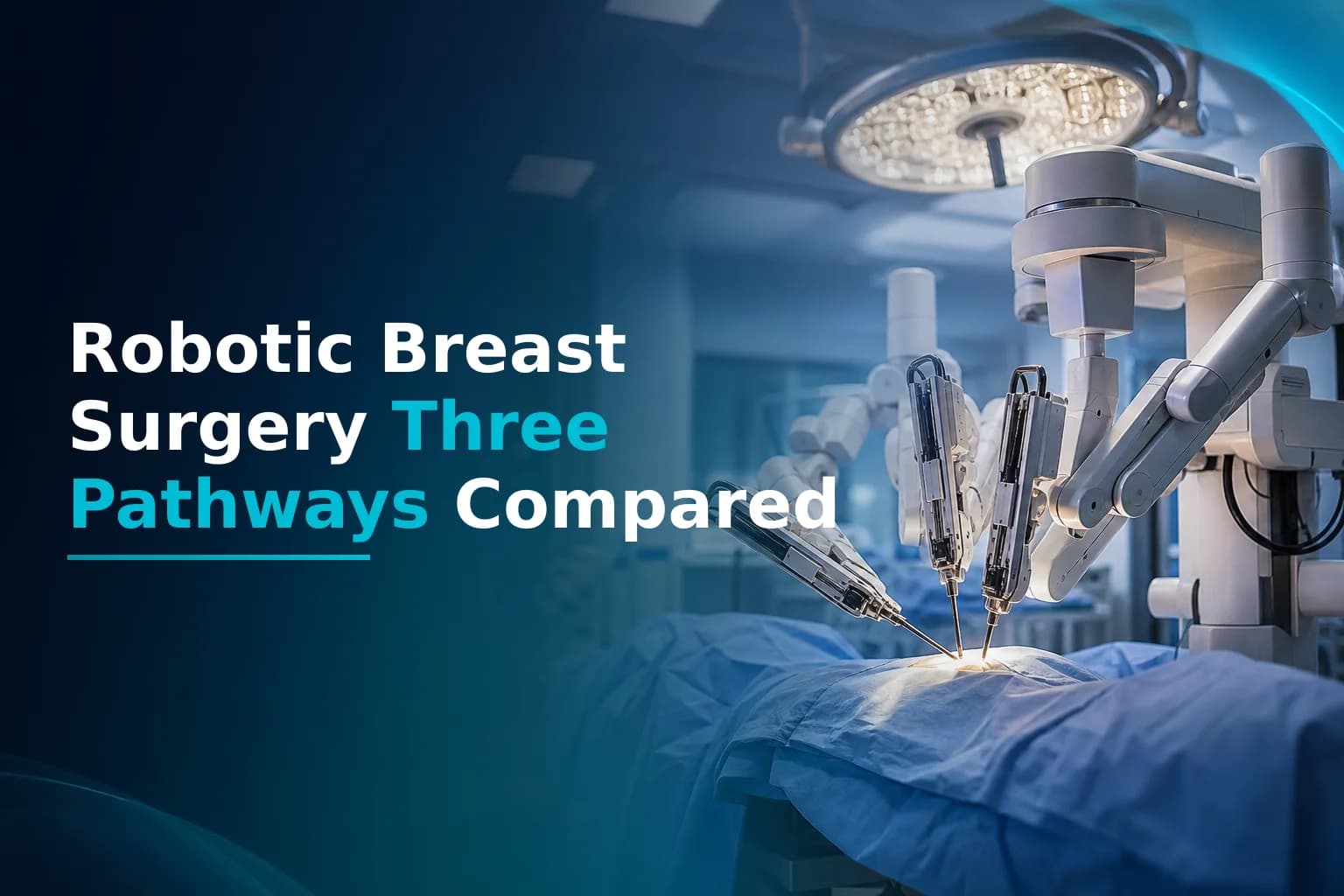
Robotic breast surgery is not routinely available on the NHS. Most NHS hospitals use conventional open surgery for mastectomy and breast-conserving procedures. If you want a robotic approach, you are most likely to find it at a private UK specialist centre - or by travelling to a hospital in India, where costs are often much lower than UK private fees.
This article compares the three pathways and how to choose.
What Is Robotic Breast Surgery?
Robotic-assisted surgery uses a system of small, precise mechanical arms controlled by a surgeon. The most widely used platform is the da Vinci surgical system. The surgeon sits at a console inside the operating theatre and operates the arms through hand and foot controls. Because the robotic arms are smaller than a human hand and can move at angles that open instruments cannot, they allow surgery through very small incisions.
For breast cancer, robotic techniques are used mainly for nipple-sparing mastectomy - removing breast tissue while leaving the nipple and overlying skin intact - and for certain breast-conserving procedures. Some surgeons also use robotic assistance during breast reconstruction. Smaller, precisely placed incisions mean less visible scarring and a faster return to daily activities than conventional open surgery.
Not every woman is a candidate. Tumour size, position, and stage all shape whether a robotic approach is safe and appropriate for your specific situation. Any assessment of candidacy should come from a surgeon who has reviewed your imaging and pathology in detail.
Does the NHS Offer Robotic Breast Surgery?
In most cases, no. The NHS uses robotic systems mainly for urological and gynaecological procedures - prostate and hysterectomy operations, for example. Robotic breast surgery is not part of the standard NHS surgical pathway at most trusts in England, Scotland, Wales, or Northern Ireland. A small number of specialist teaching hospitals have explored it, but it remains uncommon.
If you receive NHS breast cancer surgery, you will almost certainly be offered conventional open or laparoscopic (keyhole) surgery. The article on why most NHS hospitals cannot offer robotic breast surgery explains the reasons.
NHS waiting times also matter. Breast Cancer Now reports that the NHS has not met its 85% target since November 2020. Over three years, more than 10,000 patients didn't receive treatment within the 62-day target window. Cancer Research UK explains what these figures mean and what you're entitled to ask for. NHS England publishes cancer waiting times data monthly.
Waiting is hard after a new diagnosis. Some women look at private options in the UK or abroad to access robotic surgery and shorter waits.
How Do Robotic Breast Surgery Options Compare: NHS, Private UK, and India?
| Factor | NHS | Private UK | India (private) |
|---|---|---|---|
| Robotic surgery availability | Very limited; not standard care at most trusts | Available at select specialist centres | Available at leading oncology hospitals with da Vinci systems |
| Typical wait to surgery | 62-day referral-to-treatment target; frequently missed since late 2020 | Typically shorter than the NHS pathway; varies by hospital | Often arranged within weeks for international patients; varies by centre |
| Indicative cost (GBP) | No direct patient charge for procedures the NHS provides | Starting from approx. GBP 7,422 for mastectomy; robotic technique and reconstruction add to this - verify current pricing with the hospital | Varies significantly by hospital and technique - request a written quote |
| Nipple-sparing mastectomy | Offered at some specialist centres; not universal | Available at specialist private hospitals | Routinely performed at leading oncology centres |
| Immediate breast reconstruction | Available; pathway depends on individual NHS trust | Available at most private hospitals | Available alongside robotic mastectomy at leading centres |
Sources: KIMS Hospital published price list; Breast Cancer Now waiting times analysis. Cost figures are estimates. Always ask your hospital for a current itemised quote.
The main difference across these three options is access to robotic surgery. Few NHS centres offer it. UK private centres offer it at select locations at higher cost. Indian hospitals offer it to international patients at lower cost.
What Does Private Robotic Breast Surgery Cost in the UK?
Private hospitals in the UK publish starting prices. KIMS Hospital in Kent, for example, lists prices for private mastectomy. Robotic technique, specialist anaesthesia, nipple-sparing approach, and immediate reconstruction add to this cost. A robotic mastectomy with immediate reconstruction at a London specialist centre costs more.
Private medical insurance may cover these costs depending on your policy. If you're self-funding, ask any private hospital for a fully itemised written quote that includes the surgical fee, hospital stay, anaesthetist, pathology, and follow-up appointments. This lets you compare centres fairly.
For more detail on how UK private costs compare with India, see the article on private robotic breast surgery in the UK vs India.
Why Are Some Women Considering India for Robotic Breast Surgery?
Robotic availability, cost, and speed of access draw women to India for breast cancer surgery.
Oncology hospitals in cities such as Mumbai, Chennai, Bangalore, and Delhi operate da Vinci robotic systems. Their surgical teams perform robotic nipple-sparing mastectomy and robotic-assisted reconstruction as standard practice.
On cost, Indian private hospitals typically charge less than UK private fees. Since costs vary by hospital and procedure, request a written quote from your hospital for accurate pricing.
On speed, Indian centres can often arrange surgery within weeks for international patients - faster than typical NHS wait times.
If you're considering surgery in India, you can consult the Art of Healing Cancer team. They work with robotic breast surgeons in India and can explain how post-operative care is coordinated with your UK team.
Is Robotic Breast Surgery in India as Safe as in the UK?
Safety depends on the individual hospital and surgeon, not on geography. The same principle applies to private UK centres: credentials and case volume matter more than location.
When evaluating any centre abroad, ask for:
- Accreditation by the National Accreditation Board for Hospitals (NABH) or the Joint Commission International (JCI)
- The number of robotic breast procedures the team performs each year - case volume is a recognised marker of surgical quality
- The surgeon's board certification in surgical oncology and specific robotic breast training
- A written plan for sharing operative reports and pathology with your UK oncologist so adjuvant treatment can proceed without delay
The evidence base for robotic nipple-sparing mastectomy is growing. A meta-analysis published in PubMed Central reviewed studies comparing robotic and conventional nipple-sparing mastectomy and showed comparable complication rates. A separate prospective multicenter trial, also published in PubMed Central, compared robotic, endoscopic, and conventional nipple-sparing mastectomy across five hospital sites. It showed that robotic surgery achieved comparable oncological outcomes and good cosmetic results.
This evidence base is still developing. Robotic breast surgery is not yet standard care worldwide. The data supports it for appropriate candidates, but your surgical team should review your case.
Who May Not Be a Candidate for Robotic Breast Surgery?
Not every woman with breast cancer will suit a robotic approach. Candidacy depends on tumour size, position within the breast, skin involvement, lymph node status, and your overall health. Women whose tumours sit close to the nipple or skin, or who have locally advanced disease, may not be candidates for nipple-sparing mastectomy - robotic or conventional.
Other tissue-sparing options may still be available. Skin-sparing mastectomy with immediate reconstruction is one possibility that a specialist can explain alongside your pathology results. A surgeon who has seen your full imaging and biopsy reports can answer candidacy questions.
If your NHS surgeon recommends conventional mastectomy and you want to explore other options, the article on getting a second opinion when you have been recommended mastectomy explains how.
Questions to Ask Before Choosing Your Pathway
Whichever route you consider, these questions can help you compare options fairly:
- Is robotic nipple-sparing mastectomy technically possible given my tumour size, position, and pathology?
- What is the realistic wait from today to my surgery date on each pathway?
- What is the full itemised cost, including reconstruction, follow-up, and complication management if needed?
- If I have surgery abroad, how will my adjuvant treatment - radiotherapy or chemotherapy - be coordinated with my UK team?
- How many robotic breast procedures does this surgical team perform each year?
- Is a female surgeon or coordinator available, if that matters to me?
These are reasonable questions to raise with any surgical team, in the UK or abroad. A team that answers them clearly is a good sign.
Taking Your Next Step
Choosing between NHS and private, or between UK and India, should not come down to cost alone. Think about what matters most: the surgical technique, cosmetic outcome, wait time, distance from home, and how your follow-up care will be coordinated.
If you want more information, contact BreastCancer.One. The team includes female patient coordinators and can connect you with robotic breast surgeons to review your case.
When to Talk to Your Doctor
Talk to your oncologist or breast surgeon before making any changes to your treatment, including seeking a private or international opinion. Share your pathology reports, imaging, and treatment history so any new team can give you an accurate assessment. Exploring private or overseas options doesn't mean leaving your NHS team. Many women coordinate NHS adjuvant treatment with surgery at private or overseas centres.
This article is for general information and is not a substitute for medical advice. Always consult your oncologist or care team about your specific situation.