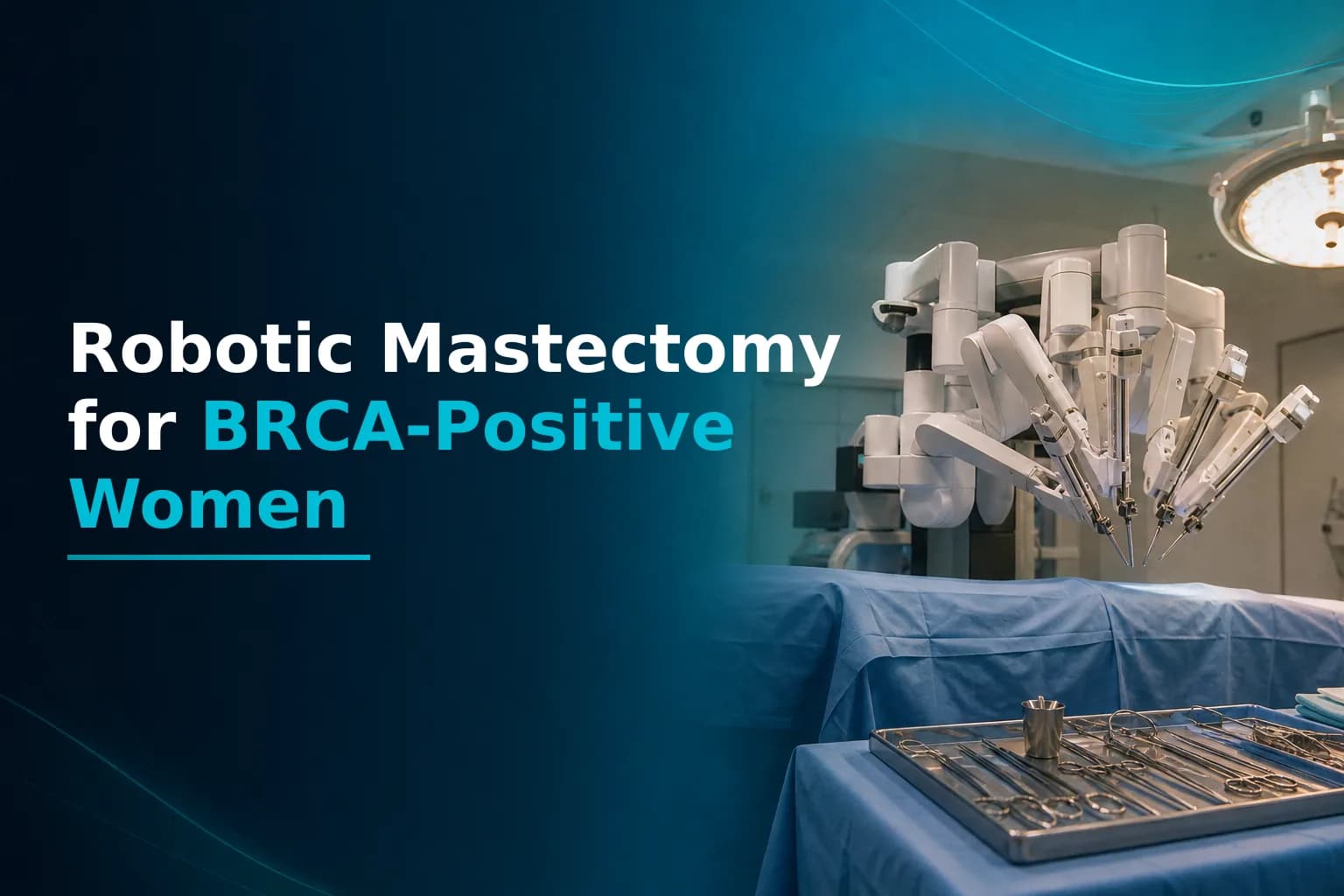
If you carry a BRCA1 or BRCA2 gene mutation, removing one or both breasts before cancer develops may reduce your lifetime breast cancer risk by up to 95%. Robotic surgery lets surgeons preserve your nipple and reduce visible scarring through small, hidden cuts. This is very different from traditional surgery. Whether this is right for you depends on your personal risk level, reconstruction preferences, readiness for surgery, and access to specialist surgical teams.
What Does It Mean to Be BRCA-Positive?
BRCA1 and BRCA2 are genes that normally stop tumours from growing. When you carry a harmful change (called a pathogenic variant) in one of these genes, you lose that protection. This means you have a much higher lifetime risk of both breast and ovarian cancer.
According to NHS Genomics Education data, women with a pathogenic variant in BRCA1 have about a 72% chance of breast cancer by age 80. For BRCA2, the risk is about 69% by age 80. By comparison, the general population lifetime risk of breast cancer is about 12 to 13%. These are population averages - your personal risk will depend on your specific mutation, family history, age when you got your first period, and how much oestrogen your body has had over your lifetime.
Besides BRCA1 and BRCA2, other genes like PALB2, CHEK2, and ATM can raise breast cancer risk, though usually less dramatically. Some women without a single high-risk gene change are still classified as high-risk based on strong family history and other factors. If you're unsure what your test result means, our guide to BRCA genetic testing and robotic breast surgery options explains the process in simple terms.
What Is Prophylactic (Risk-Reducing) Mastectomy?
Prophylactic mastectomy (also called risk-reducing mastectomy) is surgery to remove one or both breasts before cancer develops. The goal is to remove all the breast tissue where cancer could start.
There are two main forms:
- Bilateral risk-reducing mastectomy (BRRM): removal of both breasts in a woman who has not been diagnosed with breast cancer yet. Women with a high-risk BRCA1 or BRCA2 mutation most often choose this to reduce their risk as much as possible.
- Contralateral risk-reducing mastectomy (CRRM): removal of the healthy breast in a woman already treated for breast cancer. This reduces the risk of a new cancer in the other breast by around 91%.
According to the National Cancer Institute, risk-reducing mastectomy can reduce breast cancer risk by up to 95% in women with a BRCA1 or BRCA2 mutation. It is the most effective risk-reduction strategy available, but it is also the most invasive. You need to carefully consider the emotional and physical effects.
NICE guidance (CG164) says women with a known or suspected BRCA1, BRCA2, or TP53 mutation should fully discuss the risks and benefits of risk-reducing surgery with their care team. It also recommends that every woman considering this has a chance to speak with a surgical team experienced in breast reconstruction, and that psychological support is available before any decision. Removing healthy breast tissue cannot be undone, so this is not a decision to rush.
How Robotic Surgery Changes This Procedure
In traditional prophylactic mastectomy, surgeons make a long cut across the breast to reach the tissue. This leaves a visible scar on a healthy breast, which many women find hard to accept.
Robotic mastectomy (most often done as a robotic nipple-sparing mastectomy, or RNSM) is very different. The surgeon makes a small cut in the armpit or along a natural skin fold, then uses a robotic system with a high-definition 3D camera and thin, precise tools to remove the breast tissue from inside. The nipple and surrounding darker skin are left in place. When reconstruction happens at the same time, the chest keeps its natural shape and the cut is hidden in a less visible spot.
Surgeons first described this approach for BRCA carriers in 2015, and specialist centres in Italy, South Korea, India, and the United States have adopted it since. A 2024 review comparing robotic with standard nipple-sparing mastectomy found that the robotic method had fewer problems after surgery and similar results in terms of cancer outcomes. However, the researchers note that longer-term data from different centres are still being collected. Earlier studies on nipple-sparing mastectomy as a risk-reducing procedure for BRCA patients found it was safe and could work in the right candidates.
For women having surgery on healthy tissue, how the surgery looks afterward is very important. Keeping the nipple and reducing scars can help with the emotional side of having surgery to stay healthy. But the results of robotic mastectomy really depend on how experienced the surgeon is, not just the technology.
What Are Your Risk-Management Options as a BRCA-Positive Woman?
There are other options besides prophylactic mastectomy, and what is right for you depends on your situation. Your clinical team (a breast surgeon, a clinical geneticist, and a breast care nurse) should discuss strategies tailored to you.
| Risk-Reducing Mastectomy | Enhanced Surveillance | Risk-Reducing Medication | |
|---|---|---|---|
| Effect on breast cancer risk | Up to 95% risk reduction in BRCA1/2 carriers | Does not reduce risk - aims for early detection | Modest reduction in specific hormone-receptor-positive groups; discuss with specialist |
| Invasiveness | Surgery under general anaesthetic; several weeks recovery | Non-surgical - regular imaging only | Non-surgical - daily tablet for several years |
| Nipple preservation | Possible with robotic nipple-sparing technique | Not applicable | Not applicable |
| Ongoing commitment | Recovery and reconstruction follow-up, then routine monitoring | Annual or biannual MRI and mammography | Regular review for medication management and side-effect monitoring |
| Key consideration | Surgical risks; psychological adjustment; reconstruction planning | Risk remains unchanged; repeated scanning can cause ongoing anxiety | Not suitable for all mutation types; side-effect profile varies |
Risk reduction figures for mastectomy come from the National Cancer Institute. Your doctor or genetic specialist must decide if risk-reducing medication is right for you based on your specific mutation and hormone-receptor status.
In short, risk-reducing mastectomy offers the best reduction in breast cancer risk but requires surgery and reconstruction planning. Watching your breasts carefully works for women who want to avoid surgery and can accept that their risk stays the same. Risk-reducing medicine works for only some patients and needs to be checked individually. None of these choices is permanent - your approach may change over time.
Who Is a Good Candidate for Robotic Prophylactic Mastectomy?
Being a candidate for prophylactic mastectomy doesn't mean you can have robotic surgery. A specialist surgeon will look at several factors:
- Breast size and shape: very large or drooping breasts can make robotic surgery more difficult, though experienced surgeons can handle many different breast shapes.
- Nipple eligibility: to keep the nipple safely, the tissue behind it must be healthy. Some centres take a small biopsy from this tissue during surgery to confirm it is safe to leave.
- Reconstruction preferences: most surgeons do robotic mastectomy with immediate reconstruction (using implants or your own tissue, called autologous reconstruction). Your choice of reconstruction can change how the surgeon plans the operation. For a detailed comparison, see our guide to implant vs autologous reconstruction after robotic mastectomy.
- Prior surgery or radiation in the breast area: past treatment can damage the tissue and limit what techniques the surgeon can use.
- General health: you need to be healthy enough for general anaesthesia, like all surgery patients.
Robotic prophylactic mastectomy is hard to get on the NHS. Most NHS trusts don't offer robotic breast surgery yet, and it depends on where you live. If you want robotic surgery, you may need to pay for private care in the UK or go to specialist centres abroad, where surgeons do more of these operations and wait times are shorter.
The Previvor Experience: Living with Hereditary Risk
Women who carry a high-risk gene mutation but haven't been diagnosed with cancer are sometimes called previvors (people dealing with the risk of a hereditary condition rather than cancer itself). This is a unique and often lonely experience. You may feel pushed to act fast, and at the same time feel unprepared for surgery on a healthy body. Both feelings are normal and understood by doctors who work with hereditary breast cancer.
Psychological support (through a psychologist, breast care specialist, or support group) is an important part of your care, not something optional. NICE guidance says you should know about the emotional effects of prophylactic mastectomy, including how it can change your body image and sex life, before you decide. Taking a few weeks to gather information, talk to different experts, and think about what you're facing is fine for most women. Just stay in touch with your doctors and tell them about any new breast changes right away.
Timing Your Decision: NHS, UK Private, or International Options
Once you get a BRCA-positive result or a formal high-risk classification, timing feels urgent. Some women develop breast cancer while waiting for prophylactic mastectomy surgery, so waiting is something to discuss with your care team. But taking a few weeks to make a well-supported decision is not wasting time.
If you're weighing options (NHS, UK private care, or specialist robotic surgery abroad), getting full information before you decide is worth your time. Specialist centres in India do robotic nipple-sparing mastectomy with reconstruction the same day and can usually fit in UK patients quickly. Any decision to travel for surgery should involve your UK genetics or oncology team, who will keep managing your care.
If you want to learn more about robotic prophylactic mastectomy and how treatment in India with UK coordination works, you can contact specialist centres for information.
Questions to Ask at Your Next Appointment
- What is my estimated personal lifetime breast cancer risk, based on my specific mutation, age, and family history?
- Am I a candidate for nipple-sparing mastectomy, and can a robotic surgeon do this?
- What reconstruction options would be offered with prophylactic surgery, and can reconstruction happen in the same operation?
- If I choose surveillance instead, how often would I need MRI and mammography, and what is my risk if I have to wait for surgery?
- Is risk-reducing medication an option for my mutation type and hormone status?
- What psychological support is available to me as I work through this decision?
- Can I get a second opinion from a surgeon about whether robotic mastectomy is an option for me?
When to Talk to Your Doctor
Talk to your oncologist, breast surgeon, or genetic specialist right away if you got a BRCA1 or BRCA2 positive result and haven't had a full discussion of your options. Ask for an urgent appointment if you notice any new breast changes (a lump, thickening skin, nipple discharge, or persistent pain) while you're deciding. A genetic specialist or genetic counsellor can help you understand your personal risk and think through your options in a way that fits your life, values, and health goals.
This article is for general information and is not a substitute for medical advice. Always consult your oncologist or care team about your specific situation.